
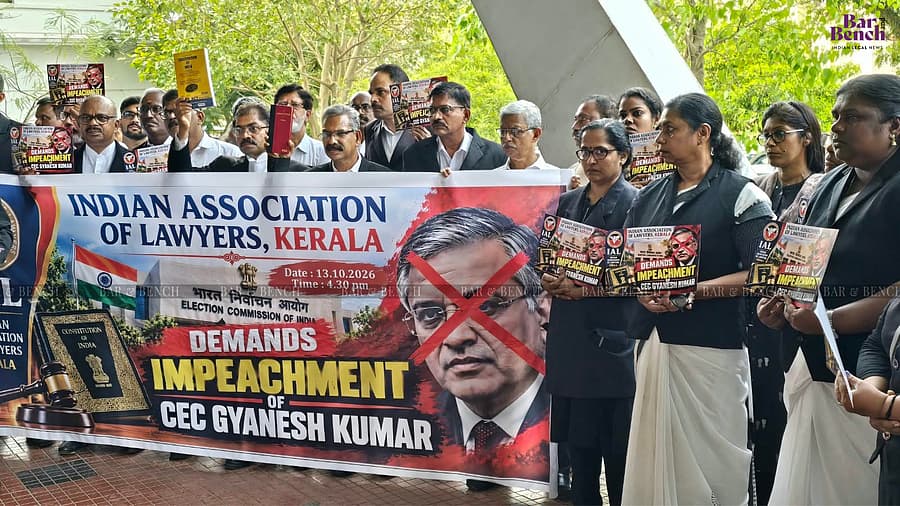
Kerala Lawyers: Symbolic Impeachment of CEC Gyanesh Kumar
Summary
- Lawyers in Kerala held a symbolic impeachment of CEC Gyanesh Kumar over concerns about the Election Commission's independence.
- The Indian Association of Lawyers organized the protest, with participants from 88 court centers.
- A resolution was passed stating that a lack of public confidence in the ECI's neutrality undermines democracy.
- The lawyers formally requested parliamentary leaders to consider Kumar's removal under Article 324 (5) and the Judges (Inquiry) Act, 1968.
- This action aligns with nationwide protests demanding Kumar's removal due to alleged irregularities in electoral roll revisions.
What Happened
This event signals increasing scrutiny and calls for accountability regarding the Election Commission of India's independence, particularly concerning the legal mechanisms for the removal of election commissioners under Article 324(5) and the Judges (Inquiry) Act, 1968, indicating potential future legal challenges or policy advocacy in this area.
Lawyers from across Kerala recently convened near the Kerala High Court premises to conduct a symbolic impeachment of Chief Election Commissioner (CEC) Gyanesh Kumar. This significant gathering, organized by the Indian Association of Lawyers (IAL), saw invitations extended to representatives from 88 court centers throughout the state, highlighting a broad base of concern among the legal community.
The assembly took place on a Tuesday evening, specifically at 4:30 PM, in front of the Kerala High Court Advocates Association Golden Jubilee Chamber Complex. Participants displayed banners and held copies of the Constitution, collectively demanding Kumar's removal from office. A key part of the demonstration involved the recitation of the Preamble to the Constitution, followed by the adoption of a resolution that formally declared Kumar symbolically impeached. The resolution articulated a profound concern that any erosion of public trust in the Election Commission's impartiality fundamentally jeopardizes India's democratic governance.
Legal Context of the Demand
Beyond the symbolic act, the lawyers also took a concrete step by formally requesting the Chairman of the Rajya Sabha and the Speaker of the Lok Sabha to consider a notice of motion for CEC Kumar's removal. This request was grounded in specific constitutional and statutory provisions, citing Article 324 (5) of the Constitution, which governs the conditions of service and removal of election commissioners, read in conjunction with Article 124 (4), typically pertaining to the removal of Supreme Court judges.
Furthermore, the lawyers invoked the Judges (Inquiry) Act, 1968, as the procedural framework for such a removal process. Their explicit aim was to ensure that the allegations against Kumar could be thoroughly and impartially examined in strict accordance with established legal procedures. This emphasis on due process underscores the legal community's call for accountability within the constitutional framework.
Wider Implications and Concerns
This symbolic impeachment in Kerala is not an isolated incident but rather emerges amidst a backdrop of broader nationwide protests demanding CEC Gyanesh Kumar's removal. These widespread calls for his ouster are primarily fueled by allegations of irregularities identified during the Special Intensive Revision of electoral rolls, which have raised significant questions about the integrity of the electoral process.
The core of the lawyers' and the wider public's concern revolves around the perceived functioning and independence of the Election Commission of India. The actions taken by the Kerala lawyers, by meticulously referencing constitutional articles and legal acts, underscore a growing demand for transparency and accountability from the nation's electoral body. This event signals increasing scrutiny and calls for accountability regarding the Election Commission of India's independence, particularly concerning the legal mechanisms for the removal of election commissioners under Article 324(5) and the Judges (Inquiry) Act, 1968, indicating potential future legal challenges or policy advocacy in this area.
Practical Implications
Lawyers should monitor the increasing scrutiny and calls for accountability regarding the Election Commission of India's independence, particularly concerning the legal mechanisms for the removal of election commissioners under Article 324(5) and the Judges (Inquiry) Act, 1968, as this symbolic action signals potential future legal challenges or policy advocacy in this area.
Source
Source: Original reporting via The Hindu
How does this affect you?
Get an AI analysis of this article grounded in your jurisdictions, practice areas, and any policy documents you've uploaded to Wansom.
Finish Reading the Full Story and the Expert Analysis.
Get the latest legal & regulatory intelligence in India
Wansom is AI and can make mistakes.