
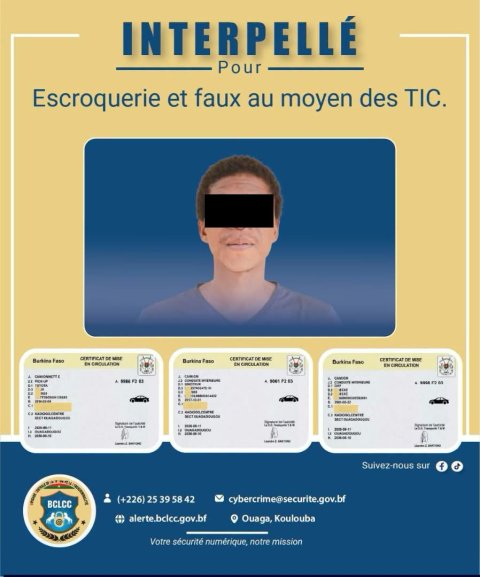
Ouagadougou: Fausse Carte Grise IA Arrestation Signals New Cybercrime Threat
Summary
- A 36-year-old student and intermediary, D.R., was arrested in Ouagadougou for allegedly producing fake vehicle registration documents.
- The suspect reportedly used artificial intelligence tools to create counterfeit 'cartes grises'.
- He exploited his former role as an intermediary at the Directorate General of Land and Maritime Transport (DGTTM) to deceive applicants and extort money.
- The Central Brigade for Combating Cybercrime (BCLCC) conducted the arrest, highlighting the growing threat of AI-powered cybercrime.
- This incident underscores the urgent need for enhanced fraud detection protocols and legal advisories regarding AI-generated fake documents.
What Happened
This incident signals an escalating threat of AI-powered document fraud in West Africa, requiring legal and compliance professionals to update their due diligence and fraud detection protocols.
Authorities in Ouagadougou have apprehended an individual suspected of leveraging artificial intelligence to create fraudulent vehicle registration documents. The Central Brigade for Combating Cybercrime (BCLCC) confirmed the arrest of D.R., a 36-year-old student who also worked as an intermediary. He is alleged to have produced counterfeit 'cartes grises' using sophisticated AI tools, marking a significant development in the fight against digital fraud in the region.
The suspect's method involved exploiting his prior professional experience. D.R. had previously served as an intermediary at the Directorate General of Land and Maritime Transport (DGTTM), a position that provided him with insight into the processes surrounding vehicle registration. This background reportedly enabled him to deceive applicants seeking legitimate documents, subsequently extorting money from them under false pretenses.
This Ouagadougou fausse carte grise IA arrestation highlights an emerging threat where traditional document fraud is amplified by advanced technological capabilities. The BCLCC's investigation uncovered the alleged scheme, which combined human deception with AI-powered falsification, allowing for the creation of highly convincing fake official papers. The incident underscores the evolving landscape of cybercrime and the challenges faced by law enforcement agencies in detecting and prosecuting such sophisticated offenses.
Legal and Regulatory Context
The involvement of the Central Brigade for Combating Cybercrime (BCLCC) in this case underscores the serious legal implications of digital fraud, particularly when advanced technologies like AI are employed. The BCLCC is specifically tasked with addressing cybercriminality in Burkina Faso, and this arrest falls squarely within its mandate to protect citizens and institutions from technologically-enabled illicit activities. The use of AI to generate fraudulent documents represents a new frontier in cybercrime, demanding updated investigative techniques and legal responses.
Cases involving faussaire documents IA present unique challenges for prosecution, as they require proving not only the act of falsification but also the intent and the specific tools used. The exploitation of a former role at the DGTTM further complicates the matter, adding elements of breach of trust and abuse of insider knowledge to the core charge of fraud. This incident contributes to a growing body of evidence regarding the increasing sophistication of fraud documentaire intelligence artificielle, necessitating a robust legal framework to deter and punish such acts.
For Burkina Faso cybercriminalité IA, this arrest serves as a critical precedent, signaling that law enforcement is adapting to the evolving methods of digital criminals. It emphasizes the need for continuous training and resource allocation to agencies like the BCLCC to effectively counter threats posed by individuals who weaponize artificial intelligence for illicit gains. The legal system must grapple with how existing statutes apply to AI-generated fakes, potentially leading to calls for new legislation or amendments to address this specific form of technological crime.
Why It Matters
This incident signals an escalating threat of AI-powered document fraud in West Africa, requiring legal and compliance professionals to update their due diligence and fraud detection protocols. The ability of artificial intelligence to produce highly convincing counterfeit documents, such as the DGTTM fausses cartes grises allegedly created in this case, poses significant risks to governmental integrity, financial institutions, and the general public. The ease with which such fakes can be generated and disseminated demands a proactive approach from all stakeholders.
Lawyers should advise clients on enhanced verification methods for official documents and potential liabilities related to AI-generated fakes. Businesses and individuals relying on official identification or registration papers must implement more rigorous checks, as traditional authentication methods may no longer be sufficient against sophisticated AI-driven forgeries. The risk of AI falsification documents extends beyond vehicle registration to potentially impact passports, identity cards, and other critical legal instruments, undermining trust in official processes.
The arrest in Ouagadougou serves as a stark reminder that the digital transformation brings with it new vulnerabilities. As AI technologies become more accessible, the potential for their misuse in criminal activities will only grow. This necessitates a collaborative effort between law enforcement, technology experts, and legal professionals to develop robust countermeasures, educate the public, and ensure that regulatory frameworks are agile enough to address the rapidly evolving landscape of cybercrime.
Practical Implications
This incident signals an escalating threat of AI-powered document fraud in West Africa, requiring legal and compliance professionals to update their due diligence and fraud detection protocols. Lawyers should advise clients on enhanced verification methods for official documents and potential liabilities related to AI-generated fakes.
Source
Source: Original reporting via {source}
How does this affect you?
Get an AI analysis of this article grounded in your jurisdictions, practice areas, and any policy documents you've uploaded to Wansom.
Finish Reading the Full Story and the Expert Analysis.
Wansom is AI and can make mistakes.