
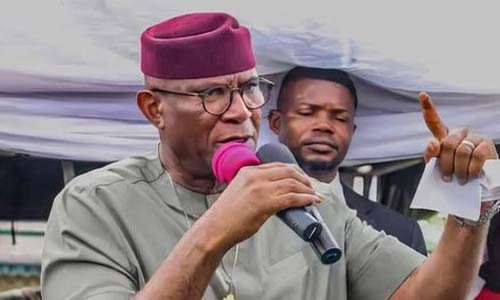
Omo-Agege: Denies Delta Police Summons for Uduere Violence Probe
Summary
- Former Deputy Senate President Ovie Omo-Agege denies refusing a police invitation from the Delta State Command.
- He asserts that no formal summons has been served to him or his office regarding the matter.
- The invitation relates to deadly violence that occurred during a political campaign activity in Uduere, Ughelli North Local Government Area.
- Omo-Agege's position emphasizes the importance of proper service for any police summons to be valid.
- The dispute highlights procedural aspects of investigations involving high-profile individuals.
What Happened
The former lawmaker maintains that neither he nor his official representatives have received any formal summons regarding an investigation into a fatal incident.
Ovie Omo-Agege, former Deputy Senate President, whose 2027 senatorial candidacy was recently nullified by a Federal High Court, has publicly refuted claims that he declined an invitation from the Delta State Police Command. The former lawmaker maintains that neither he nor his official representatives have received any formal summons regarding an investigation into a fatal incident.
The police invitation reportedly pertains to an episode of deadly violence that transpired during a political campaign event. This unfortunate occurrence took place in Uduere, located within the Ughelli North Local Government Area of Delta State. The core of Omo-Agege's stance is that one cannot refuse an invitation that was never properly delivered, thereby challenging the premise of any accusation of non-compliance.
The dispute centers squarely on the procedural aspect of notification. Omo-Agege denies Delta police summons, asserting that the fundamental requirement of proper service has not been met. This position underscores a critical point in legal and investigative processes, particularly when high-profile individuals are involved in inquiries related to public order.
Legal Context
The assertion by Senator Ovie Omo-Agege regarding the lack of formal service highlights a crucial element of due process in legal and police investigations. For any summons or invitation to be legally binding and for an individual to be held accountable for non-compliance, it is generally understood that the notice must be properly and formally served to the intended recipient or their authorized representative. Without such service, the legal obligation to appear or respond may not be fully established.
Lawyers should note the emphasis on proper service of police summons, as disputes over receipt can significantly impact the validity of subsequent legal proceedings or a client's defense strategy, particularly in high-profile investigations. A failure to demonstrate proper service can undermine the foundation of an investigation, potentially leading to challenges regarding jurisdiction or the legitimacy of any subsequent actions taken by law enforcement, such as the Delta State Police Command summons.
In cases involving sensitive matters like the Uduere Ughelli violence, the procedural integrity of the investigation becomes paramount. Any perceived shortcuts or failures in adhering to established protocols for notification can be leveraged by legal teams to contest the legitimacy of the process, thereby complicating efforts to bring clarity or resolution to the underlying incident.
Why It Matters
The controversy surrounding the alleged Ovie Omo-Agege police invitation carries significant implications beyond the immediate facts of the case. It underscores the delicate balance between law enforcement's duty to investigate serious incidents, such as the deadly political violence in Delta State, and the rights of individuals, including prominent political figures, to due process.
Such disputes over procedural matters can delay investigations and potentially erode public confidence in the fairness and impartiality of the justice system. When a high-ranking former official like Senator Omo-Agege disputes the receipt of a summons related to Omo-Agege political violence Delta, it inevitably draws considerable public and media attention, placing the police command under scrutiny regarding its operational protocols.
Ultimately, the resolution of this particular issue hinges on whether the Delta State Police Command can demonstrate that a formal invitation was indeed served to Senator Omo-Agege or his office. The outcome will not only affect the progression of the investigation into the Uduere violence but also reinforce or challenge public perceptions of accountability and procedural correctness within the Nigerian legal framework.
Practical Implications
Lawyers should note the emphasis on proper service of police summons, as disputes over receipt can significantly impact the validity of subsequent legal proceedings or a client's defense strategy, particularly in high-profile investigations.
Source
How does this affect you?
Get an AI analysis of this article grounded in your jurisdictions, practice areas, and any policy documents you've uploaded to Wansom.
Finish Reading the Full Story and the Expert Analysis.
Get the latest legal & regulatory intelligence in Nigeria
Wansom is AI and can make mistakes.