
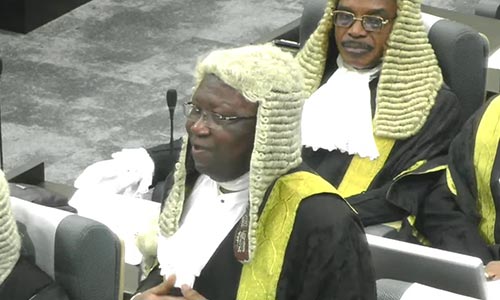
Olanipekun SAN: Court of Appeal Not Hearing Leave to Appeal to Supreme Court
Summary
- Chief Wole Olanipekun, SAN, informed the Supreme Court that applications for leave to appeal are not being heard at the Court of Appeal.
- He argued that a Supreme Court decision, purportedly preventing these hearings, does not actually contain such a directive.
- Olanipekun emphasized that no judge possesses the authority to establish their own legal principles.
- His address highlighted the urgent need for the Chief Justice of Nigeria to intervene in this procedural bottleneck.
A Critical Procedural Bottleneck
The integrity of the appellate process hinges on the timely resolution of such procedural bottlenecks, ensuring that justice is not delayed or denied.
Chief Wole Olanipekun, a distinguished Senior Advocate of Nigeria (SAN) and recipient of national honors including CFR and OFR, recently brought a significant procedural issue to the attention of the Supreme Court. During his formal address to the apex court, Olanipekun highlighted a concerning development at the Court of Appeal: a substantial number of applications for leave to appeal not heard are reportedly accumulating without due process. This revelation points to a potential systemic delay within the Nigerian legal appeal procedure, impacting numerous litigants seeking to advance their cases to higher judicial instances and potentially prolonging justice.
The non-hearing of these crucial applications at the Court of Appeal represents a critical bottleneck in the judicial system. Obtaining leave to appeal is a fundamental prerequisite for many cases to progress to the Supreme Court, and their stagnation can lead to protracted litigation, increased financial burdens for parties, and potential denials of timely justice. Olanipekun's direct communication to the Supreme Court underscores the gravity of this issue, suggesting it has reached a point where intervention from the highest judicial authority is deemed necessary to ensure the smooth and equitable functioning of the appellate process.
Clarifying Supreme Court Jurisprudence
A central and critical aspect of Olanipekun's address involved a direct challenge to the prevailing interpretation of a particular Supreme Court decision. He firmly asserted that the said decision, which is purportedly being invoked by some as justification for the non-hearing of applications for leave to appeal, does not, in fact, contain any directive that would legitimately prevent these applications from being heard. This contention directly questions the accurate application of Supreme Court jurisprudence appeal process at a lower appellate level, suggesting a significant misinterpretation or misapplication of established legal precedent.
In his powerful statement, Olanipekun underscored a fundamental principle of judicial practice and legal hierarchy, declaring unequivocally that "no judge can create his own jurisprudence." This assertion reinforces the hierarchical nature of the Nigerian legal system, where lower courts are strictly bound by the pronouncements and interpretations of higher courts, particularly the Supreme Court. His argument implies that any practice stemming from a misreading of Supreme Court rulings, especially one that impedes the fundamental judicial process and access to justice, must be promptly rectified to maintain consistency, fairness, and adherence to the rule of law.
Call for Judicial Intervention
The concerns meticulously raised by Chief Wole Olanipekun, SAN, during his address, implicitly serve as an urgent and necessary call for high-level judicial intervention. His detailed account to the Supreme Court, outlining the pervasive Nigeria Court of Appeal delays in hearing applications for leave to appeal, highlights the pressing need for the Chief Justice of Nigeria (CJN) to step in. A decisive Wole Olanipekun CJN intervention could provide the necessary clarity, guidance, and administrative direction to effectively resolve this significant procedural impasse, thereby ensuring that the appellate courts operate efficiently and in strict accordance with established legal principles and the constitution.
The current situation, where numerous applications for leave to appeal not heard are accumulating, carries profound implications for the overall administration of justice in Nigeria. It not only directly affects the individual litigants whose cases are unjustly stalled but also risks undermining public confidence in the efficiency, fairness, and accessibility of the judicial system. The integrity of the appellate process hinges on the timely resolution of such procedural bottlenecks, ensuring that justice is not delayed or denied. Addressing this issue promptly, potentially through a clear directive or authoritative clarification from the Supreme Court or the CJN, is absolutely vital to uphold the integrity and effectiveness of the Olanipekun SAN leave to appeal Supreme Court process and the broader Nigerian legal appeal procedure.
Practical Implications
Lawyers handling appeals in Nigeria should be aware of the reported delays in hearing applications for leave to appeal at the Court of Appeal, which could significantly impact case timelines and appeal strategies. They should closely monitor any intervention or clarification from the Chief Justice of Nigeria or the Supreme Court regarding this procedural bottleneck and its implications for ongoing and future appellate matters.
Source
How does this affect you?
Get an AI analysis of this article grounded in your jurisdictions, practice areas, and any policy documents you've uploaded to Wansom.
Finish Reading the Full Story and the Expert Analysis.
Get the latest legal & regulatory intelligence in Nigeria
Wansom is AI and can make mistakes.