
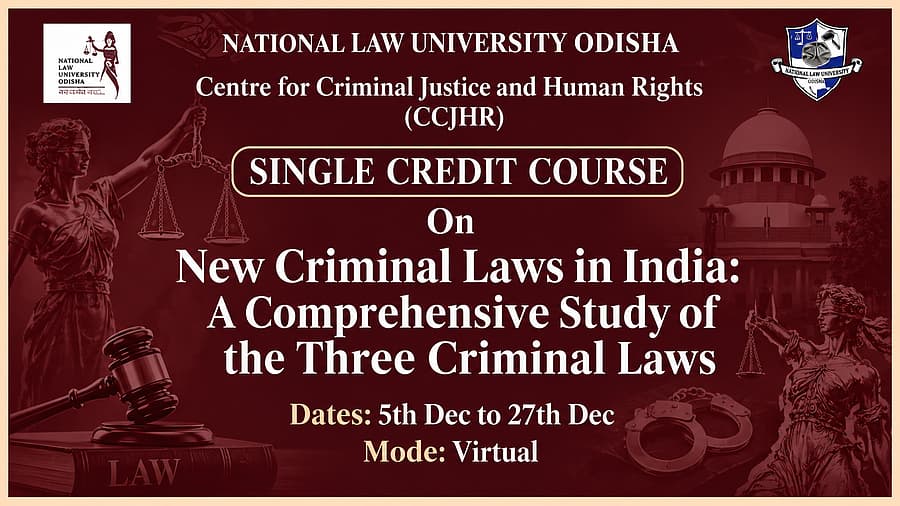
NLUO New Criminal Laws Course: Registration Now Open
Summary
- The Centre for Criminal Justice and Human Rights at NLUO is offering a Single Credit Course on India's new criminal laws.
- The course, running from December 5 to 27, 2026, requires registration by December 1.
- It covers the Bharatiya Nyaya Sanhita, Bharatiya Nagarik Suraksha Sanhita, and Bharatiya Sakshya Adhiniyam, which replaced older codes.
- The program aims to provide a comprehensive understanding of the new framework, its principles, and implications for criminal justice.
- It targets law students, advocates, legal practitioners, academicians, researchers, and other interested professionals.
Course Announcement
India's criminal justice system has recently undergone a profound transformation, necessitating a thorough understanding of its updated legal framework.
The Centre for Criminal Justice and Human Rights (CCJHR) at the National Law University Odisha (NLUO) has opened registrations for a specialized Single Credit Course focusing on India's recently enacted criminal statutes. Titled "New Criminal Laws in India: A Comprehensive Study of the Three Criminal Laws," this program offers an in-depth exploration of the legislative changes. The NLUO new criminal laws course is scheduled to run from December 5 to December 27, 2026, providing participants with a focused period of study. Prospective attendees must complete their registration by December 1 to secure a spot in this timely educational offering.
India's Evolving Criminal Justice Landscape
India's criminal justice system has recently undergone a profound transformation, necessitating a thorough understanding of its updated legal framework. This significant overhaul is marked by the introduction of three pivotal pieces of legislation in 2023, fundamentally reshaping the country's approach to criminal law. These new statutes, the Bharatiya Nyaya Sanhita (BNS), the Bharatiya Nagarik Suraksha Sanhita (BNSS), and the Bharatiya Sakshya Adhiniyam (BSA), have replaced their colonial-era predecessors. Specifically, the BNS supersedes the Indian Penal Code of 1860, while the BNSS replaces the Code of Criminal Procedure from 1973. Similarly, the BSA has taken the place of the Indian Evidence Act of 1872, completing a comprehensive legislative update that impacts every facet of criminal proceedings. This India criminal law reform course aims to address the new Indian criminal code implications.
The comprehensive nature of these changes means that legal professionals require specialized training to navigate the altered landscape effectively. The NLUO's program, therefore, is designed to provide a detailed examination of these new laws, covering their foundational principles and the wide-ranging implications for how criminal justice is administered across the nation. Participants will gain familiarity with the critical modifications introduced across substantive criminal law, criminal procedure, and the law of evidence, ensuring they are well-equipped to practice under the revised system. This includes specific modules that could be seen as a Bharatiya Nyaya Sanhita course, Bharatiya Nagarik Suraksha Sanhita training, and a Bharatiya Sakshya Adhiniyam seminar, all integrated into one comprehensive offering to ensure a holistic understanding.
Why This Course Matters
The CCJHR NLUO criminal law program is meticulously structured to cater to a diverse group of individuals who interact with the criminal justice system. This includes current law students seeking to build a foundational understanding of the new codes, practicing advocates and legal practitioners who must adapt their expertise, as well as academicians and researchers delving into the legislative shifts. Furthermore, any other professional with an interest in criminal law and its administration will find the course highly relevant.
Through an application-oriented methodology, the course is designed not merely to inform but to foster critical engagement with the new legal provisions. It seeks to illuminate the practical implications arising from these changes and to prepare participants for the challenges inherent in their implementation. By offering a structured environment for learning, the program ensures that attendees can thoroughly grasp the nuances of the transformed legal framework, which is crucial for effective legal practice and scholarly inquiry in the evolving Indian legal landscape.
Practical Implications
Lawyers and compliance officers practicing in India must understand the significant changes introduced by the Bharatiya Nyaya Sanhita, Bharatiya Nagarik Suraksha Sanhita, and Bharatiya Sakshya Adhiniyam. This course offers a structured opportunity to gain a comprehensive understanding of these new laws, which is critical for ensuring compliance, effective legal representation, and advising clients under the transformed criminal justice framework.
Source
How does this affect you?
Get an AI analysis of this article grounded in your jurisdictions, practice areas, and any policy documents you've uploaded to Wansom.
Finish Reading the Full Story and the Expert Analysis.
Get the latest legal & regulatory intelligence in India
Wansom is AI and can make mistakes.