
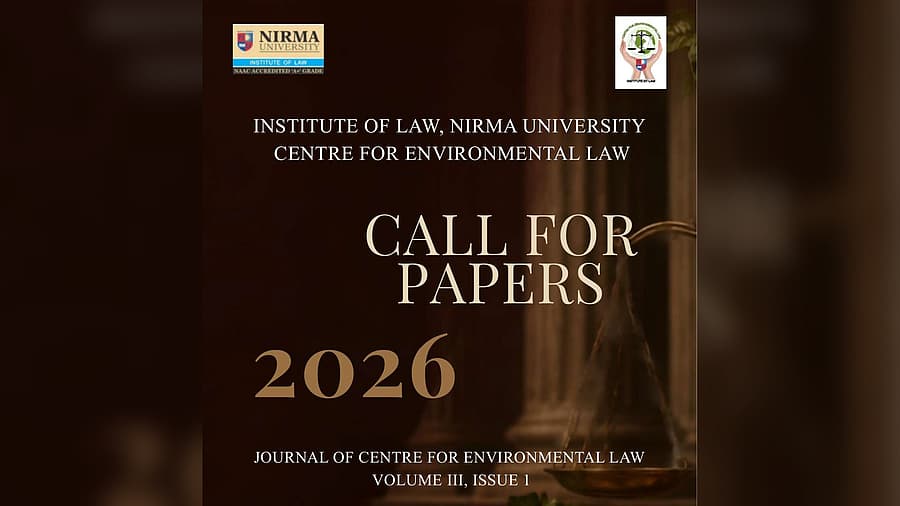
Nirma University: Environmental Law Journal Call for Papers on Tech & Environment
Summary
- The Centre for Environmental Law at Nirma University has invited submissions for its journal.
- The call is for Volume III, Issue 1, focusing on "Law, Technology and Environment."
- Suggested sub-themes include AI in environmental governance and digital technologies for monitoring.
- Other topics cover climate change, emerging liabilities, data privacy, and environmental justice.
- Submissions must be original and unpublished research.
Call for Papers Issued
This call represents a vital opportunity for legal scholars and practitioners to contribute to the academic discourse surrounding some of the most pressing environmental and technological challenges of our time.
The Centre for Environmental Law at the Institute of Law, Nirma University (ILNU), has issued an invitation for scholarly contributions to the upcoming Volume III, Issue 1 of its distinguished journal. This call specifically targets research exploring the intricate connections between "Law, Technology and Environment," a theme designed to foster interdisciplinary discourse on critical contemporary issues.
This initiative provides a significant platform for academics, legal practitioners, and researchers to delve into how technological advancements are reshaping environmental legal frameworks and governance. The journal aims to publish original, unpublished research that offers fresh perspectives and rigorous analysis on this evolving landscape.
Key Thematic Areas
The journal's overarching theme, "Law, Technology and Environment," encompasses a broad spectrum of sub-themes, offering numerous avenues for exploration. These include the regulatory applications of Artificial Intelligence in environmental governance, examining aspects such as algorithmic decision-making, environmental risk assessment, and accountability mechanisms. Another crucial area is the role of digital technologies in environmental monitoring, covering innovations like satellite imaging, remote sensing, drones, and big data analytics for technology-driven environmental compliance.
Further topics of interest extend to the intersection of technology, climate change, and energy transition, focusing on the legal regulation of clean technologies, renewable energy, carbon markets, and technology-led climate action. The call also encourages submissions on emerging technologies and environmental liability, addressing legal responsibility for technology-induced environmental harm, corporate accountability, and associated regulatory challenges. Additionally, researchers may explore data, privacy, and environmental regulation, considering the collection and use of environmental data, digital surveillance, transparency, access to information, and privacy concerns. Finally, the theme embraces technology's role in sustainable development and environmental justice, including resource governance, equitable access, and the distribution of environmental benefits and burdens. While these sub-themes are illustrative, contributors are welcome to submit research on any relevant subject falling within the broader scope of law, technology, and the environment.
Why It Matters for Legal Scholars
This call represents a vital opportunity for legal scholars and practitioners to contribute to the academic discourse surrounding some of the most pressing environmental and technological challenges of our time. By submitting research, individuals can establish thought leadership in rapidly evolving fields such as environmental governance with AI or technology-driven environmental compliance. The journal serves as a critical forum for disseminating cutting-edge legal research that can inform policy development and shape future regulatory approaches.
Engaging with these themes allows legal professionals to analyze the complex interplay between innovation and environmental protection, offering insights into how legal frameworks can adapt to technological change. The requirement for original and unpublished work ensures that the journal will feature novel contributions, further enriching the academic conversation and providing valuable resources for those navigating the legal implications of technology in environmental contexts.
Practical Implications
Lawyers and legal scholars with expertise in environmental law, technology, and their intersection should consider submitting research papers to this journal. This presents an opportunity to contribute to academic discourse, establish thought leadership, and potentially influence policy in emerging areas like AI in environmental governance or technology-driven environmental compliance.
Source
How does this affect you?
Get an AI analysis of this article grounded in your jurisdictions, practice areas, and any policy documents you've uploaded to Wansom.
Finish Reading the Full Story and the Expert Analysis.
Get the latest legal & regulatory intelligence in India
Wansom is AI and can make mistakes.