
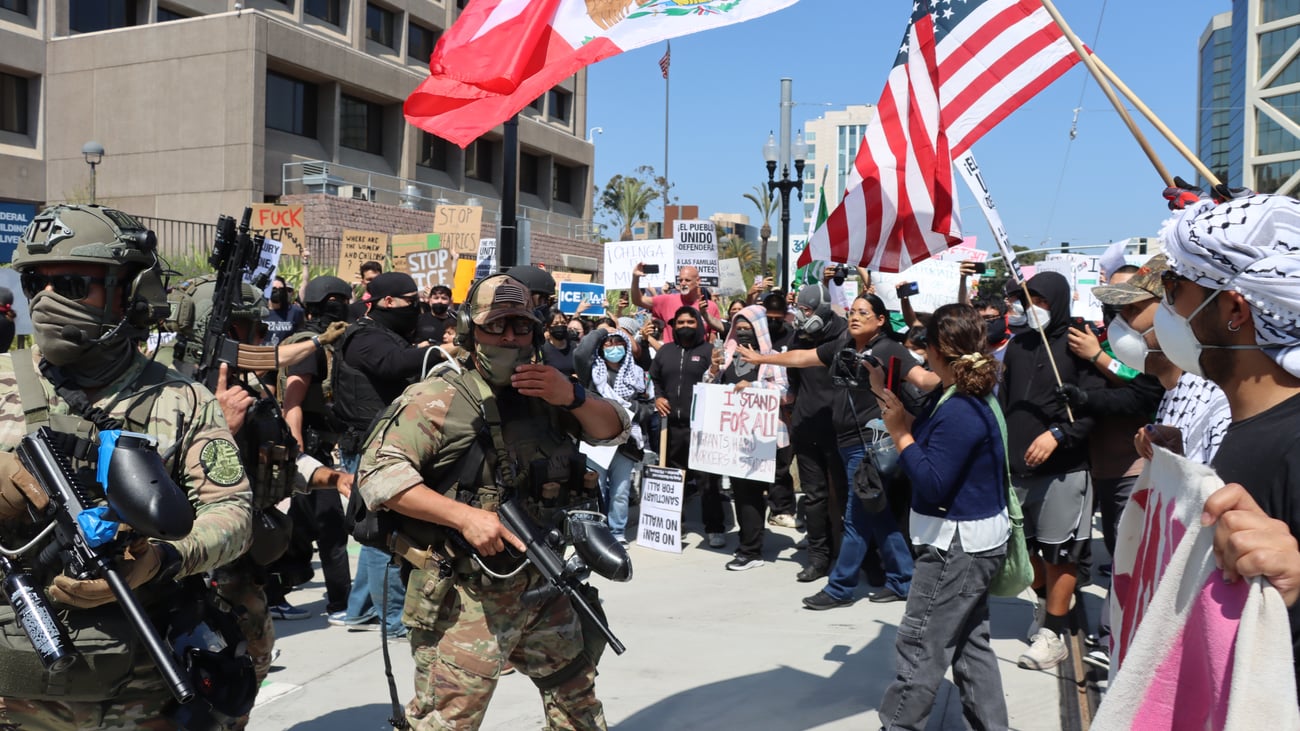
Ninth Circuit: California No Vigilantes Act Faces Skepticism
Summary
- The Ninth Circuit is reviewing California's 'No Vigilantes Act,' which mandates identification for nonuniformed federal officers.
- A Ninth Circuit panel previously paused a key provision of the Act requiring federal agents to wear identifying badges.
- The federal government argues the Supremacy Clause prevents states from regulating federal operations, citing the 1920 *Johnson v. Maryland* precedent.
- California lawmakers enacted the law in response to federal immigration enforcement actions and incidents involving unidentified agents.
- The panel heard arguments but did not issue a decision on the state's ability to impose identification requirements on federal agents.
Ninth Circuit Considers California's 'No Vigilantes Act'
The federal government has consistently argued that the Supremacy Clause of the U.S. Constitution prohibits states from enacting laws that regulate federal operations.
A Ninth Circuit panel recently convened to hear oral arguments concerning California's 'No Vigilantes Act,' a state law mandating identification for nonuniformed federal officers. The proceedings on Tuesday saw judges express skepticism regarding the state's ability to maintain the law in its current form, with U.S. Circuit Judge Jacqueline Nguyen, an appointee of Barack Obama, noting that California's Deputy Solicitor General, Mica Moore, faced a challenging task in defending the legislation.
This hearing follows an earlier decision in April by a different Ninth Circuit panel, which temporarily halted a specific provision of the state law requiring federal agents operating out of uniform to display identifying badges. The federal government has consistently argued that the Supremacy Clause of the U.S. Constitution prohibits states from enacting laws that regulate federal operations. Justice Department attorneys have contended that the April 22 ruling should effectively conclude the legal dispute, urging the three-judge panel to overturn a lower court's denial of a preliminary injunction and to issue its own injunction to prevent enforcement of the contested section of the No Vigilantes Act. The panel did not render a decision during Tuesday's session.
Background on California's Identification Requirements for Federal Officers
The 'No Vigilantes Act' and its companion legislation, the 'No Secret Police Act,' emerged as a direct response to widespread federal immigration enforcement actions conducted last year. California lawmakers introduced these bills to address concerns about federal agents operating without clear identification. Specifically, the No Vigilantes Act mandates that nonuniformed officers carry identification displaying either their name or badge number.
The 'No Secret Police Act' further targeted federal immigration agents who had been observed wearing masks while apprehending individuals suspected of being in the country without authorization. This related law sought to prohibit federal law enforcement personnel from wearing masks, though it included certain exceptions. Legislators highlighted incidents such as the experience of Daniel Rascon, an American citizen, who reported that four armed, masked men approached his stopped vehicle, pounded on the windows, and refused to show identification. As his father-in-law drove away, Rascon stated that one of the men discharged a firearm.
Legal Arguments and Precedent in the Supremacy Clause Federal Agents Debate
During the arguments, Deputy Solicitor General Mica Moore pressed the judges to consider the extent of regulation when evaluating whether the state law unduly interferes with federal authorities. Moore asserted that requiring an officer to wear an identifying badge does not impede their performance, suggesting that federal agencies' primary concern might be individuals attempting to 'dox' their personnel. She maintained that a law requiring federal officers to provide an agency name and badge number could withstand constitutional scrutiny.
Moore referenced the 1920 U.S. Supreme Court case *Johnson v. Maryland*, which established that a federal postal worker did not require a state driver's license for official duties. However, she noted that the *Johnson* decision also indicated that a local ordinance governing how a driver navigates a street corner could potentially apply to a federal employee. In contrast, Justice Department attorney Andrew Bernie argued that states are expressly prohibited from dictating the operations of the federal government, characterizing the issue as 'purely a legal matter.' U.S. Circuit Judge Daniel Collins, also a Trump appointee, remarked that the No Vigilantes Act constitutes 'regulating government activity,' rather than an 'incidental' impact. Bernie further stated that three other federal courts have concurred with the Ninth Circuit's April decision since its issuance, emphasizing that nothing has changed since that ruling except for additional courts aligning with the Ninth Circuit's stance. He contended that a state law directly regulating federal agents in the performance of their duties represents a direct regulation of an inherently sovereign function, making the panel's decision straightforward. Bernie also asserted that California's Act is 'contrary to the public interest,' distinguishing it from the 'turning at the corners' scenario mentioned in *Johnson v. Maryland*.
Practical Implications
Lawyers and compliance officers should closely monitor the Ninth Circuit's decision in this case, as it will clarify the extent to which states can regulate federal law enforcement operations, particularly regarding identification requirements for federal officers. The outcome will have significant implications for federal preemption under the Supremacy Clause and could influence future state-level attempts to oversee federal agent conduct.
Source
How does this affect you?
Get an AI analysis of this article grounded in your jurisdictions, practice areas, and any policy documents you've uploaded to Wansom.
Wansom is AI and can make mistakes.