
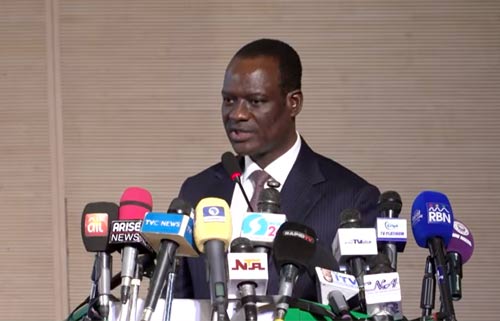
Nigeria FG: NNPCL Petrol Price Capped at N1350 Per Litre
Summary
- The Federal Government has set a temporary petrol price ceiling of N1,350 per litre at NNPCL filling stations.
- This price will be in effect for the next thirty days and is subject to monthly review.
- The government clarifies that this N1,350 price reflects the actual cost and is not a subsidy.
- Public transporters will receive priority access to fuel at this specified rate.
- The announcement was made in Abuja by a government official, Mr. Taiwo.
Government Sets New Fuel Price Ceiling
The new Nigeria FG NNPCL petrol price N1350 is not intended as a long-term fixed rate but rather as an initial benchmark.
The Federal Government of Nigeria has announced a temporary price cap for petrol sales at stations operated by the Nigerian National Petroleum Company Limited (NNPCL). For the next thirty days, consumers will be able to purchase petrol at a fixed rate of N1,350 per litre. This directive, issued from Abuja, aims to provide a standardized cost for fuel across these specific outlets.
The new **Nigeria FG NNPCL petrol price N1350** is not intended as a long-term fixed rate but rather as an initial benchmark. Officials have indicated that this price point will undergo a comprehensive review on a monthly basis, allowing for adjustments based on prevailing market conditions and operational costs. A key aspect of this new policy is the prioritization of public transporters, who will receive preferential access to fuel at this discounted rate, aiming to mitigate the impact of fuel costs on public transportation services.
Mr. Taiwo, a government representative, conveyed the details of this new pricing structure. The announcement clarifies that this measure is not a subsidy but rather an effort by the government to ensure that fuel is sold at its actual cost of acquisition and distribution. This approach signals a shift towards cost recovery within the NNPCL's retail operations, moving away from previous intervention models.
Regulatory Framework and Monthly Review
This new **Nigerian fuel price ceiling** represents a significant policy decision by the Federal Government, emphasizing a direct cost-recovery model rather than a subsidized one. The N1,350 per litre price is explicitly stated not to be a subsidy, with the government asserting that it reflects the true cost of the product. This framing is crucial for understanding the economic rationale behind the intervention, as it suggests an attempt to stabilize prices without incurring direct financial burdens on the state budget.
The commitment to an **NNPCL petrol cost review monthly** underscores a dynamic approach to fuel pricing. This regular assessment mechanism is designed to allow the government to adapt the price ceiling in response to fluctuations in global crude oil prices, exchange rates, and other operational expenses. Such a flexible **FG fuel pricing policy** aims to prevent significant discrepancies between the regulated price and the actual cost of supply, thereby ensuring the financial viability of NNPCL's retail operations while attempting to manage consumer impact.
The monthly review process will be critical in determining the sustainability and effectiveness of this pricing strategy. It provides a structured avenue for the government to adjust the price ceiling, ensuring that it remains reflective of the economic realities of fuel procurement and distribution. This transparent, albeit temporary, pricing structure is a notable development in the country's energy sector management.
Implications for Public Transport and the Market
The introduction of the N1,350 per litre price at NNPCL stations, coupled with its monthly review, carries substantial implications, particularly for the public transportation sector. By granting **Nigeria public transport fuel priority**, the government aims to cushion the effects of fuel price volatility on commuters and the broader economy. This preferential treatment is expected to help public transporters manage their operational expenses more effectively, potentially leading to more stable fares for passengers.
While the N1,350 price is a temporary measure, its existence as a **Nigerian fuel price ceiling** at NNPCL outlets could influence pricing dynamics across the wider market. Other fuel marketers may feel pressure to align their prices, or at least consider the NNPCL rate as a benchmark, even if they are not bound by the same regulatory constraints. The government's assertion that this is a 'cost' price, not a subsidy, also sets a precedent for how future fuel pricing discussions might be framed.
The ongoing **NNPCL petrol cost review monthly** will be a critical factor for businesses and consumers alike. Predictable, albeit adjustable, pricing can aid in economic planning, especially for sectors heavily reliant on fuel. The success of this policy will depend on its ability to balance the need for cost recovery with the imperative to maintain affordable public services and stable market conditions.
Practical Implications
Businesses, particularly those in logistics, transportation, and manufacturing, must closely monitor the monthly review of the N1,350 petrol price ceiling by the Nigerian government to accurately forecast operational costs, adjust pricing strategies, and ensure compliance with any related regulatory directives or contractual obligations that may be impacted by fluctuating fuel prices.
Source
How does this affect you?
Get an AI analysis of this article grounded in your jurisdictions, practice areas, and any policy documents you've uploaded to Wansom.
Finish Reading the Full Story and the Expert Analysis.
Get the latest legal & regulatory intelligence in Nigeria
Wansom is AI and can make mistakes.