
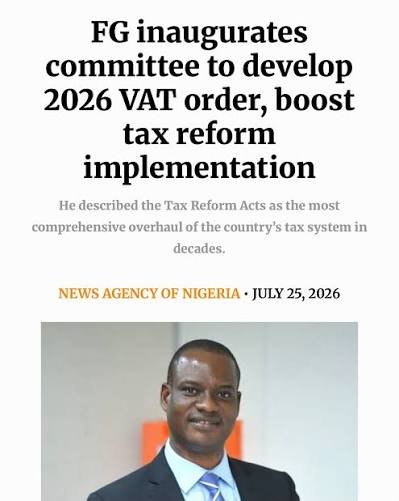
Nigeria's New VAT Order Is Coming in Six Weeks.
Introduction
The committee, inaugurated by Minister of Finance and Coordinating Minister of the Economy Taiwo Oyedele, has been given six weeks to report, with a mandate covering the VAT-exempt and zero-rated schedules in Part IV of the Act, harmonised system codes, a stakeholder consultation report, and recommendations on any further legislative amendments needed.
Why it matters
This matters because the Tax Reform Acts that took effect on 1 January 2026 represent the most significant overhaul of Nigeria's tax system in decades, and VAT treatment is one of the areas businesses have been waiting on for operational certainty. The previous VAT Modification Order was made under the now-repealed VAT Act and does not map cleanly onto the new Nigeria Tax Act framework.
Until this new Order is finalised, businesses across food, healthcare, education, energy, exports, and manufacturing face open questions about their exempt or zero-rated status.
The Order will determine the specific goods and services eligible for VAT exemption or zero-rating going forward, directly affecting pricing, invoicing, input VAT recovery, and compliance obligations for VAT-registered businesses.
Background
The core legal mechanism here is delegated legislation. The Nigeria Tax Act 2025 sets the statutory framework for VAT, but the Minister of Finance retains power to issue a Modification Order that operationalises the exempt and zero-rated schedules within that framework. This is significant because it means the actual scope of VAT relief for any given sector will be determined by ministerial order, not by further primary legislation, giving the Federal Government considerably more flexibility to adjust the schedule than would be the case if changes required a full legislative amendment.
Who is affected
Boards and finance leadership in VAT-affected businesses should treat this as a matter requiring active tracking, not passive awaiting. Tax and finance committees at board level should be receiving updates on whether the organisation, directly or through a trade association, is participating in the stakeholder consultation the committee has been directed to conduct. Governance failure here looks like a business discovering its VAT status has changed only after the Order is gazetted, with no opportunity to have shaped the outcome.
Compliance and tax teams should prepare now for two scenarios: continuity of current exempt or zero-rated status, and loss or gain of that status. This means having invoicing systems, ERP tax codes, and customer-facing pricing structures ready to be updated on short notice once the Order is published, since implementation timelines for VAT changes in Nigeria have historically been tight once an Order takes effect. Businesses should also review whether their current understanding of their VAT position rests on the old Modification Order or on interpretations of the new Nigeria Tax Act that may not yet be settled, since that ambiguity is precisely what the committee has been tasked to resolve.
For Legal Counsel Review current VAT positions against the Nigeria Tax Act 2025 and flag any reliance on the repealed VAT Act's Modification Order that may no longer hold, and monitor for the committee's report and the eventual gazetted Order.
For Compliance Teams Prepare invoicing, ERP, and tax coding systems for rapid update once the new Order is published, and document current VAT treatment assumptions to support a clean transition.
For Risk Managers Assess financial exposure under scenarios where current exemptions narrow or expand, particularly for businesses with significant exempt or zero-rated revenue lines.
Conclusion
This is a narrow procedural step, a committee inauguration, that carries outsized practical weight because of what it will produce. The 2026 VAT Modification Order will be the document businesses actually operate against, more immediately relevant to day-to-day compliance than the Nigeria Tax Act itself. The six-week timeline is short given the scope of the mandate, and businesses that treat this as a passive wait-and-see period risk losing the chance to shape a schedule that will govern their VAT position for years. Finance, tax, and legal teams should be engaging the consultation process now, not after the Order is gazetted.
Citations
- 1.Nigeria Tax Act, 2025, Part IV (VAT-exempt and zero-rated supplies).
- 2.Value Added Tax Act (repealed, as replaced by the Nigeria Tax Act 2025).
- 3.Tax Reform Acts, effective 1 January 2026 (Federal Republic of Nigeria).
- 4.Agreement Establishing the African Continental Free Trade Area (AfCFTA), regional integration commitments referenced by the Federal Ministry of Finance.
- 5.Federal Ministry of Finance, statement on the inauguration of the inter-ministerial VAT Modification Order committee, 25 July 2026.
Finish Reading the Full Story and the Expert Analysis.
Get the latest legal & regulatory intelligence in Nigeria
Wansom is AI and can make mistakes.