
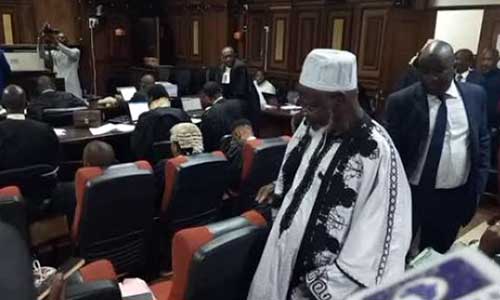
Federal High Court: Nigeria Coup Trial Evidence Admissibility Ruling Set
Summary
- The Federal High Court in Abuja has set December 7, 2026, to rule on the admissibility of evidence in an alleged coup plot trial.
- Justice Joyce Abdulmalik will decide whether statements and video recordings from six defendants can be admitted.
- This decision follows the conclusion of a 'trial-within-trial' where both prosecution and defense presented arguments.
- The ruling will establish precedents for evidentiary standards, particularly for statements and video evidence in national security cases.
Crucial Ruling Awaited in Alleged Coup Trial
The upcoming Nigeria coup trial evidence admissibility ruling by Justice Joyce Abdulmalik on December 7, 2026, carries significant weight for the country's legal landscape.
The Federal High Court in Abuja has scheduled December 7, 2026, as the date for a pivotal ruling concerning the admissibility of key evidence in an ongoing trial. This decision will determine whether statements and video recordings obtained from six individuals accused of plotting to overthrow the Federal Government of Nigeria can be presented as evidence in the substantive case.
The court's pronouncement follows the conclusion of a 'trial-within-trial' proceeding, a distinct legal mechanism employed to assess the voluntariness and proper procurement of evidence, particularly confessions or statements made by defendants. Both the prosecution and the defense teams have presented their final arguments in this preliminary hearing, setting the stage for Justice Joyce Abdulmalik to deliver her verdict.
This specific proceeding is designed to scrutinize the circumstances under which the evidence was gathered, ensuring compliance with legal standards and constitutional rights. The outcome will directly impact the strength of the prosecution's case against the six defendants, who face serious charges related to an alleged coup plot against the Nigerian state.
Legal Framework of Admissibility Challenges
A 'trial-within-trial' is a fundamental procedural safeguard in Nigerian criminal jurisprudence, specifically invoked when the defense challenges the admissibility of a defendant's statement, typically on grounds of involuntariness, duress, or non-compliance with procedural requirements. This mini-trial allows the court to hear evidence solely on the circumstances surrounding the taking of the statement, separate from the main charges, before deciding if it can be admitted.
Beyond written or oral statements, the admissibility of video evidence in Nigeria's legal system also faces rigorous scrutiny. Courts often consider factors such as the authenticity of the recording, the chain of custody, potential for manipulation, and whether the recording was obtained legally and without violating the defendant's rights. The Federal High Court Abuja Justice Joyce Abdulmalik's ruling will therefore address not only the traditional challenges to statements but also the contemporary issues surrounding digital evidence in high-stakes cases.
This process underscores the judiciary's commitment to ensuring fair trial standards, even in matters of national security. The arguments presented during the trial-within-trial in Abuja would have delved into the specifics of how the alleged coup plot trial evidence, including both statements and video recordings, was collected and preserved, highlighting potential breaches or adherence to due process.
Implications for Future Evidentiary Standards
The upcoming Nigeria coup trial evidence admissibility ruling by Justice Joyce Abdulmalik on December 7, 2026, carries significant weight for the country's legal landscape. The decision will likely set important precedents regarding the standards for admitting both confessional statements and video evidence, particularly in sensitive national security cases. This ruling could influence how law enforcement agencies conduct investigations and gather evidence in future alleged coup plot trials or similar high-profile criminal proceedings.
For legal practitioners, the outcome of these trial-within-trial arguments in Abuja will be closely watched. It will offer crucial insights into the court's interpretation of evidentiary rules concerning the admissibility of statements video evidence Nigeria, providing guidance for both prosecution and defense strategies. A strict stance on admissibility could compel investigators to adhere more rigorously to procedural safeguards, while a more lenient approach might alter the dynamics of challenging evidence in court.
Ultimately, this ruling will shape the evidentiary standards that govern criminal trials across Nigeria, especially those involving grave allegations against the state. The Federal High Court's decision will serve as a benchmark for assessing the integrity of evidence collection and presentation, impacting how justice is administered in complex cases for years to come.
Practical Implications
Lawyers practicing criminal defense or prosecution in Nigeria should closely monitor this ruling for precedents on the admissibility of statements and video recordings, particularly in high-profile national security cases, as it will shape future evidentiary standards and trial strategies.
Source
How does this affect you?
Get an AI analysis of this article grounded in your jurisdictions, practice areas, and any policy documents you've uploaded to Wansom.
Finish Reading the Full Story and the Expert Analysis.
Get the latest legal & regulatory intelligence in Nigeria
Wansom is AI and can make mistakes.