
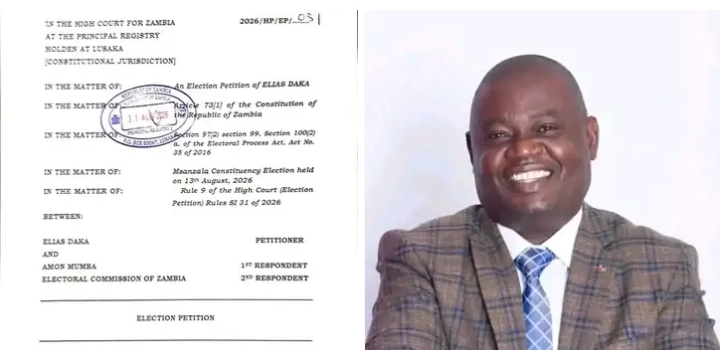
Msanzala Election: Elias Daka Petitions Amon Mumba’s Victory
Elias Daka, a third-placed candidate in Zambia, has formally petitioned the parliamentary election of Amon Mumba for Msanzala Constituency, challenging his victory. This action initiates a formal legal process to scrutinize the conduct and outcome of the Msanzala parliamentary election, placing the declared results under judicial review. The petition names Hon. Amon Mumba as the first respondent, indicating that he will be required to defend his victory in court.
This development carries significant legal implications for practitioners, the involved parties, and the public. For attorneys, it signals the commencement of potentially complex and resource-intensive litigation, demanding meticulous evidence gathering, witness preparation, and expert legal arguments concerning electoral law compliance. The outcome of such a petition could range from the confirmation of the election result to the nullification of the election, potentially leading to a by-election. This process is vital for upholding the integrity of Zambia's democratic institutions and ensuring that elections are conducted freely and fairly, in accordance with the law.
The legal context for this petition is Zambia's electoral framework, primarily governed by the Electoral Process Act, which outlines the specific grounds upon which an election can be challenged, such as electoral irregularities, corrupt practices, or non-compliance with the law. The High Court typically has original jurisdiction over parliamentary election petitions, with appeals potentially proceeding to the Constitutional Court. The Electoral Commission of Zambia, as the body responsible for conducting the elections, is usually a necessary party to such proceedings, even if not explicitly named as a respondent in the initial excerpt.
Key parties involved are Elias Daka as the petitioner, Hon. Amon Mumba as the first respondent, and implicitly, the Electoral Commission of Zambia. The court seized with this matter would be the High Court. The practitioner takeaway is that attorneys representing candidates, political parties, or the Electoral Commission must prepare for rigorous litigation, focusing on the strict rules of evidence and procedure applicable to election petitions. Businesses and investors with interests in the Msanzala Constituency may also monitor the proceedings due to potential political instability or changes in local representation. The outcome of this matter is not yet reported.
How does this affect you?
Get an AI analysis of this article grounded in your jurisdictions, practice areas, and any policy documents you've uploaded to Wansom.
Finish Reading the Full Story and the Expert Analysis.
Wansom is AI and can make mistakes.