
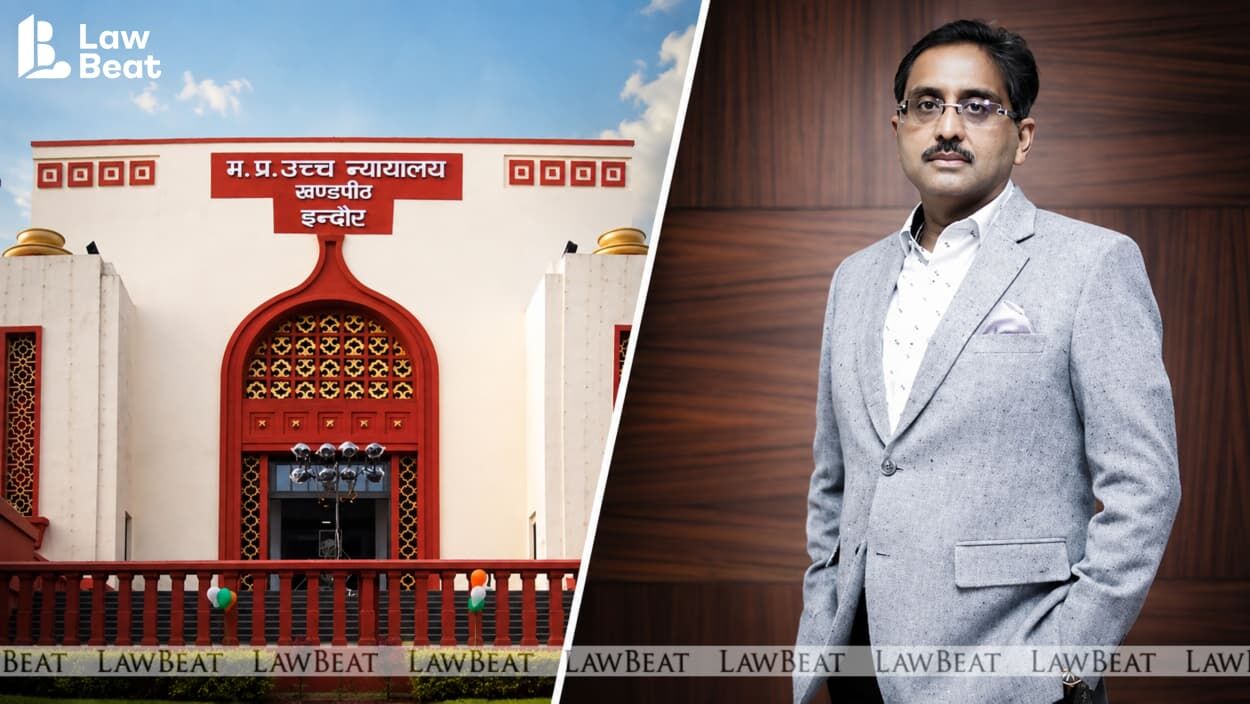
MP High Court: Anand Kedia Suppressed Encroachment Proof, Petition Dismissed
Summary
- The MP High Court dismissed Anand Kedia's petition against a demolition notice, citing his suppression of evidence.
- Kedia was ordered to pay Rs 20,000 in costs for approaching the court with 'unclean hands' by concealing a joint inspection report.
- The report confirmed Kedia had encroached on government land by building a wall, a fact known to his representative.
- The demolition notice from the Indore Municipal Corporation aimed to widen a road under the Indore Development Plan, 2021.
- The court applied the 'falsus in uno, falsus in omnibus' principle, denying Kedia any relief due to his lack of full disclosure.
Court Dismisses Plea Over Suppressed Evidence
The court unequivocally stated that Kedia had not approached the judiciary with 'clean hands,' directly leading to the dismissal of his petition.
The Madhya Pradesh High Court, sitting in its Indore Bench, has definitively dismissed a writ petition filed by Anand Kumar Kedia, challenging a demolition notice issued by the Indore Municipal Corporation (IMC). The ruling, delivered by Justice Sandeep N. Bhatt on August 17, 2026, found that Kedia had approached the court without full disclosure, specifically by suppressing a critical document that indicated his encroachment on government land. This lack of transparency was the primary reason for the petition's rejection.
As a direct consequence of this finding, the court imposed a cost of Rs 20,000 on Kedia. This amount is mandated to be paid to the District Legal Services Authority, Indore, within a strict seven-day timeframe. The decision underscores the judiciary's firm stance against litigants who fail to present all material facts, particularly in cases involving public land and development projects.
Background to the Demolition Notice
Anand Kumar Kedia, a prominent business leader associated with the Kedia Group and formerly Chairman of Business Promotion & Development at Associated Alcohols & Breweries Ltd. (AABL), had sought judicial intervention against a demolition notice dated August 11, 2026. This notice originated from the Building Officer of Zone 19 of the Indore Municipal Corporation and targeted construction on Kedia's residential premises, which spans 1.452 hectares in Bicholi Hapsi village, Indore.
The municipal corporation's directive required Kedia to demolish structures to an average depth of 12.782 metres. This action was deemed necessary to facilitate the construction of a 30-metre road, a key component of the superseded Indore Development Plan, 2021, designed to connect Hotel Pride to the City Forest. This legal challenge followed an earlier round of litigation where the High Court, on July 21, 2026, had directed a joint inspection and provided Kedia an opportunity to object before any coercive measures were taken.
Conflicting Legal Arguments
Kedia's legal team, led by Senior Advocate Kishore Shrivastava and assisted by Advocate Amit Dubey, contended that the demolition notice was unlawful. Their arguments hinged on the assertion that no Town Development Scheme had been finalized and published under Section 50(7) of the M.P. Nagar Tatha Gram Nivesh Adhiniyam, 1973. Without this crucial step, they argued, no vesting of acquired land could legally occur under Section 57 of the same Adhiniyam. Furthermore, Kedia's representatives alleged that the Corporation had maliciously shifted the road's central line to shield other illegal encroachers at Kedia's expense, constituting 'malice in law' and a violation of Article 14 of the Constitution. They also claimed breaches of Article 300A of the Constitution and the Right to Fair Compensation Act, 2013.
Conversely, the respondents, represented by Advocate Rishi Tiwari for the Indore Municipal Corporation and Panel Lawyer Tanishq Patel for the State, vigorously opposed the petition. They highlighted Kedia's suppression of a joint inspection report, which clearly demonstrated his encroachment on government land by constructing a wall that incorporated public property into his private holdings. Citing the Supreme Court's precedent in Ravindra Ramchandra Waghmare v. Indore Municipal Corporation, they asserted that a development plan is binding on the Corporation. They further argued that Section 305 of the M.P. Municipal Corporation Act, 1956, permits automatic vesting of land for road-widening without requiring a separate acquisition process, thereby negating any violation of Article 300A.
The Doctrine of 'Unclean Hands'
The High Court's decision ultimately rested on the principle of 'unclean hands,' a fundamental tenet of equity jurisprudence. Justice Bhatt meticulously examined the 'mauka panchnama' — a site inspection report — dated July 30, 2026. This document unequivocally demonstrated that Kedia had erected a wall, thereby incorporating government land into his private property. Crucially, the court noted that this document had been duly served on Kedia's representative, whose signature was present on its overleaf, confirming Kedia's awareness of its contents and implications.
The court unequivocally stated that Kedia had not approached the judiciary with 'clean hands,' directly leading to the dismissal of his petition. In its reasoning, the court invoked the Latin maxim 'falsus in uno, falsus in omnibus,' meaning 'false in one thing, false in everything,' to underscore the severe consequences of suppressing material facts. This application of the doctrine meant that Kedia was denied any relief, regardless of the merits of his other arguments, due to his deliberate concealment of pertinent information.
Practical Implications
This ruling reinforces the critical importance of full disclosure and 'clean hands' when approaching Indian courts, particularly in land dispute and demolition cases. Lawyers must advise clients that suppressing material facts can lead to immediate dismissal of their plea and imposition of costs, even if there are arguable points on the merits of the demolition notice itself. It also clarifies the powers of municipal corporations for road-widening under specific state acts.
Source
How does this affect you?
Get an AI analysis of this article grounded in your jurisdictions, practice areas, and any policy documents you've uploaded to Wansom.
Finish Reading the Full Story and the Expert Analysis.
Wansom is AI and can make mistakes.