
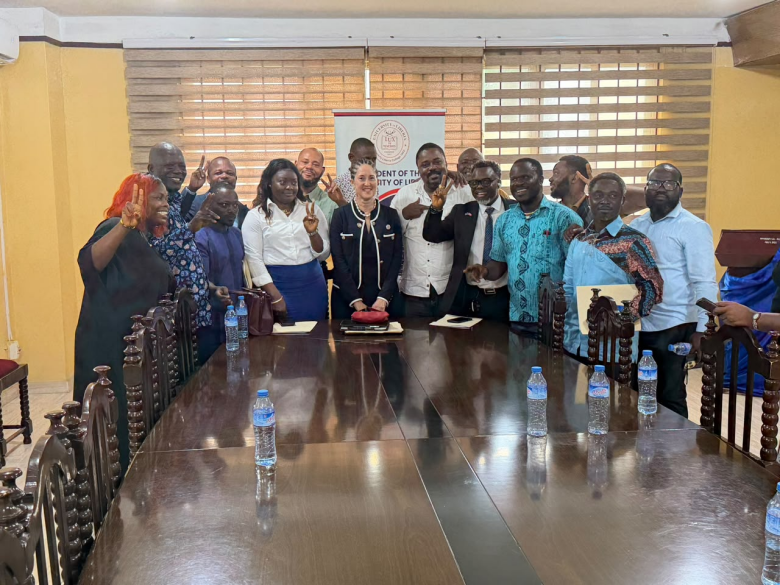
Martin Wleh Pennie: AAUL Presidency Challenge Over Extended Tenure
Summary
- Martin Wleh Pennie's five-year tenure as acting president of the University of Liberia Alumni Association (AAUL) is being challenged by concerned alumni.
- The dispute centers on differing interpretations of the AAUL constitution regarding term limits and the role of an acting president.
- Concerned alumni allege constitutional violations regarding elections, while Pennie cites poor member participation and financial contributions as reasons for electoral delays.
- Pennie assumed the acting role in January 2021 after the death of the elected president, James S. Davis.
- The University of Liberia President has intervened in the escalating leadership disagreement.
The Leadership Challenge
The prolonged tenure of an acting president, even when initially justified by unforeseen circumstances, can lead to significant internal strife and questions regarding leadership legitimacy if constitutional mandates for elections are not strictly followed.
Martin Wleh Pennie's extended tenure as acting president of the University of Liberia Alumni Association (AAUL) is facing significant opposition from a group of concerned alumni. This challenge centers on the legitimacy of his more than five years in the role without a fresh electoral mandate. The dispute has brought to light fundamental disagreements over the interpretation of the association's governing documents and the responsibilities of its leadership and members.
The Concerned Alumni of the University of Liberia formally articulated their grievances in a position statement dated November 4, 2026. They contend that the current leadership has systematically disregarded key constitutional provisions related to elections, term limits, and financial accountability. Mr. Pennie assumed the acting presidency in January 2021, following the passing of the then-incumbent President, James S. Davis. His continued occupancy of the office without a subsequent election has become the focal point of the controversy.
In response to these allegations, Mr. Pennie issued a nine-point defense to FrontPage Africa, asserting that the National Executive Committee's (NEC) actions are consistent with the AAUL constitution. He maintains that the association's foundational document permits the vice president to step into the acting presidential role until a successor is duly elected. He attributes the prolonged absence of elections to practical difficulties, including low member turnout at meetings, a consistent failure to achieve quorum, and insufficient financial contributions from the membership.
Constitutional Crossroads
Central to the ongoing disagreement is Article VIII of the AAUL Constitution, which stipulates a two-year term for elected officials, with the possibility of serving one additional term. The concerned alumni argue that the last elected slate of officers, which included both the late President Davis and Mr. Pennie, took office in 2019. Under this interpretation, their mandate would have concluded in 2021, necessitating new elections. They further calculate that subsequent elections should have occurred in 2023 and 2025, placing 2027 as the next scheduled election year under normal circumstances.
While acknowledging Mr. Pennie's constitutional right to assume the acting leadership after President Davis's death on January 3, 2021, the dissenting group points to Article V, Section II. They assert that this provision was designed to facilitate a temporary transition until a new president could be elected, not to establish a long-term acting arrangement. Their position is encapsulated by their statement that "An acting arrangement is a bridge to legitimate leadership, not a substitute for it."
Mr. Pennie, however, offers an alternative reading of Article V, Section II. He emphasizes that the clause specifies the vice president shall serve as acting president in instances of the president's illness, absence, resignation, removal, death, or any other inability to serve, explicitly "until a new president is elected." He argues that the framers of the constitution included this language precisely to avert a leadership vacuum and ensure the association's continuous operation, particularly in scenarios where low member engagement makes holding timely elections challenging.
Justifications and Counterarguments
Mr. Pennie has consistently maintained that the National Executive Committee made repeated efforts to engage members for various meetings and Annual General Assemblies. He states that these attempts were frequently hampered by poor attendance and the inability to reach a quorum. Furthermore, he claims that on occasions when a quorum was achieved, members present explicitly directed the leadership to continue managing the association's affairs until broader participation could be secured for future electoral processes. He asserts that comprehensive attendance records and meeting minutes are available to substantiate the NEC's account.
The concerned alumni vehemently dispute the notion that factors such as low attendance or the COVID-19 pandemic adequately explain the prolonged delay in conducting elections. They highlight that Liberia's national State of Emergency, initially declared in April 2020, was officially lifted on July 21, 2020. This date predates both President Davis's passing and the anticipated 2021 election cycle by several months. The group has formally requested access to meeting notices, minutes, and attendance records to verify whether the leadership genuinely pursued the constitutionally mandated meetings.
In a counter-argument, Mr. Pennie underscores the reciprocal responsibilities of the association's members. He points to Article XII of the constitution, which obligates members to attend meetings and contribute dues as determined by the Annual General Assembly. Specifically, the constitution mandates a minimum monthly contribution of L$100. Mr. Pennie contends that inconsistent payment of dues and a general lack of member presence at meetings have significantly impaired the association's operational capacity and its ability to fulfill its functions effectively.
Organizational Health and Future
The escalating dispute within the University of Liberia Alumni Association has drawn the attention of higher authorities, with the University of Liberia President reportedly convening a stakeholder meeting to address the contentious issues. This intervention underscores the gravity of the situation and the potential impact on the association's reputation and functionality. The ongoing challenge to Martin Wleh Pennie's acting presidency highlights the critical importance of clear constitutional adherence and robust succession planning within non-profit organizations.
The prolonged tenure of an acting president, even when initially justified by unforeseen circumstances, can lead to significant internal strife and questions regarding leadership legitimacy if constitutional mandates for elections are not strictly followed. This case serves as a stark reminder for legal advisors to associations and non-profit entities about the necessity of thoroughly reviewing constitutional provisions related to acting leadership, electoral processes, and member engagement.
The core issue extends beyond individual leadership to the health of the organization itself. The arguments presented by both sides — from claims of member apathy and financial shortfalls to accusations of constitutional breaches — reflect deeper challenges in maintaining an active and engaged alumni base. Ensuring transparent governance and a clear path for leadership transitions is paramount for the long-term viability and credibility of any alumni association.
Practical Implications
Lawyers advising associations or non-profit organizations should review their clients' constitutional provisions regarding acting leadership, succession planning, and election procedures. This case highlights the legal risks and internal disputes that can arise when constitutional mandates for elections are not strictly adhered to, even in the face of member inactivity or unforeseen circumstances, potentially leading to challenges over leadership legitimacy.
Source
How does this affect you?
Get an AI analysis of this article grounded in your jurisdictions, practice areas, and any policy documents you've uploaded to Wansom.
Finish Reading the Full Story and the Expert Analysis.
Get the latest legal & regulatory intelligence in Liberia
Wansom is AI and can make mistakes.