
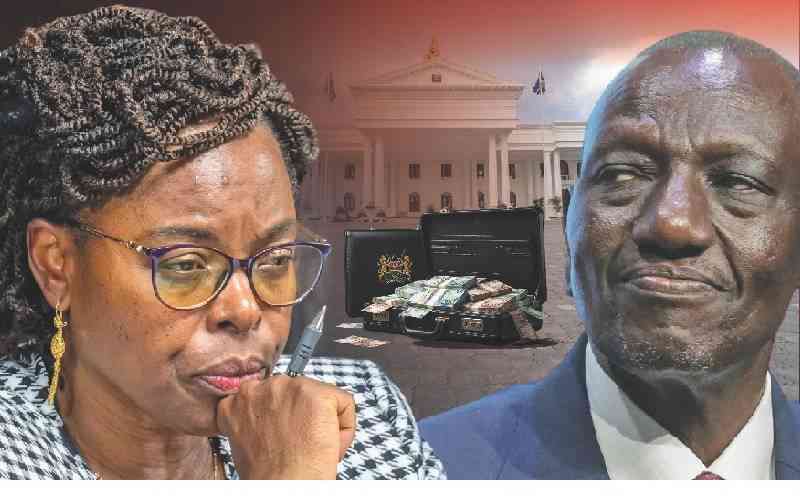
Margaret Nyakang'o: Exposes Gaps in Government Funds Oversight
Summary
- Controller of Budget Margaret Nyakang'o reported her office lacks visibility over billions of shillings in government funds.
- Key funds affected include the National Infrastructure Fund and the Sovereign Wealth Fund.
- This oversight gap exists because these standalone funds operate outside the Consolidated Fund, the government's central account.
- The revelation renews concerns about financial transparency within the Ruto administration's financial mechanisms.
- Nyakang'o's statement highlights a systemic challenge to Kenya's public funds accountability.
Oversight Concerns Emerge
The absence of robust oversight for billions of shillings channeled through specific government funds signals a heightened risk environment for public finance in Kenya.
Controller of Budget Margaret Nyakang'o has publicly raised significant concerns regarding the transparency and accountability of substantial government financial resources. She disclosed that her office currently lacks the necessary visibility to track billions of shillings collected through various key government funds and levies. This revelation has reignited anxieties surrounding the financial transparency of the current administration's multi-billion-shilling financial mechanisms.
Specifically, Nyakang'o highlighted funds such as the National Infrastructure Fund Kenya and the Sovereign Wealth Fund Kenya as examples where her office's oversight capabilities are severely limited. Her statement, made during an appearance on Citizen TV, underscored a critical gap in the financial monitoring landscape.
The core issue, as explained by Nyakang'o, stems from the operational structure of these particular funds. Unlike most government revenues and expenditures that pass through the Consolidated Fund, which serves as the central repository for state finances, these standalone funds operate independently. This separation effectively places them outside the direct purview and tracking mechanisms of the Office of the Controller of Budget (CoB), creating a significant blind spot in the overall Margaret Nyakang'o government funds oversight.
The Controller's Mandate and Systemic Gaps
The Office of the Controller of Budget (CoB) holds a crucial constitutional mandate in Kenya, primarily tasked with overseeing the implementation of the national budget and ensuring that public funds are spent lawfully and prudently. This includes authorizing withdrawals from the Consolidated Fund, thereby acting as a key gatekeeper for government expenditure. The CoB's powers are designed to uphold Kenya public funds accountability and prevent financial mismanagement.
However, the existence of significant government funds operating entirely outside this central framework presents a fundamental challenge to the established system of checks and balances. When funds like the National Infrastructure Fund Kenya and the Sovereign Wealth Fund Kenya bypass the Consolidated Fund, they effectively circumvent the standard oversight mechanisms that the Controller of Budget is constitutionally empowered to enforce.
This structural arrangement means that while the CoB is responsible for ensuring fiscal discipline across the government, a substantial portion of public money remains untracked by her office once collected. The lack of visibility into how these billions are ultimately utilized or disbursed raises serious questions about the integrity of public finance management and the effectiveness of the Kenya Controller of Budget powers in practice.
Heightened Risks to Public Funds
The absence of robust oversight for billions of shillings channeled through specific government funds signals a heightened risk environment for public finance in Kenya. Without the scrutiny of the Controller of Budget, there is an increased potential for financial impropriety, inefficient allocation of resources, or even outright misuse of funds. This situation directly impacts the Ruto administration financial transparency goals, as a significant portion of its financial vehicles operates without clear public accountability.
The concerns articulated by Margaret Nyakang'o underscore a systemic vulnerability where large sums of public money, intended for critical national development projects or long-term wealth generation, could be managed without adequate checks. This scenario not only undermines public trust but also creates an environment ripe for corruption, as the usual safeguards are absent.
For stakeholders, including citizens, investors, and international partners, the renewed fears about transparency are particularly troubling. The integrity of national development initiatives, especially those funded through mechanisms like the National Infrastructure Fund, relies heavily on transparent and accountable financial management. The current situation suggests a significant gap in achieving this standard.
Calls for Enhanced Scrutiny
The revelations from Controller of Budget Margaret Nyakang'o necessitate a re-evaluation of the existing frameworks governing government funds oversight. Her statements implicitly call for greater scrutiny and potentially legislative or regulatory reforms to ensure that all public monies, regardless of their specific fund designation, are subject to comprehensive oversight.
Addressing this "blind spot" is crucial for bolstering Kenya public funds accountability and restoring confidence in the management of national resources. This could involve integrating these standalone funds into the Consolidated Fund system or establishing alternative, equally rigorous, and transparent oversight mechanisms that fall under the CoB's mandate.
The ongoing discourse around the Ruto administration financial transparency will likely intensify as a result of these concerns. Moving forward, a concerted effort will be required from all branches of government to close these identified gaps, ensuring that the billions of shillings collected and spent are fully visible and accountable to the Kenyan public.
Practical Implications
This report signals significant transparency and accountability gaps in Kenya's public finance management, particularly concerning specific government funds. Lawyers advising clients on public procurement, infrastructure projects, or investments linked to these funds should note the heightened risk of financial impropriety and potential for future regulatory scrutiny or legislative reforms to enhance oversight. Compliance officers must conduct enhanced due diligence when engaging with entities or projects funded through such channels.
Source
How does this affect you?
Get an AI analysis of this article grounded in your jurisdictions, practice areas, and any policy documents you've uploaded to Wansom.
Finish Reading the Full Story and the Expert Analysis.
Get the latest legal & regulatory intelligence in Kenya
Wansom is AI and can make mistakes.