
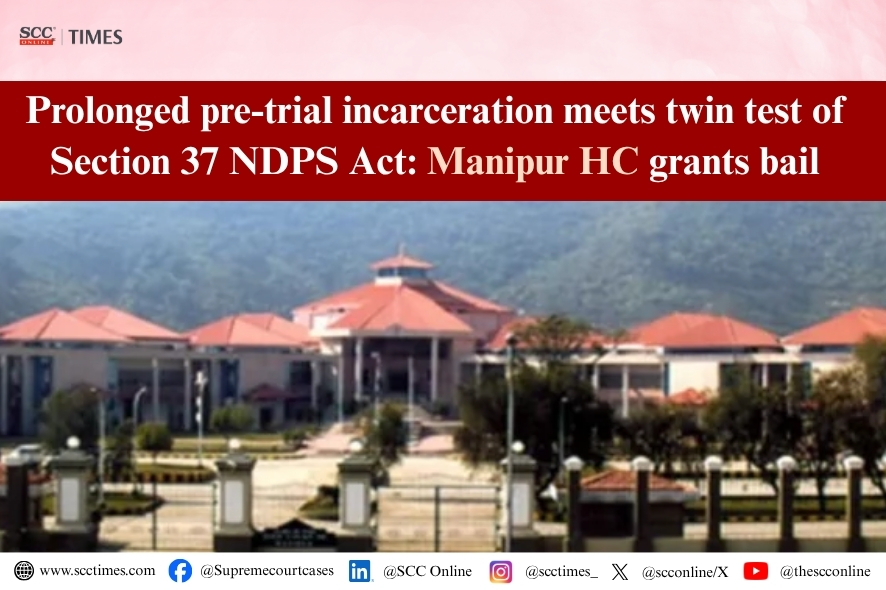
Manipur HC: Prolonged Detention Satisfies NDPS Bail Twin Test
Summary
- The Manipur High Court granted bail to an accused under the NDPS Act.
- The Court ruled that prolonged pre-trial incarceration can satisfy the Section 37 twin test for bail.
- The case primarily relied on the rebuttable statutory presumption under Section 35 of the NDPS Act.
- The Section 37 twin test remains mandatory for NDPS cases involving commercial quantities.
Manipur HC Grants Bail Citing Prolonged Detention
It determined that the extended period spent in custody, coupled with the fact that the prosecution's case relied heavily on a rebuttable presumption rather than irrefutable direct evidence, was sufficient to meet the demanding criteria of the Section 37 NDPS Act twin test.
The Manipur High Court recently granted bail to a petitioner-accused, making a significant observation regarding the stringent conditions for release under the Narcotic Drugs and Psychotropic Substances, Act, 1985 (NDPS Act). This decision centered on the principle that prolonged pre-trial incarceration can, under certain circumstances, be deemed sufficient to satisfy the rigorous "twin test" stipulated by Section 37 of the NDPS Act. This ruling offers a crucial precedent for individuals facing charges under this severe legislation, particularly those enduring extended periods of detention before trial.
The Court's order to release the accused on bail underscores a nuanced interpretation of the legal requirements for freedom in cases involving drug offenses. It directly addressed the challenge of balancing the strict mandates of the NDPS Act with the fundamental right to liberty, especially when an individual has spent a considerable time in custody awaiting the resolution of their case. This specific outcome from the Manipur HC NDPS bail proceedings highlights a potential pathway for relief in similar situations across India.
Navigating the NDPS Act's Strict Bail Conditions
Under the NDPS Act, particularly for offenses involving a commercial quantity of illicit substances, obtaining bail is exceptionally difficult due to the "twin test" enshrined in Section 37. This provision mandates that a court must be satisfied, based on reasonable grounds, that the accused is not guilty of the offense and is unlikely to commit any offense while on bail. These stringent conditions are designed to prevent the release of individuals involved in serious drug trafficking.
Furthermore, the prosecution in NDPS cases often relies on statutory presumptions, such as those found in Section 35 of the Act. Section 35 establishes a presumption of culpable mental state, meaning that unless the contrary is proved, a person found in possession of illicit substances is presumed to have known about the nature of the substance and to have intended to possess it. However, the Manipur High Court explicitly noted that this presumption under Section 35 NDPS Act is rebuttable, meaning it can be challenged and overturned by evidence presented by the defense. This distinction between a mandatory twin test and a rebuttable presumption forms a critical part of the legal landscape governing NDPS Act commercial quantity bail applications.
Court's Rationale: Rebuttable Presumption and Detention Length
In its decision to grant bail, the Manipur High Court carefully considered the nature of the evidence presented against the petitioner-accused. The Court observed that the prosecution's case substantially rested upon the statutory presumption outlined in Section 35 of the NDPS Act. Crucially, the Court reiterated that while such a presumption exists, it is not absolute and remains rebuttable. This acknowledgment formed a cornerstone of its reasoning.
It determined that the extended period spent in custody, coupled with the fact that the prosecution's case relied heavily on a rebuttable presumption rather than irrefutable direct evidence, was sufficient to meet the demanding criteria of the Section 37 NDPS Act twin test. This interpretation suggests that the duration of detention can, in certain circumstances, serve as a factor in satisfying the court's requirement for reasonable grounds to believe the accused is not guilty, especially when the foundational evidence is not incontrovertible.
Why It Matters for NDPS Bail Applications
This ruling from the Manipur High Court carries significant implications for the legal strategy in NDPS cases, particularly those involving commercial quantities and protracted pre-trial detention. It establishes a precedent where the sheer length of an individual's incarceration prior to trial can be a decisive factor in securing bail, even when the stringent Section 37 twin test is applicable. This offers a potential avenue for relief for many individuals who face prolonged pre-trial incarceration India under the NDPS Act, often for years, while their cases slowly progress through the judicial system.
The decision underscores that while the Section 37 twin test remains mandatory for NDPS Act commercial quantity bail, its application is not entirely rigid. When the prosecution's case relies heavily on statutory presumptions, which are inherently rebuttable, and the accused has already endured substantial detention, courts may be inclined to view the "reasonable grounds" requirement of Section 37 as satisfied. This Manipur High Court bail NDPS judgment provides a valuable reference point for defense counsel arguing for bail in similar circumstances, emphasizing the importance of both the evidentiary basis of the charges and the duration of an accused's pre-trial liberty deprivation.
Practical Implications
Lawyers defending clients under the NDPS Act in India, particularly those facing charges involving commercial quantities and prolonged pre-trial detention, should note this Manipur HC ruling as a precedent for arguing that prolonged incarceration can satisfy the Section 37 twin test for bail, especially when the prosecution's case relies on rebuttable statutory presumptions.
Source
Source: Original reporting via SCC Times
How does this affect you?
Get an AI analysis of this article grounded in your jurisdictions, practice areas, and any policy documents you've uploaded to Wansom.
Finish Reading the Full Story and the Expert Analysis.
Get the latest legal & regulatory intelligence in India
Wansom is AI and can make mistakes.