
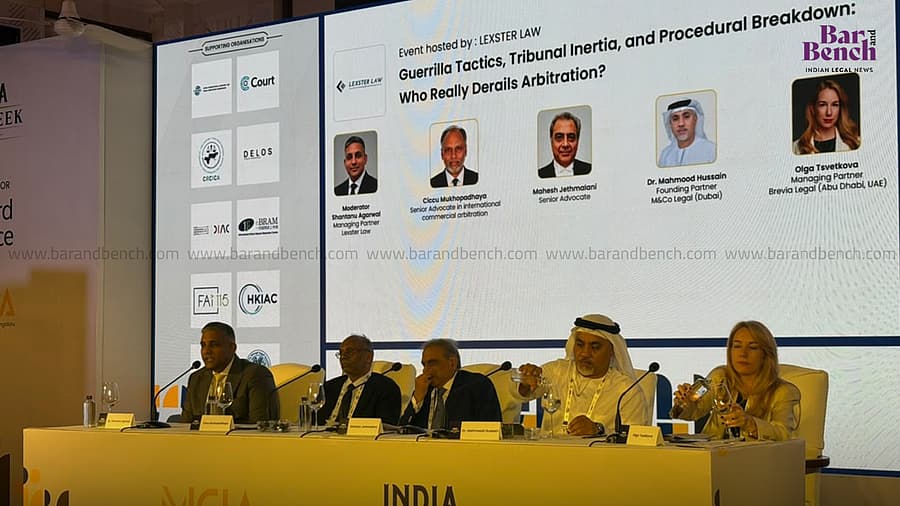
Ciccu Mukhopadhaya: Arbitrators in India Urged to Take Firm Stand
Summary
- Senior Advocate Ciccu Mukhopadhaya urged Indian arbitrators to firmly control proceedings, disregarding fears of court intervention.
- He emphasized that tribunals, not just institutions, bear ultimate responsibility for managing arbitration effectively.
- Mukhopadhaya highlighted common delay tactics, such as late submission of thousands of documents before witness examination.
- He advised that well-reasoned tribunal orders are unlikely to be overturned by courts, reinforcing `Indian arbitration tribunal powers`.
- The discussion occurred during a panel moderated by Shantanu Agarwal, including Mahesh Jethmalani, Mahmood Hussain, and Olga Tsvetkova.
Call for Firmness in Indian Arbitration
His counsel suggests that if a tribunal issues a meticulously reasoned order, clearly articulating its rationale for denying a party's repeated attempts to delay or abuse the process, then judicial interference with the arbitration award court interference becomes significantly less likely.
Senior Advocate Ciccu Mukhopadhaya recently delivered a strong message to arbitrators in India, urging them to adopt a resolute and proactive stance in managing arbitration proceedings. His remarks, made on Thursday, underscored a critical need for tribunals to assert greater control over the process, even when faced with the apprehension that their decisions might later be challenged or overturned by a court. Mukhopadhaya emphasized that such fears should not deter arbitrators from fulfilling their fundamental duty to efficiently guide the arbitration.
This call for a `Ciccu Mukhopadhaya arbitrators firm stand India` highlights a growing recognition of the challenges posed by procedural abuses within the country's arbitration landscape. It suggests a shift towards empowering arbitrators to take decisive action to prevent delays and ensure the timely resolution of disputes, thereby enhancing the overall efficacy of the arbitration mechanism.
Addressing Pervasive Delay Tactics
Mukhopadhaya elaborated on the pervasive issue of delay tactics, which parties frequently employ across virtually every stage of an arbitration. These strategies can manifest from the initial appointment of arbitrators and the filing of pleadings to the crucial phase of document production and the submission of repeated adjournment requests. He provided a vivid illustration of this problem, recounting instances where parties deliberately withheld key documents during the pleading phase, only to introduce thousands of pages—sometimes as many as 10,000—just prior to witness examinations.
This sudden influx of material leaves the opposing side with severely limited time to prepare effective rebuttal statements or conduct thorough cross-examinations, thereby undermining the fairness and efficiency of the proceedings. Despite the clear disadvantage created, tribunals have, on occasion, permitted the inclusion of such belated submissions, contributing to the cycle of `arbitration delay tactics India` and prolonging the dispute resolution process.
Tribunal Authority and Judicial Review
While acknowledging that arbitral institutions can play a supportive role in mitigating these procedural delays, Mukhopadhaya unequivocally stated that the ultimate responsibility for maintaining `arbitrator control proceedings India` rests squarely with the tribunal itself. He advised that arbitrators must cultivate confidence in their own authority and not be unduly swayed by the prospect of a court potentially setting aside their award.
The Senior Advocate's counsel suggests that if a tribunal issues a meticulously reasoned order, clearly articulating its rationale for denying a party's repeated attempts to delay or abuse the process, then judicial interference with the `arbitration award court interference` becomes significantly less likely. This perspective reinforces the substantial `Indian arbitration tribunal powers` when exercised judiciously and transparently. The insights were shared during a panel discussion moderated by Shantanu Agarwal, Managing Partner of Lexster Law, and featured other prominent legal figures including Senior Advocate Mahesh Jethmalani, Mahmood Hussain, Founding Partner of M&Co Legal, Dubai, and Olga Tsvetkova, Managing Partner of Brevia Legal, Abu Dhabi, UAE.
Practical Implications
Lawyers involved in Indian arbitration should advise clients that tribunals are being encouraged to take a firmer stance against delay tactics and procedural abuses. This implies a need for meticulous preparation and timely submission of evidence, as arbitrators may be less tolerant of last-minute filings or requests for adjournment, potentially impacting case strategy and outcomes.
Source
How does this affect you?
Get an AI analysis of this article grounded in your jurisdictions, practice areas, and any policy documents you've uploaded to Wansom.
Finish Reading the Full Story and the Expert Analysis.
Get the latest legal & regulatory intelligence in India
Wansom is AI and can make mistakes.