
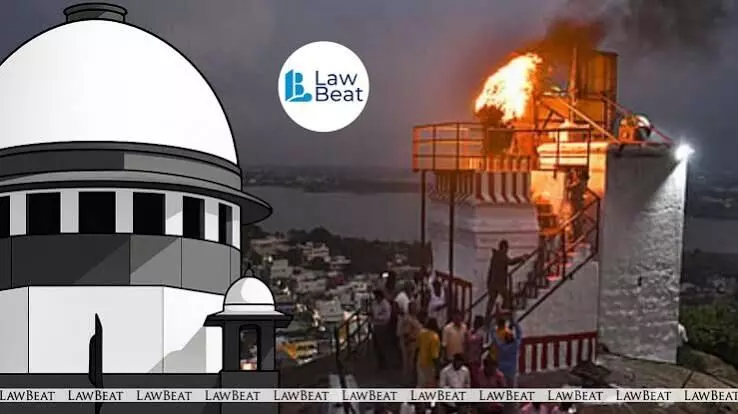
Madurai Collector: Apology to Supreme Court Over Deepam Lighting Failure
Summary
- Madurai Collector Nishant Krishna apologized to the Supreme Court for failing to comply with its November 20 order.
- The order permitted the Karthigai Deepam lighting at the Deepathoon atop Thiruparankundram hill on November 24.
- The Collector stated the temple administration did not authorize the team to light the lamp at the Deepathoon, despite his arrangements.
- Hindu parties filed a fresh plea seeking directions to ensure the lamp is lit at the Deepathoon and accused the State of circumventing the order.
- The Supreme Court declined to initiate *suo motu* contempt proceedings but allowed parties to file a separate petition.
The Apology and Ongoing Dispute
This incident highlights the critical importance for government officials and entities to ensure strict compliance with Supreme Court directives, as failure to do so can lead to apologies before the court and potential contempt proceedings.
The Madurai Collector, Nishant Krishna, recently tendered an apology before the Supreme Court, acknowledging the district administration's failure to comply with a prior judicial directive concerning the Karthigai Deepam lighting at the Deepathoon atop Thiruparankundram hill. This development unfolded on November 25, following the non-execution of the Court's November 20 order, which had permitted the ceremonial lamp to be lit at the disputed stone pillar on November 24. The incident underscores the ongoing "Thiruparankundram Deepam row," a contentious issue that has now led to a formal apology from a senior government official to the nation's highest court.
This "Madurai Collector apology Supreme Court Deepam" issue arose when the lamp, despite the Supreme Court's explicit permission, was not illuminated at the designated Deepathoon. In response, Hindu parties involved in the dispute promptly filed a new application. This fresh plea seeks specific instructions from the Court to ensure the lamp is lit at the Deepathoon, highlighting their continued efforts to enforce the original judicial mandate.
Details of Non-Compliance
During the proceedings before a Bench comprising Justices Aravind Kumar and Vipul M Pancholi, Senior Advocate Gopal Sankaranarayanan, representing Collector Nishant Krishna, informed the Court that the Deepam could not be lit at the Deepathoon on the specified date. A status report submitted by the Collector detailed the efforts made by the district administration to adhere to the Supreme Court's November 20 "Supreme Court Deepathoon order." According to the report, all necessary arrangements were put in place to facilitate the "Karthigai Deepam lighting" at the Deepathoon.
However, the report clarified that the critical hurdle was the temple administration's refusal to authorize the team designated to light the lamp. Instead of complying with the Court's directive, the temple administration opted to follow its established custom of illuminating the lamp at a traditional spot near the Uchipillaiyar Temple. Despite repeated attempts by the Collector to coordinate with local and police authorities, the temple administration never communicated the necessary authorization for personnel to light the lamp at the Deepathoon, leaving the district administration's preparations incomplete solely due to this lack of approval.
Allegations and Contempt Proceedings
Following the Collector's apology, the Hindu parties presented their fresh application, requesting directions for the State and temple authorities to transfer the lamp already burning at the Deepa Mandapam near the Uchipillaiyar Temple to the Deepathoon. Their application proposed either using the existing flame or making new arrangements in line with the Supreme Court's November 20 order. Senior Advocate Guru Krishnakumar, representing these parties, strongly criticized the State, accusing it of employing "strategies and devices" to circumvent the Supreme Court's clear directive.
Krishnakumar further alleged that the State was engaging in "anticipatory mentioning against a blatant breach of the law." The Hindu parties also contended that the State had misled the Madras High Court just a day prior by assuring compliance with the Supreme Court's order. They specifically accused the temple's Board of Trustees of being instrumental in preventing the Deepam from being lit at the Deepathoon and sought the initiation of "contempt proceedings Deepathoon" against the State. While the Supreme Court declined to initiate *suo motu* contempt proceedings, it granted the parties the liberty to file a separate contempt petition, indicating that appropriate orders would be passed once such a petition is submitted. Krishnakumar confirmed that a contempt petition would be filed shortly.
Judicial Authority and Compliance
This incident highlights the critical importance for government officials and entities to ensure strict compliance with Supreme Court directives, as failure to do so can lead to apologies before the court and potential contempt proceedings. The Supreme Court's initial November 20 order had specifically recognized no customary right for the Deepam at the Thirupparankundram Deepathoon, allowing the lighting only for November 24, thereby setting a clear legal precedent for this specific instance. The subsequent non-compliance, despite the Madurai Collector's reported efforts, underscores the complexities that can arise when judicial orders intersect with established local customs and administrative structures.
The Collector's detailed status report, outlining multiple meetings and coordination efforts, serves as a testament to the administrative challenges faced in implementing the order. However, the ultimate outcome—a formal apology to the Supreme Court—reinforces the judiciary's authority and the expectation of unwavering adherence to its pronouncements. Lawyers advising public bodies or religious institutions should emphasize clear internal communication and authorization processes to avoid non-compliance, even when faced with administrative or customary challenges, as demonstrated by this significant "Madurai Collector apology Supreme Court Deepam" case.
Practical Implications
This case highlights the critical importance for government officials and entities to ensure strict compliance with Supreme Court directives, as failure to do so can lead to apologies before the court and potential contempt proceedings. Lawyers advising public bodies or religious institutions should emphasize clear internal communication and authorization processes to avoid non-compliance, even when faced with administrative or customary challenges.
Source
How does this affect you?
Get an AI analysis of this article grounded in your jurisdictions, practice areas, and any policy documents you've uploaded to Wansom.
Finish Reading the Full Story and the Expert Analysis.
Get the latest legal & regulatory intelligence in India
Wansom is AI and can make mistakes.