
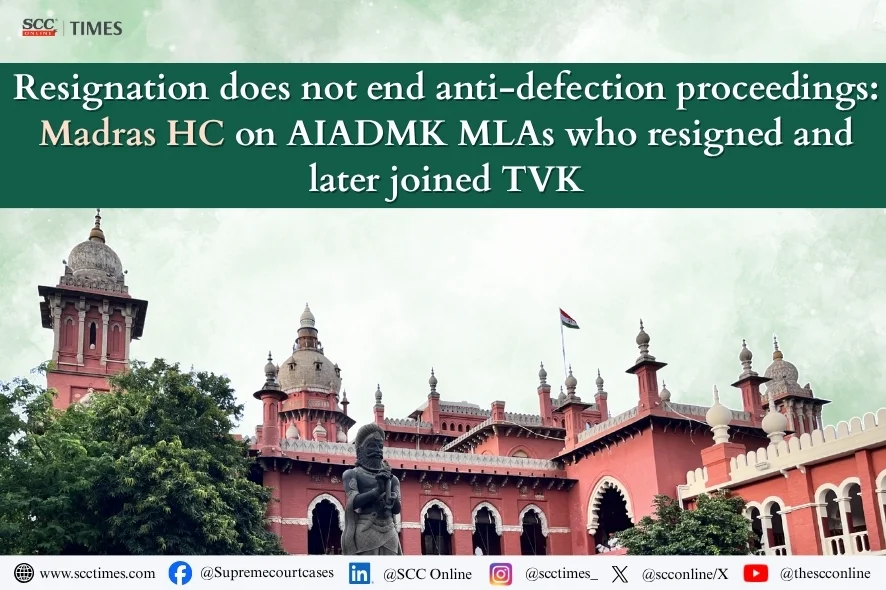
Madras High Court: Resignation Does Not Halt Anti-Defection Proceedings
The Madras High Court ruled that the resignations of six AIADMK MLAs, who had voted against their party whip to support the Chief Minister C. Joseph Vijay’s TVK-led government and subsequently joined TVK, do not extinguish pending disqualification proceedings against them under the Tenth Schedule of the Indian Constitution. This significant judgment clarifies the interplay between resignation and anti-defection law, reinforcing the constitutional scheme.
This ruling carries substantial legal significance for political parties, legislators, and constitutional law practitioners across India. It prevents legislators from circumventing disqualification under the anti-defection law by simply resigning from their seats after engaging in defection. This strengthens the intent of the Tenth Schedule, which aims to curb political defections and ensure party discipline, thereby promoting political stability and integrity in legislative bodies. For the public, it upholds the democratic principle that elected representatives should adhere to the mandate on which they were elected.
The legal context for this decision is the Tenth Schedule to the Indian Constitution, commonly known as the Anti-Defection Law, which was introduced by the 52nd Amendment Act, 1985. This Schedule specifies the grounds for disqualification of a Member of Parliament or a State Legislature, including voluntarily giving up membership of their political party or voting/abstaining from voting contrary to any direction issued by their political party. The Speaker or Chairman of the House is the adjudicating authority for such disqualification petitions. The Madras High Court's decision aligns with the broader judicial trend of interpreting the Tenth Schedule to prevent its circumvention through technicalities.
The key parties involved were the Madras High Court, which delivered the ruling, and the six AIADMK MLAs whose resignations and subsequent actions were at the heart of the matter. Their decision to vote against the party whip and then join the TVK-led government triggered the disqualification proceedings. While the excerpt states the court upheld the acceptance of their resignations, the crucial part of the holding is that these resignations do not terminate the pending disqualification proceedings, implying that the legal consequences of their defection could still be pursued.
Practitioners advising political parties or individual legislators must take note of this clear judicial stance: resignation is not a shield against anti-defection proceedings. Attorneys should counsel their clients that actions leading to potential disqualification under the Tenth Schedule will likely face scrutiny regardless of subsequent resignations. This ruling underscores the need for strict adherence to party directives and the constitutional provisions governing legislative conduct, with significant implications for political strategy and legislative governance.
How does this affect you?
Get an AI analysis of this article grounded in your jurisdictions, practice areas, and any policy documents you've uploaded to Wansom.
Finish Reading the Full Story and the Expert Analysis.
Get the latest legal & regulatory intelligence in India
Wansom is AI and can make mistakes.