
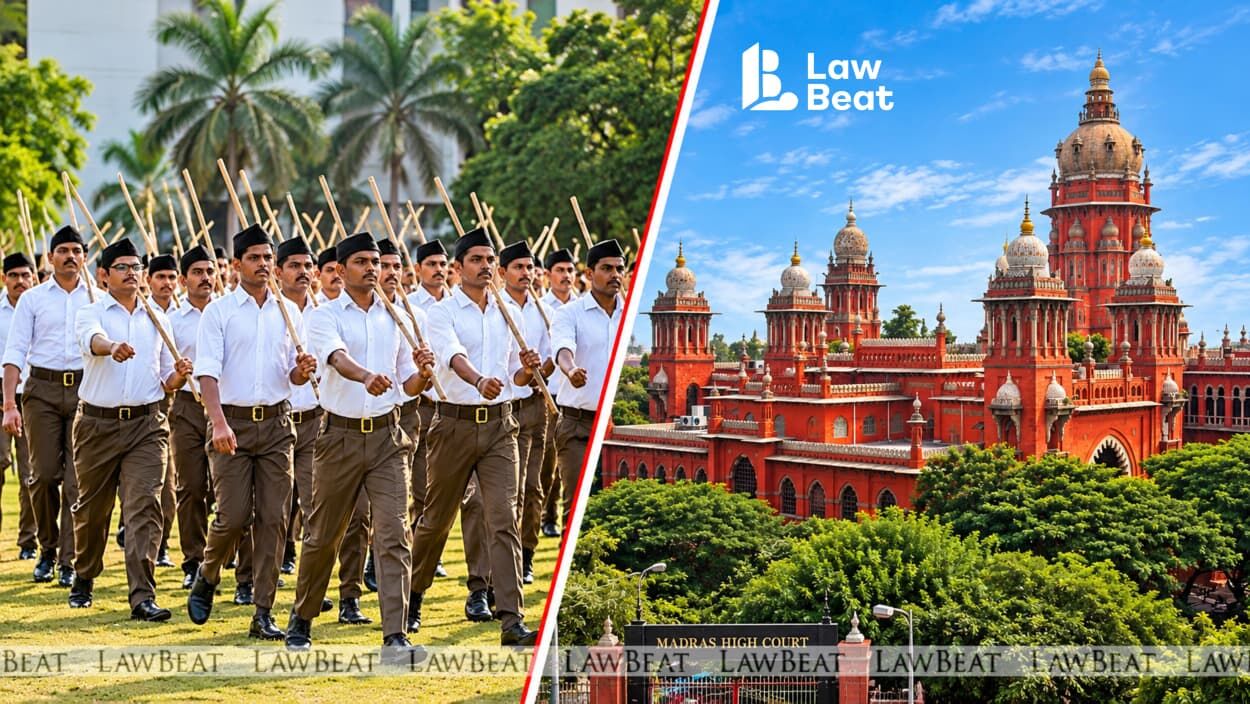
Madras High Court Questions State Over Repeated RSS March Refusals
The Madras High Court, in India, recently questioned the Tamil Nadu government's repeated refusals to permit route marches by the Rashtriya Swayamsevak Sangh (RSS), suggesting a blanket opposition to processions and urging a peaceful resolution.
The Madras High Court, specifically Justice V Lakshminarayanan, expressed strong disapproval of the Tamil Nadu government's consistent refusal to grant permission for route marches by the Rashtriya Swayamsevak Sangh (RSS), forcing the organization into annual litigation. The court was hearing a petition from RSS member VG Jagadeesan, who sought police permission for marches on specific dates. The judge observed that the government appeared to be against any procession, not just those by the RSS, and that such blanket refusals lead to unnecessary litigation, treating citizens seeking to protest "like enemies." The court highlighted that the issue was not limited to one political party, stating, "Whichever government is coming up, they’re rejecting." The court urged both sides to find a peaceful way to hold the procession. The outcome of this matter is not yet reported, as the court has only made observations and sought resolution.
This development is highly significant for the fundamental right to freedom of assembly and expression in India, enshrined under Article 19(1)(b) and (d) of the Constitution. The High Court's strong remarks underscore the judiciary's role in safeguarding these rights against arbitrary state action. For practitioners, it highlights the legal avenues available when administrative permissions for public gatherings are denied without sufficient justification. It also signals judicial impatience with state governments that use blanket prohibitions, potentially forcing a re-evaluation of how permissions for processions and protests are handled, ensuring they are based on specific, justifiable grounds rather than general policy.
The case primarily revolves around Article 19(1)(b) (right to assemble peaceably and without arms) and Article 19(1)(d) (right to move freely throughout the territory of India) of the Constitution of India. These rights are subject to reasonable restrictions under Article 19(3) and (5) in the interest of public order, morality, or the sovereignty and integrity of India. The police's power to grant or deny permission for processions is typically derived from provisions like Section 30 of the Police Act, 1861, or state-specific police acts, which require authorities to regulate assemblies to maintain public order. The High Court's intervention is an exercise of its writ jurisdiction (Article 226 of the Constitution) to enforce fundamental rights. Key parties include the Madras High Court, Justice V Lakshminarayanan, the Tamil Nadu government, the Rashtriya Swayamsevak Sangh (RSS), and VG Jagadeesan.
Attorneys advising organizations or individuals planning public assemblies, protests, or processions in India, particularly in Tamil Nadu, should take note of the Madras High Court's firm stance. This ruling reinforces the principle that administrative authorities cannot issue blanket refusals for such events without specific, justifiable reasons related to public order or safety. Practitioners should be prepared to challenge such arbitrary denials, emphasizing the constitutional right to assembly and the need for proportionate restrictions. It also suggests that courts are increasingly willing to intervene to prevent "avoidable litigation" caused by administrative intransigence.
How does this affect you?
Get an AI analysis of this article grounded in your jurisdictions, practice areas, and any policy documents you've uploaded to Wansom.
Finish Reading the Full Story and the Expert Analysis.
Get the latest legal & regulatory intelligence in India
Wansom is AI and can make mistakes.