
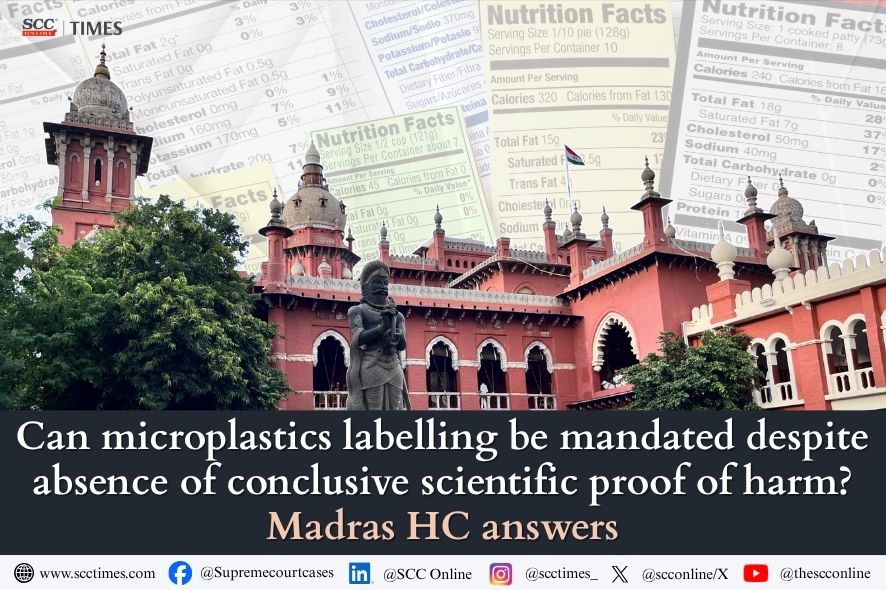
Madras High Court: Microplastics Labelling Mandate Despite Absence of Certainty
Summary
- The Madras High Court examined the validity of directives requiring labels on packaged drinking water, sugar, and salt.
- These labels would disclose the possible presence of micro and nano plastics in the products.
- The court considered scientific uncertainty regarding harm, potential health risks, and consumers' right to informed choices.
- A key question was whether microplastics labelling can be mandated despite the absence of conclusive scientific proof of harm.
The Court's Review of Labelling Directives
The ability to mandate microplastics labelling despite the absence of conclusive scientific proof of harm is a critical point of law.
The Madras High Court recently undertook a significant review concerning directives that would mandate specific labelling on certain consumer products. These directives aimed to require manufacturers of packaged drinking water, sugar, and salt to include disclosures regarding the potential presence of micro and nano plastics within their products. The court's examination focused squarely on the legal and practical validity of these proposed requirements, particularly in light of various complex considerations.
This judicial scrutiny was prompted by a confluence of factors, including growing public and scientific concerns surrounding the pervasive nature of microplastics in the environment and their potential entry into the food chain. The court was tasked with evaluating whether such a mandate for microplastics labelling could be justified, even in the absence of definitive scientific consensus on the precise extent of harm posed by these microscopic particles. The outcome of this examination holds considerable weight for both consumers and industries involved in the production of these widely consumed goods.
Navigating Scientific Uncertainty and Consumer Rights
At the heart of the Madras High Court's deliberation was the intricate balance between scientific uncertainty and the fundamental right of consumers to make informed purchasing decisions. The court acknowledged the ongoing debate within the scientific community regarding the conclusive proof of harm directly attributable to micro/nano plastics in food products. This lack of absolute scientific certainty presented a unique challenge for regulators seeking to implement precautionary measures through mandatory labelling.
Despite the evolving scientific landscape, the court also had to weigh the imperative of consumer awareness. The ability of individuals to choose products based on comprehensive information, including potential contaminants, is a cornerstone of consumer protection. Therefore, the central question became whether the potential health risks, even if not yet fully quantified or conclusively proven, were sufficient grounds to compel manufacturers to disclose the possible presence of micro/nano plastics on product packaging for items like packaged drinking water, sugar, and salt.
Broader Implications for Regulatory Policy
The Madras High Court's decision on the enforceability of microplastics labelling carries substantial implications for future regulatory frameworks, particularly in areas where environmental and health concerns intersect with scientific ambiguity. The ruling provides guidance on how judicial bodies might approach mandates for disclosure when definitive scientific proof of harm is still under investigation. It sets a precedent for how the principle of precaution can be applied in the context of consumer product information.
This case highlights the ongoing tension between industry interests, which often seek clear scientific evidence before implementing costly labelling changes, and public health advocates, who prioritize the consumer's right to know about potential risks. The court's examination of these directives for packaged drinking water, sugar, and salt underscores the complex legal landscape surrounding emerging contaminants and the challenges in formulating effective policy responses that are both scientifically sound and protective of public interest. The ability to mandate microplastics labelling despite the absence of conclusive scientific proof of harm is a critical point of law.
Source
Source: Original reporting via SCC Times
How does this affect you?
Get an AI analysis of this article grounded in your jurisdictions, practice areas, and any policy documents you've uploaded to Wansom.
Finish Reading the Full Story and the Expert Analysis.
Get the latest legal & regulatory intelligence in India
Wansom is AI and can make mistakes.