
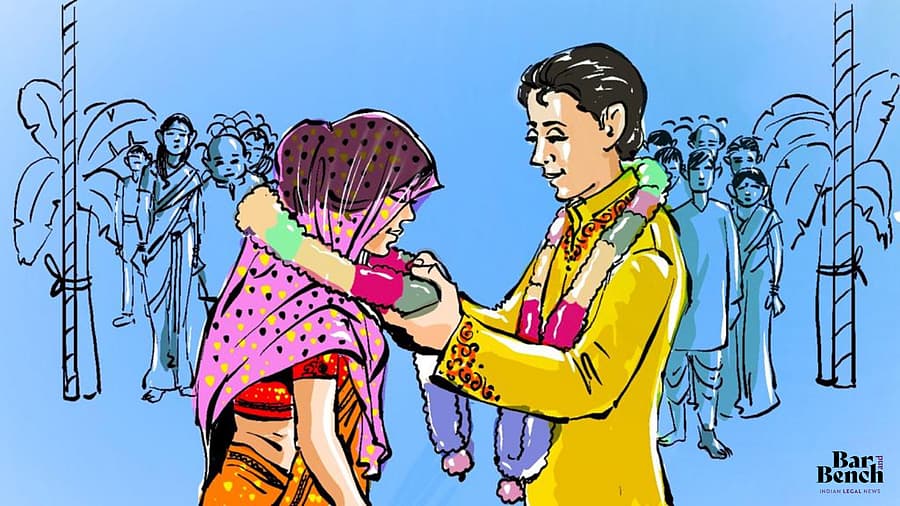
Madras High Court: Hindu Christian Marriage Cannot Be Registered Under Hindu Marriage Act
Summary
- The Madras High Court recently ruled that a marriage between a Hindu and a Christian cannot be registered under the Hindu Marriage Act, 1955.
- This Act is exclusively applicable to marriages between two individuals who are Hindus.
- The ruling stemmed from an appeal in the case of Naveen Kumar Vs Vigneshwari, where a man sought to invalidate his marriage.
- The High Court found that the man was Christian at the time of registration and that no marriage ceremony had occurred.
- Registration under Section 8 of the Act cannot validate a marriage that fails to meet the conditions of Section 5.
Case Background
The judges emphasized that a combined reading of Section 5 and Section 8 of the Hindu Marriage Act makes it abundantly clear that a union between a Hindu and a person adhering to a different religion cannot be recognized or validated simply through registration under the Act.
The Madras High Court recently addressed the validity of a marriage between individuals of different faiths, specifically a Hindu and a Christian, under the Hindu Marriage Act, 1955. This significant ruling emerged from an appeal initiated by a man seeking to annul a marriage that was registered in February 2009. The man contended that he had been deceived by the woman, alleging she led him to the registrar's office under the pretense of signing as a witness for a different marriage. Conversely, the woman maintained that their marriage had been solemnized with his full consent, refuting his claims of misdirection.
Initially, a family court had dismissed the man's legal challenge in 2019. This dismissal was based on the family court's disbelief of his assertion that he was a Christian at the time of the marriage. However, the High Court undertook a more thorough review of the evidence. Upon examining baptism certificates issued in 1998 and 2006, the High Court concluded that the man was indeed a Christian when the marriage was recorded. Furthermore, the court's bench discovered that, contrary to what was stated on the marriage certificate, no actual marriage ceremony had taken place prior to the registration. These factual findings were crucial to the subsequent legal determination regarding the Madras High Court Hindu Christian marriage registration.
Legal Framework and Ruling
A Division Bench of the Madras High Court, comprising Justices CV Karthikeyan and S Raveekumar, delivered a definitive judgment regarding the applicability of the Hindu Marriage Act, 1955, to interfaith marriage. The court unequivocally stated that a marriage involving a Hindu and a Christian cannot be solemnized or registered under this particular legislation. The fundamental reason for this stance is that the Hindu Marriage Act is specifically designed to govern marriages exclusively between two individuals who are Hindus.
The court's decision clarified that merely registering a marriage under Section 8 of the Hindu Marriage Act cannot confer validity if the marriage itself fails to meet the essential conditions stipulated in Section 5 of the same Act. The judges emphasized that a combined reading of Section 5 and Section 8 of the Hindu Marriage Act makes it abundantly clear that a union between a Hindu and a person adhering to a different religion cannot be recognized or validated simply through registration under the Act. This interpretation directly impacts the Hindu Christian marriage validity India when attempted under this specific legal framework. The ruling in Naveen Kumar Vs Vigneshwari thus sets a clear precedent for Madras High Court Section 5 Hindu Marriage Act interpretations.
Implications for Interfaith Unions
This recent pronouncement by the Madras High Court carries significant implications for individuals considering interfaith marriage in India, particularly those involving a Hindu and a Christian. The judgment underscores that the Hindu Marriage Act, 1955, is not the appropriate legal avenue for registration inter-religious marriage when one party is not Hindu. The court's finding that a marriage certificate cannot override the absence of a proper ceremony or the religious disqualification under the Act highlights the stringent requirements for legal recognition.
The outcome of Naveen Kumar Vs Vigneshwari serves as a critical reminder that while registration provides legal proof of marriage, it cannot legitimize a union that fundamentally does not comply with the statutory prerequisites of the specific law under which it is registered. For Hindu Christian marriage validity India, couples must ensure their union is solemnized and registered under alternative legislation, such as the Special Marriage Act, 1954, which is designed for inter-religious unions. This ruling reinforces the necessity for legal practitioners to guide clients accurately through the complexities of Indian marriage laws to ensure their marital status is legally sound and protected against future challenges.
Practical Implications
Lawyers advising clients on interfaith marriages, particularly between a Hindu and a Christian in India, must be aware that registration under the Hindu Marriage Act, 1955, is invalid. They should ensure such marriages are solemnized and registered under the appropriate legislation, such as the Special Marriage Act, to avoid future legal challenges regarding the marriage's validity and to ensure proper legal standing for their clients.
Source
Source: Based on recent court reporting.
How does this affect you?
Get an AI analysis of this article grounded in your jurisdictions, practice areas, and any policy documents you've uploaded to Wansom.
Finish Reading the Full Story and the Expert Analysis.
Get the latest legal & regulatory intelligence in India
Wansom is AI and can make mistakes.