
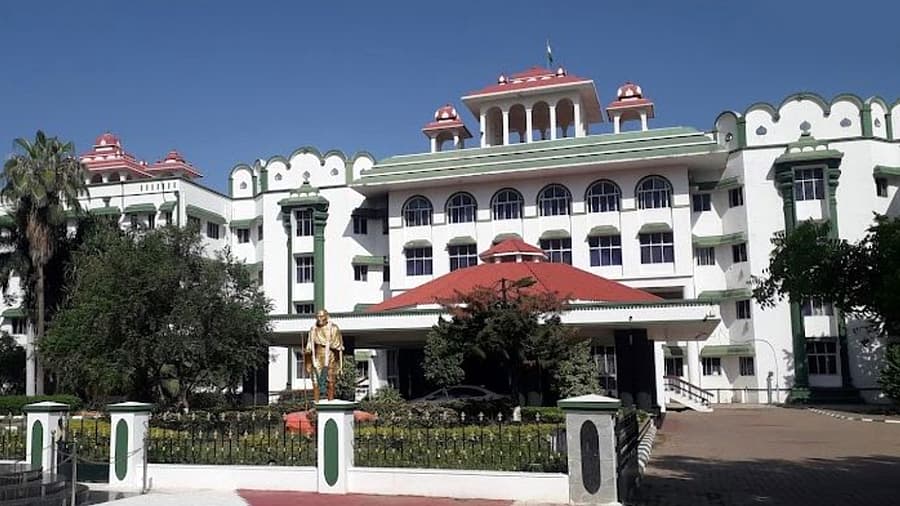
Madras High Court: Court Fee Refund for Non-Maintainable Appeals
Summary
- The Madras High Court ruled that court fees should be refunded to litigants whose cases are found to be non-maintainable.
- This decision is based on the principle that litigants are "consumers of justice" and receive no service if their case cannot be heard.
- The ruling stemmed from the `Murugavel v Pichai` case, where an appeal against an arbitral award was incorrectly filed under Section 37 instead of Section 34 of the Arbitration Act.
- Justices GR Swaminathan and KK Ramakrishnan stated that a "failure of consideration" occurs when a case is dismissed for lack of maintainability.
- This sets a precedent for court fee refunds when cases are dismissed due to jurisdictional errors or incorrect procedural filings.
What Happened
This ruling by the Madras High Court carries significant implications for litigants across India, particularly concerning the recovery of costs associated with legal proceedings that are ultimately dismissed on technical grounds.
The Madras High Court recently issued a significant observation regarding the refund of court fees, asserting that individuals approaching the judiciary are akin to "consumers of justice." This pronouncement came in the context of a case where an appeal was deemed non-maintainable, leading the court to conclude that a refund of the paid fees was warranted.
The specific matter, `Murugavel v Pichai`, involved an appeal filed by J. Murugavel challenging an arbitral award issued in October 2024. Murugavel had directly approached the High Court under Section 37 of the Arbitration and Conciliation Act, 1996. However, the court clarified that this particular section is designated for appeals against specific orders, not for a direct challenge to a final arbitral award.
The appropriate legal avenue for contesting a final arbitral award, as highlighted by the court, is through a petition filed under Section 34 of the same Act. Consequently, the High Court determined that Murugavel's appeal was procedurally flawed and therefore not maintainable. The bench, comprising Justices GR Swaminathan and KK Ramakrishnan, noted with some concern that the appeal had not only been filed incorrectly but had also been formally numbered, despite its inherent lack of maintainability. The appeal was subsequently closed on these grounds.
Legal Rationale for Refund
Central to the Madras High Court's decision on the refund of court fees was the principle that a litigant who cannot have their case heard due to non-maintainability has not received the judicial service for which the fee was paid. The court drew upon the insights of jurist Upendra Baxi, who characterized litigants as "consumers of justice," emphasizing their expectation of adjudication when they approach the courts.
Justices Swaminathan and Ramakrishnan articulated that if a matter cannot proceed to adjudication because it was fundamentally non-maintainable from the outset, the litigant has effectively received no service. This scenario, they explained, constitutes a "failure of consideration," thereby establishing a clear basis for the refund of the court fees. The court underscored that when a party mistakenly files a case in a forum lacking the requisite jurisdiction, they are deprived of the intended judicial process.
This perspective positions court fees not merely as a revenue generation tool but as payment for a service – the adjudication of a dispute. When that service cannot be rendered due to a procedural or jurisdictional impediment, the contractual understanding between the litigant and the justice system is broken, justifying the return of the funds. The ruling thus reinforces the idea of consumer protection within the judicial framework, particularly concerning the Madras High Court court fee refund non-maintainable principle.
Implications for Litigants and the Justice System
This ruling by the Madras High Court carries significant implications for litigants across India, particularly concerning the recovery of costs associated with legal proceedings that are ultimately dismissed on technical grounds. It establishes a precedent that court fees should be returned to individuals whose cases are found to be non-maintainable, especially when such a determination arises from jurisdictional errors or incorrect procedural filings, such as challenging an arbitration award under the wrong section. The `Murugavel v Pichai` court fee case now serves as a key reference point for this principle.
The decision underscores a commitment to litigant consumer justice in Madras and beyond, suggesting that individuals should not bear the financial burden of court fees when the judicial system cannot, for fundamental reasons, provide the intended service of adjudication. This could influence future practices regarding the court fee refund lack jurisdiction India-wide, encouraging a more equitable approach to legal costs. The specific context of the Section 37 Arbitration Act refund highlights the importance of correct procedural adherence when appealing arbitration awards, while also offering a safety net for those who err.
By affirming the right to a refund in such circumstances, the High Court's stance could encourage greater scrutiny of case maintainability at earlier stages and provide a measure of financial relief to parties who, through no fault of their own in terms of the merits of their claim, find their cases dismissed on procedural grounds. This ruling contributes to a broader understanding of fairness in the administration of justice, ensuring that the financial barrier of court fees does not become an unrecoverable loss when the judicial process itself cannot be engaged. The maintainability of an arbitration award appeal is now directly linked to the potential for court fee refunds.
Practical Implications
Lawyers should advise clients that court fees may be refundable if a case is dismissed for non-maintainability, especially due to jurisdictional errors or incorrect procedural filings (e.g., challenging an arbitral award under the wrong section). This ruling provides a precedent for seeking such refunds, potentially impacting litigation cost recovery strategies.
Source
How does this affect you?
Get an AI analysis of this article grounded in your jurisdictions, practice areas, and any policy documents you've uploaded to Wansom.
Wansom is AI and can make mistakes.