
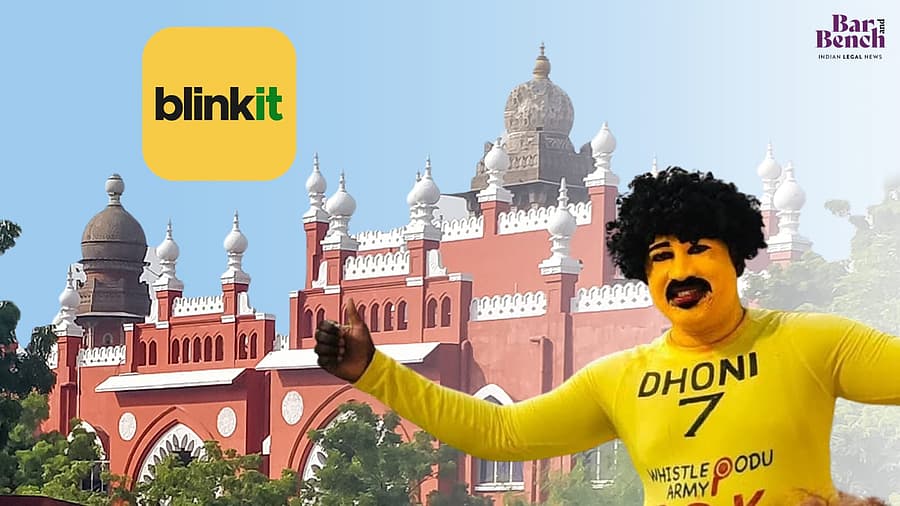
Madras High Court: Injunction on Blinkit for Saravanan Hari Persona Use
Summary
- The Madras High Court issued an interim injunction against Blinkit and The Times of India for using Saravanan Hari’s persona without consent.
- Justice PB Balaji ordered the preservation of all advertisement-related materials, including artwork and correspondence.
- Saravanan Hari is seeking ₹1.1 crore in damages for the alleged unauthorized commercial exploitation of his distinctive appearance.
- The dispute centers on a Blinkit advertisement from March 23, 2025, featuring a cartoon resembling Hari's yellow-painted, 'THALA 7' superfan look.
- Hari claims he developed his publicly recognizable 'superfan' persona around 2013.
Court Issues Injunction Against Blinkit and Times of India
Lawyers must advise clients engaged in advertising and marketing to obtain explicit written consent before using any identifiable individual's likeness, image, or persona.
The Madras High Court has issued an interim injunction, preventing Blinkit, The Times of India, and other unidentified parties from utilizing the distinctive persona of Chennai Super Kings superfan Saravanan Hari without his explicit written consent. Justice PB Balaji, presiding over the case, granted this interim relief in response to a personality rights lawsuit initiated by Saravanan Hari. The legal action specifically targets the alleged unauthorized use of a cartoon figure by Blinkit, which Hari claims bears a striking resemblance to him.
In addition to the injunction, the Court mandated that Blink Commerce Private Limited and Bennett, Coleman & Company Limited, the publisher of The Times of India, must preserve and produce all relevant materials pertaining to the disputed advertisement. This includes artwork, design records, emails, and any correspondence exchanged with designers or external vendors involved in its creation. This directive underscores the court's intent to thoroughly examine the origins and development of the contested imagery.
The Persona at the Heart of the Dispute
Saravanan Hari is seeking damages totaling ₹1.1 crore, alleging the unauthorized commercial exploitation of his unique public appearance. The core of the dispute revolves around a full-page advertisement for Blinkit, which appeared in the Chennai edition of The Sunday Times of India on March 23, 2025. The advertisement, featuring the slogan “The men in yellow always deliver,” incorporated various cricket-themed illustrations and promoted a voucher offer for match tickets.
A specific element of the advertisement, located in the bottom right corner, depicted a cartoon of a cricket fan. This figure was painted yellow, sported curly hair and a moustache, had the words “THALA 7” emblazoned on its torso, and was shown making a thumbs-up gesture. Saravanan Hari contends that this illustration directly reproduced the distinctive combination of features through which he has become widely recognized by the public. According to his legal submission, he cultivated this "superfan" appearance, which is now central to his public identity, around the year 2013.
Reinforcing Personality Rights in India
This ruling by the Madras High Court underscores the increasing enforcement of personality rights in India, particularly for public figures or individuals who have cultivated a distinctive public persona. The decision by Justice PB Balaji highlights the judiciary's commitment to protecting an individual's right to control the commercial use of their identity, even when presented in a caricatured form. This case, involving the Madras High Court Blinkit Saravanan Hari persona, serves as a significant precedent for future disputes concerning unauthorized commercial exploitation.
Lawyers must advise clients engaged in advertising and marketing to obtain explicit written consent before using any identifiable individual's likeness, image, or persona. This is crucial to avoid potential lawsuits for unauthorized commercial exploitation, regardless of whether the depiction is a direct photograph or a stylized illustration. Compliance officers, in particular, should meticulously review all advertising materials to ensure that no personality rights are infringed, thereby mitigating legal risks for their organizations.
Practical Implications
This ruling underscores the increasing enforcement of personality rights in India, particularly for public figures or individuals with distinctive public personas. Lawyers must advise clients in advertising and marketing to obtain explicit written consent before using any identifiable individual's likeness, even in caricatured form, to avoid potential lawsuits for unauthorized commercial exploitation. Compliance officers should review advertising materials to ensure no personality rights are infringed.
Source
How does this affect you?
Get an AI analysis of this article grounded in your jurisdictions, practice areas, and any policy documents you've uploaded to Wansom.
Finish Reading the Full Story and the Expert Analysis.
Get the latest legal & regulatory intelligence in India
Wansom is AI and can make mistakes.