
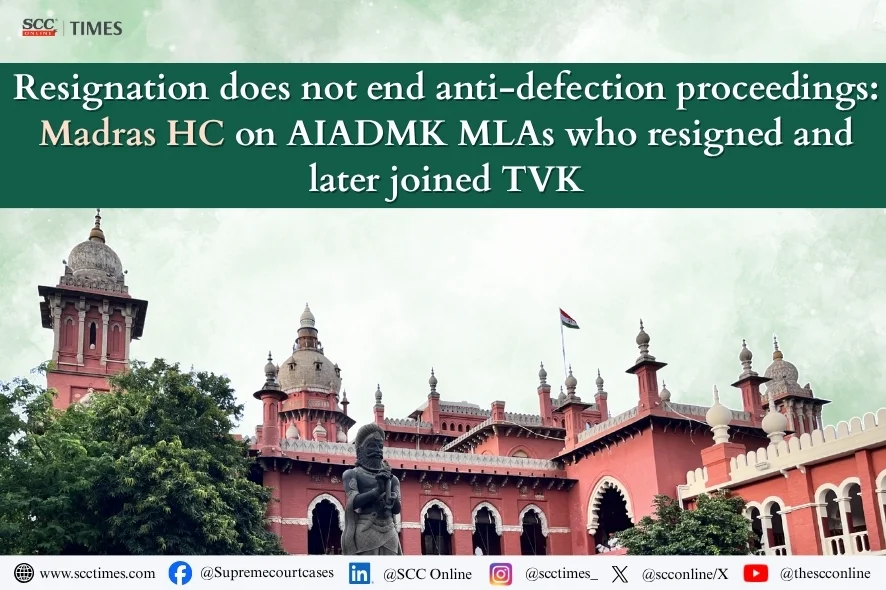
Madras HC: Anti-Defection Resignation No Halt for AIADMK MLAs
Summary
- The Madras High Court upheld the acceptance of resignations from six AIADMK MLAs.
- These MLAs had voted against their party's whip to support Chief Minister C. Joseph Vijay's TVK-led government and subsequently joined TVK.
- The court explicitly ruled that these resignations do not end pending disqualification proceedings under the Tenth Schedule.
- This decision clarifies that legislators cannot evade anti-defection penalties by simply resigning from their posts.
Judicial Precedent on Defection
The court explicitly ruled that these resignations do not end pending disqualification proceedings under the Tenth Schedule, thereby reinforcing the stringent nature of India's anti-defection law.
The Madras High Court has issued a significant ruling concerning the political actions of six members of the All India Anna Dravida Munnetra Kazhagam (AIADMK) party. These legislators had previously cast their votes in opposition to their party's official directive, choosing instead to lend their support to the government led by Chief Minister C. Joseph Vijay and his TVK party. Following this act of defiance, the six AIADMK MLAs subsequently transitioned their allegiance and joined the TVK. The High Court's recent decision specifically upheld the validity of their resignations from their legislative posts.
Crucially, while affirming the acceptance of these resignations, the Madras High Court made a definitive pronouncement regarding the legal consequences of their earlier actions. The court explicitly ruled that these resignations do not end pending disqualification proceedings under the Tenth Schedule, thereby reinforcing the stringent nature of India's anti-defection law. This ruling establishes a vital precedent concerning the interplay between a legislator's resignation and the anti-defection framework.
Understanding India's Anti-Defection Law
The Tenth Schedule of the Indian Constitution, widely recognized as the anti-defection law, was enacted with the primary objective of preventing political defections and ensuring greater stability within legislative bodies. This legal framework outlines specific conditions under which a Member of Parliament or a Member of a State Legislature can be disqualified from their membership. Key provisions include disqualification for voluntarily giving up membership of their political party or for voting or abstaining from voting in the House contrary to any direction issued by their political party, without prior permission.
Disqualification proceedings under this law are typically initiated when a legislator's conduct, such as voting against a party whip, is brought to the attention of the Speaker or Chairman of the respective house. The law aims to curb opportunistic floor-crossing and uphold the mandate given by the electorate to political parties. The recent decision by the Madras High Court directly addresses a critical aspect of these Tenth Schedule disqualification proceedings, specifically the resignation effect on disqualification, by clarifying that resignation does not automatically absolve a legislator of past actions that could lead to disqualification.
Implications for Legislative Conduct
The Madras High Court's judgment carries substantial weight for the future conduct of legislators and the enforcement of party discipline across India. By ruling that the resignations of the 6 AIADMK MLAs do not extinguish pending disqualification proceedings, the court has effectively closed a potential loophole that legislators might have exploited to circumvent the penalties prescribed by the anti-defection law. This reinforces the principle that accountability for defying party directives or defecting to another party remains, irrespective of a subsequent resignation.
This significant ruling from the Madras High Court on political defection underscores the judiciary's commitment to upholding the integrity of the legislative process. It sends a clear message that the act of resigning, while valid for ending one's tenure, does not erase the legal consequences of actions taken while still a member of the house and a political party. The AIADMK MLAs disqualification ruling thus serves as a critical interpretation of the India anti-defection law resignation provisions.
The court's decision ensures that the spirit of the anti-defection law, designed to prevent political instability caused by frequent party switching, is maintained. Legislators, and the political parties they represent, must now contend with the understanding that a strategic resignation may not be a viable escape route from the repercussions of violating party whips or engaging in defection. The judgment reinforces the notion that the process of disqualification is a distinct legal mechanism intended to address breaches of party loyalty and legislative conduct.
Practical Implications
Lawyers advising political parties or legislators must note that resignation does not automatically terminate ongoing or impending disqualification proceedings under the Tenth Schedule, requiring a more nuanced strategy for managing political defections and party discipline.
Source
Source: Original reporting via SCC Times
How does this affect you?
Get an AI analysis of this article grounded in your jurisdictions, practice areas, and any policy documents you've uploaded to Wansom.
Finish Reading the Full Story and the Expert Analysis.
Get the latest legal & regulatory intelligence in India
Wansom is AI and can make mistakes.