
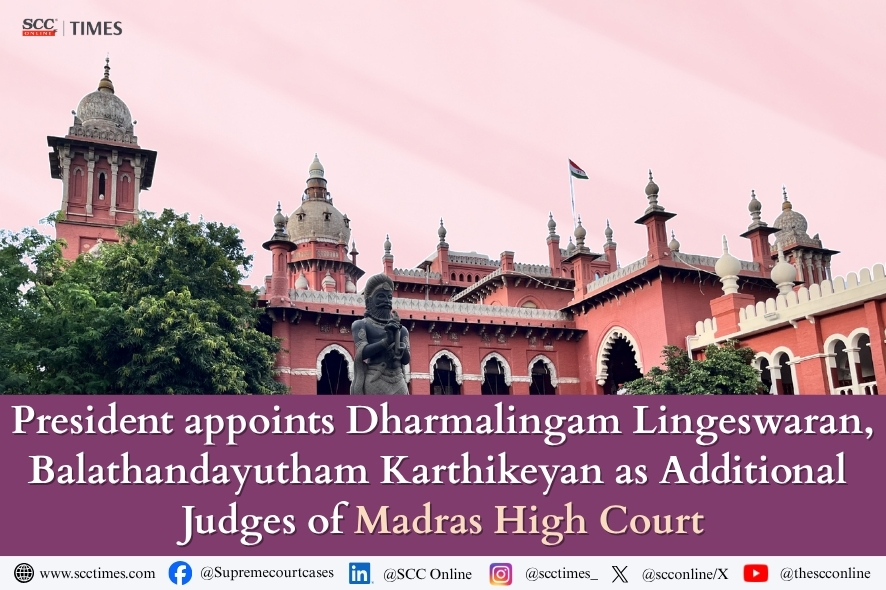
Madras High Court: Lingeswaran, Karthikeyan Additional Judge Appointment
Summary
- Dharmalingam Lingeswaran has been appointed as an Additional Judge to the Madras High Court.
- Balathandayutham Karthikeyan has also received an appointment as an Additional Judge for the same court.
- These appointments were made by the President of India.
- Both judges will serve a term of two years in their new roles.
- The appointments are in accordance with Article 224(1) of the Constitution of India.
What Happened
Lawyers practicing within the Madras High Court should note the appointment of these two new Additional Judges, as their presence will impact the composition of benches, case assignments, and potentially courtroom dynamics and judicial approaches within the court.
The Madras High Court has recently seen the significant appointment of two new judicial officers, Dharmalingam Lingeswaran and Balathandayutham Karthikeyan. These distinguished individuals have been officially designated as Additional Judges, a move that will bolster the court's judicial strength and capacity. The formal announcement confirms their roles, marking a notable development in the composition of one of India's prominent high courts. This Dharmalingam Lingeswaran Balathandayutham Karthikeyan Madras High Court appointment is a key event for the legal community.
The appointments were formally enacted by the President of India, underscoring the constitutional authority involved in such judicial selections. Both Dharmalingam Lingeswaran and Balathandayutham Karthikeyan are slated to serve in their new capacities for a fixed term of two years. This specific tenure for Madras High Court additional judges is a standard practice for such appointments, designed to address temporary increases in judicial workload or to assess suitability for permanent roles.
Legal Context of Appointments
The legal framework governing these judicial appointments is rooted deeply within the Constitution of India, specifically under Article 224(1). This particular article empowers the President to appoint Additional Judges to a High Court for a period not exceeding two years when it appears that, by reason of any temporary increase in the business of the High Court or by reason of arrears of work therein, the number of the Judges of that Court should be for the time being increased. This mechanism is crucial for maintaining the efficiency and timely dispensation of justice across the Indian judiciary.
The Presidential appointment under Article 224(1) India highlights the executive's role in the judicial appointment process, albeit typically following recommendations from the collegium system. Such appointments are vital for managing the caseloads of High Courts, which often face significant backlogs. The selection of individuals like Dharmalingam Lingeswaran and Balathandayutham Karthikeyan as new judges Madras High Court through this constitutional provision ensures that the court can continue to function effectively and address the legal needs of the region.
Why It Matters
The induction of Dharmalingam Lingeswaran and Balathandayutham Karthikeyan as Additional Judges carries considerable significance for the Madras High Court and its practitioners. Their presence will directly influence the court's operational dynamics, including the formation of benches and the allocation of cases. Lawyers practicing within the Madras High Court should note the appointment of these two new Additional Judges, as their presence will impact the composition of benches, case assignments, and potentially courtroom dynamics and judicial approaches within the court. This expansion of the judicial roster is expected to contribute to a more efficient processing of legal matters, potentially reducing delays and enhancing access to justice for litigants.
These Indian judiciary appointments are not merely procedural; they represent an infusion of new perspectives and judicial experience into the court. The addition of two more judges means a greater capacity to hear and decide cases, which can alleviate the burden on existing judges and potentially streamline the judicial process. For legal professionals, understanding the backgrounds and judicial philosophies of these new judges Madras High Court will be crucial for strategizing their cases and adapting to any evolving courtroom practices. The two-year term, while temporary, provides a vital period for these judges to contribute significantly to the court's functioning.
Practical Implications
Lawyers practicing in the Madras High Court should note the appointment of these two new Additional Judges, as their presence will impact the composition of benches, case assignments, and potentially courtroom dynamics and judicial approaches within the court.
Source
Source: Original reporting via SCC Times
How does this affect you?
Get an AI analysis of this article grounded in your jurisdictions, practice areas, and any policy documents you've uploaded to Wansom.
Finish Reading the Full Story and the Expert Analysis.
Get the latest legal & regulatory intelligence in India
Wansom is AI and can make mistakes.