
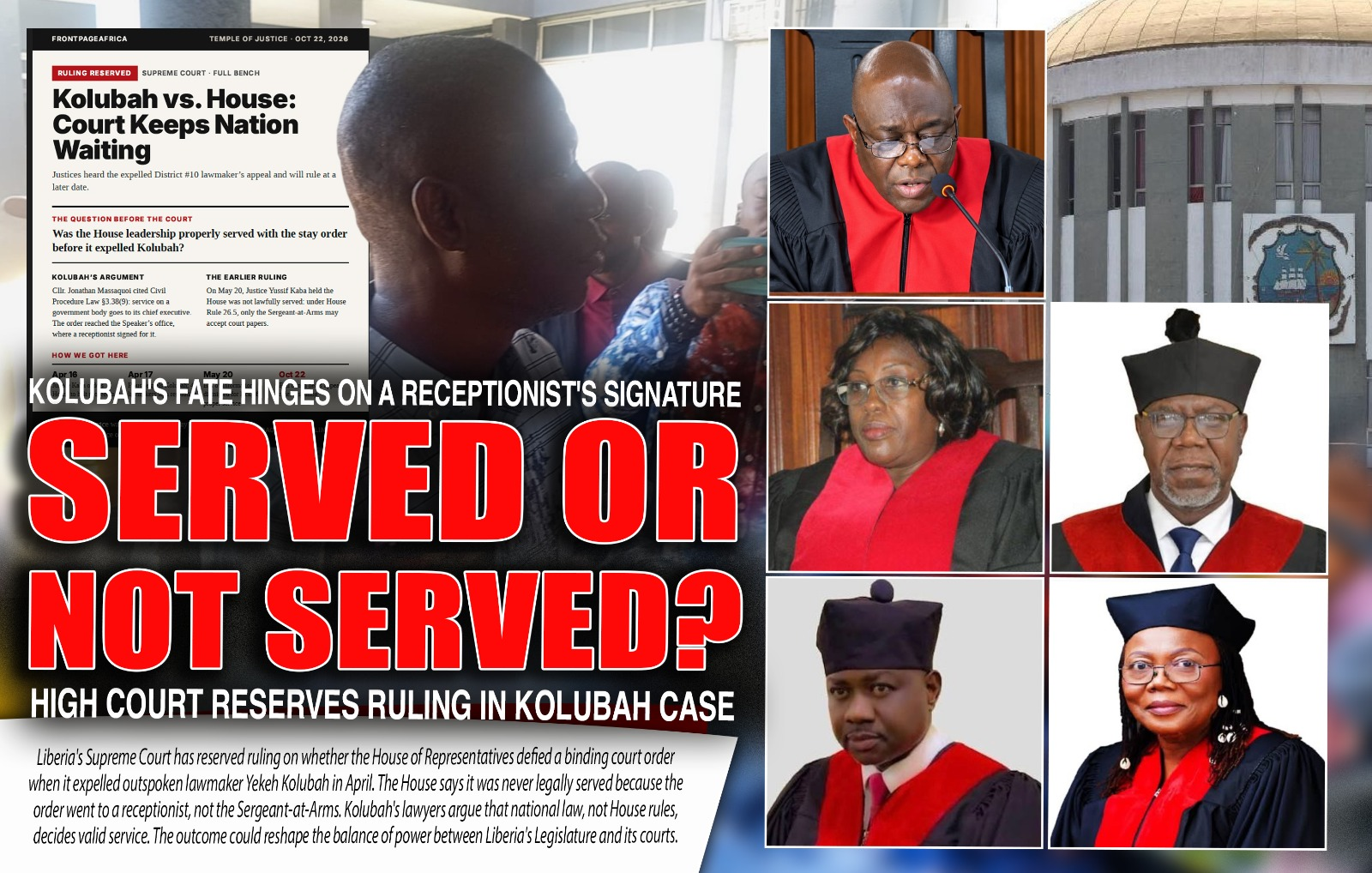
Liberia Supreme Court: Yekeh Kolubah Expulsion Defiance Case Heard
Summary
- Liberia's Supreme Court heard arguments on October 22, 2026, in the case deliberating whether the House of Representatives defied a court order by expelling former lawmaker Yekeh Kolubah in April, with a ruling still pending.
- The central legal question is whether the House was properly served with a Supreme Court writ of prohibition to halt proceedings against Kolubah.
- Kolubah's lawyers argue service to the Speaker's office was valid under Liberia's Civil Procedure Law, while the House cites its internal rule requiring service to the Sergeant-at-Arms.
- Associate Justice Yussif Kaba initially dismissed Kolubah's follow-up complaint, finding the House was not properly served, a decision now appealed to the full bench.
- The Supreme Court's ruling will clarify the precise requirements for serving court orders on the legislative branch, setting a crucial precedent for inter-branch legal challenges.
The Expulsion and Initial Court Intervention
This decision will define the precise requirements for serving court orders on the legislative branch, establishing a critical precedent for future inter-branch legal challenges and compliance with judicial directives.
Liberia's Supreme Court heard arguments on October 22, 2026, in a pivotal case that will determine whether the nation's House of Representatives acted in defiance of a judicial order when it expelled Yekeh Kolubah, a prominent lawmaker, in April, with a ruling still pending.
Mr. Kolubah, who formerly represented District 10 of Montserrado County, including the capital city of Monrovia, was known for his outspoken nature within the Legislature. Disciplinary action against him commenced following a controversial statement he made concerning the Makona River boundary dispute, which many perceived as provocative. He received formal notification on April 9, 2026, to appear before the House Committee on Rules, Order and Administration on April 13. After his legal team walked out of a subsequent committee hearing, protesting the denial of a five-day extension and access to evidence, they sought a writ of prohibition from the Supreme Court.
Associate Justice Yussif D. Kaba granted this petition on April 16, issuing an order that summoned House leaders to a conference scheduled for April 20 and mandated a stay on all further proceedings until its outcome. This directive was specifically addressed to Speaker Richard Nagbe Koon, Deputy Speaker Thomas Fallah, the House Chief Clerk, the Sergeant-at-Arms, and all individuals acting under their authority. Despite this judicial intervention, the full House proceeded with Mr. Kolubah's expulsion on April 17, with 49 of the 73 members signing a resolution, thereby meeting the constitutionally required two-thirds majority. The stated reasons for his removal were
The Core Legal Question: Service of Process
The crux of the legal dispute lies in whether the Supreme Court's order was validly served on the House of Representatives. The House maintains it was never properly served, citing its internal Rule 26.5, which stipulates that the Sergeant-at-Arms is the sole officer authorized to receive court orders on its behalf. However, court records indicate that the Supreme Court Marshal delivered the documents to a receptionist and a computer operator working in the offices of the Speaker and the Chief Clerk.
This argument regarding improper service has previously found success. In May 2026, Justice Kaba dismissed a follow-up complaint filed by Mr. Kolubah, known as a bill of information, on the grounds of improper service, concluding that the House had not been duly served with the writ and stay order. Mr. Kolubah subsequently appealed this decision to the full five-member bench of the Supreme Court, which heard arguments on the matter.
Jonathan Massaquoi, leading Mr. Kolubah's legal team, contended before the justices that the validity of service should be assessed under Liberia's Civil Procedure Law, rather than the House's internal regulations for handling correspondence. He specifically referenced Section 3.38(9) of the Civil Procedure Law, which states: "Personal service upon a subdivision of the government subject to suit or upon a municipal corporation shall be made by reading and delivering the summons to the chief executive thereof." Based on this provision, the petitioners argued that delivering the order to the Speaker's office, given his role as the House's presiding officer, constituted sufficient service. They noted that a court officer identified as Joshua B. delivered the document there, and a receptionist acknowledged receipt by signing for a copy. An unresolved question for the Court is whether this particular section of the law, which refers to a "subdivision of the government subject to suit" or a "municipal corporation," is applicable to a branch of the national Legislature.
Implications for Judicial Authority and Inter-Branch Relations
The Supreme Court's forthcoming judgment holds significant implications for the balance of power between Liberia's judicial and legislative branches. The ruling will provide much-needed clarity on the precise requirements for valid service of court orders on the House of Representatives, thereby establishing a critical precedent for future inter-branch legal challenges and ensuring compliance with judicial directives. This decision will determine the extent to which internal legislative rules can supersede or define the parameters of judicial authority.
The justices are tasked with a careful examination of several factors, including the specific wording of the original stay order, the Supreme Court Marshal's official report of service, the acknowledgment signed by the receptionist, and the legal standing of the office that received the documents. The outcome will not only resolve the immediate dispute surrounding Yekeh Kolubah's expulsion but will also profoundly shape the framework for the enforcement of judicial authority and the operational dynamics of the separation of powers within Liberia's governance structure. Lawyers in Liberia should monitor this Supreme Court judgment closely as it will clarify the precise requirements for valid service of court orders on the House of Representatives, establishing a critical precedent for inter-branch legal challenges and compliance with judicial directives.
Practical Implications
Lawyers in Liberia should monitor this Supreme Court judgment closely as it will clarify the precise requirements for valid service of court orders on the House of Representatives, establishing a critical precedent for inter-branch legal challenges and compliance with judicial directives.
Source
How does this affect you?
Get an AI analysis of this article grounded in your jurisdictions, practice areas, and any policy documents you've uploaded to Wansom.
Finish Reading the Full Story and the Expert Analysis.
Get the latest legal & regulatory intelligence in Liberia
Wansom is AI and can make mistakes.