
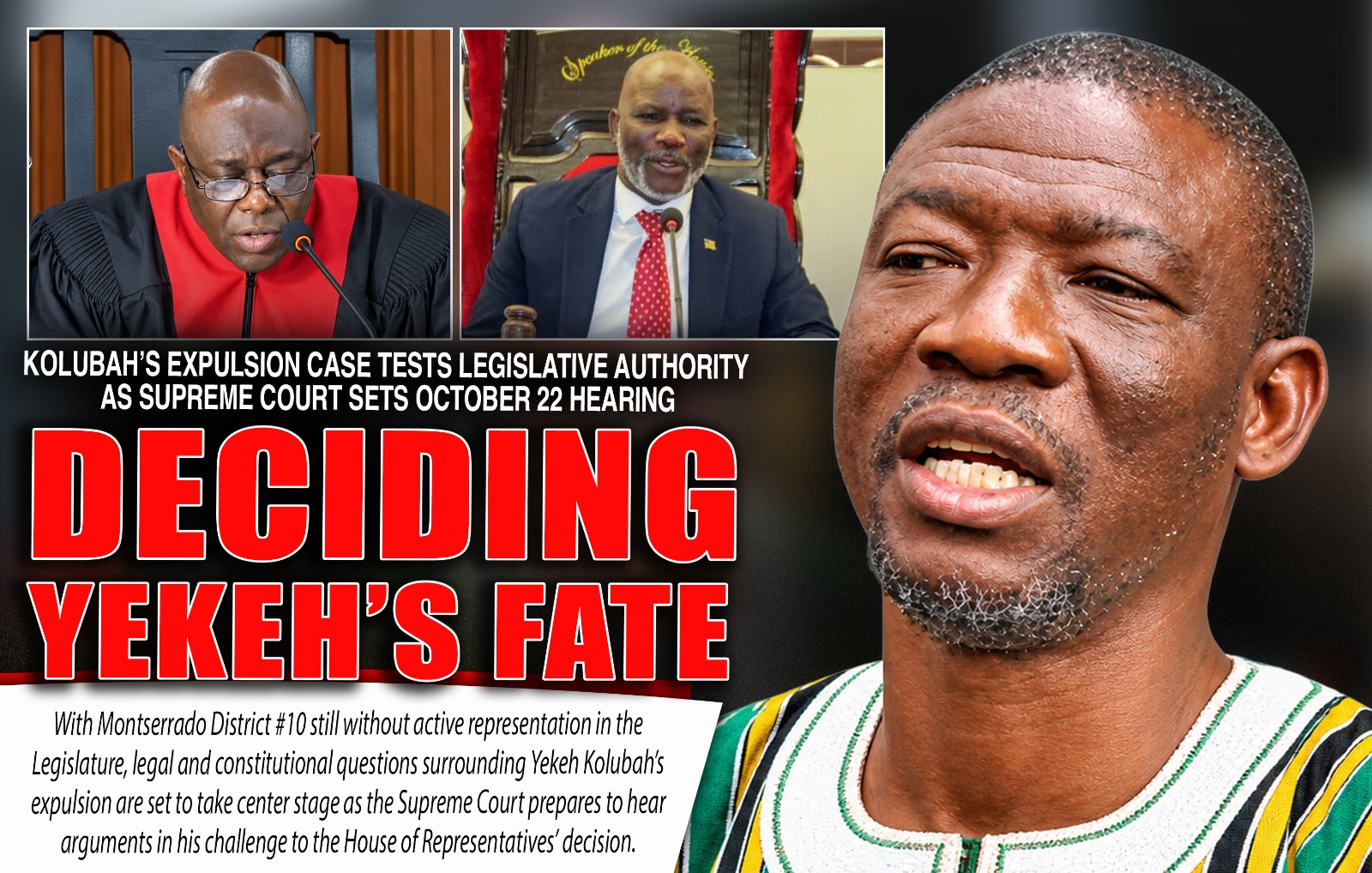
Liberia Supreme Court: Yekeh Kolubah Expulsion Appeal Set
Summary
- Yekeh Y. Kolubah, the expelled Montserrado County District 10 Representative, is appealing his expulsion from the House of Representatives to the Supreme Court of Liberia.
- The Supreme Court has scheduled a hearing for October 22, 2026, to consider arguments in the case.
- Kolubah's expulsion, approved by 49 lawmakers, originated from controversial statements he made regarding a territorial dispute with Guinea.
- The core legal challenge questions whether the legislative process adhered to constitutional due process standards, despite meeting the two-thirds vote requirement under Article 38.
- This case is poised to clarify the constitutional limits of legislative authority and establish precedents for due process in parliamentary disciplinary actions in Liberia.
What Happened
This case will specifically address the delicate balance between a legislative body's inherent power to maintain order and discipline its members, as outlined in Article 38 of the Liberian Constitution, and the fundamental due process rights guaranteed to every citizen, including elected officials, under Article 20(a).
A significant constitutional dispute involving Yekeh Y. Kolubah, the expelled Montserrado County District 10 Representative, is set to be heard by the Supreme Court of Liberia on Thursday, October 22, 2026, at 11:00 a.m. This hearing marks a critical juncture in a confrontation between the legislative and judicial branches, stemming from Kolubah's appeal against his expulsion from the House of Representatives. The Supreme Court's notice, issued on October 14 and signed by Clerk Cllr. Sam Mamulu, schedules arguments but does not indicate a decision or judgment will be rendered on the same day.
The controversy originated from statements attributed to Representative Kolubah during a sensitive period concerning Liberia's territorial disagreement with Guinea. He reportedly suggested that contested territory belonged to Guinea, prompting alarm among some lawmakers and security officials. Inspector General of Police Gregory Coleman formally communicated to the House, expressing concerns that such remarks from an elected official, lacking a legal or diplomatic basis, could destabilize border communities. Coleman also noted that Guinean authorities were referencing Kolubah's statements, potentially bolstering claims unfavorable to Liberia, and emphasized the heightened responsibility of lawmakers when discussing national sovereignty.
The matter was formally brought before the House through two communications: one from Montserrado District 3 Representative Sumo Mulbah, who sought Kolubah's expulsion for alleged misconduct and violation of his oath, and the other from Inspector General Coleman. Montserrado District 4 Representative Michael Thomas, a lawyer, subsequently moved for the Committee on Rules, Order and Administration to investigate the allegations and report its findings to the Plenary during a special session. Speaker Richard Nagbe Koon reportedly urged Kolubah to cooperate with this process. Following these proceedings, the House of Representatives voted to expel Representative Kolubah on April 17, with 49 lawmakers supporting the decision.
Legal Context
The legislative action against Representative Kolubah was taken under the authority granted by Article 38 of the Liberian Constitution, which empowers each chamber to establish its own rules, maintain internal discipline, and expel a member with the concurrence of two-thirds of its members. In a 73-member chamber, the 49 votes cast for Kolubah's expulsion numerically satisfied this two-thirds threshold, indicating that the House's position is not vulnerable on the basis of insufficient votes. However, the central legal challenge brought by Kolubah focuses not on the vote count itself, but on whether the process leading to his expulsion met constitutional and procedural standards.
House lawyers contend that Representative Kolubah was afforded an opportunity to address the allegations during a convened hearing but voluntarily departed from the proceedings. They argue that, having chosen to leave, he cannot credibly claim a denial of due process. Conversely, Kolubah's appeal directly disputes the legality of the entire process. Questions have also been raised regarding whether his legal representatives were given a genuine chance to participate, access relevant evidence, and adequately prepare a defense. Resolving these conflicting accounts will necessitate a thorough examination of the disciplinary record.
This aspect of the case highlights a critical distinction between merely holding a hearing and providing a meaningful opportunity for an individual to be heard. Article 20(a) of the Liberian Constitution, which safeguards due process rights, generally mandates adequate notice of allegations, a clear understanding of the charges, access to pertinent evidence, and a fair chance to respond. The Supreme Court's review will therefore scrutinize whether these fundamental due process requirements were sufficiently met during the legislative expulsion proceedings, particularly given the severe consequence of removing an elected official and disenfranchising their constituency.
Why It Matters
The Yekeh Kolubah expulsion Supreme Court Liberia case represents a pivotal moment for clarifying the constitutional limits of legislative authority and the scope of judicial review over internal parliamentary disciplinary actions. The outcome will establish significant judicial precedents regarding due process legislative expulsion, impacting how future challenges to legislative decisions are handled and influencing internal organizational disciplinary procedures across various institutions in Liberia.
This case will specifically address the delicate balance between a legislative body's inherent power to maintain order and discipline its members, as outlined in Article 38 of the Liberian Constitution, and the fundamental due process rights guaranteed to every citizen, including elected officials, under Article 20(a). The Supreme Court's decision will determine the extent to which the judiciary can intervene in what are often considered internal legislative affairs, thereby defining the boundaries of parliamentary disciplinary action Liberia. The ruling will have profound implications for the separation of powers and the protection of individual rights within the Liberian political system.
Practical Implications
This Supreme Court case will clarify the constitutional limits of legislative authority to expel members in Liberia and establish judicial precedents for due process standards in internal parliamentary disciplinary actions, impacting future challenges to legislative decisions and internal organizational disciplinary procedures.
Source
How does this affect you?
Get an AI analysis of this article grounded in your jurisdictions, practice areas, and any policy documents you've uploaded to Wansom.
Finish Reading the Full Story and the Expert Analysis.
Get the latest legal & regulatory intelligence in Liberia
Wansom is AI and can make mistakes.