
Liberia President Boakai: 3 Supreme Court Appointments Reshape Judiciary
Summary
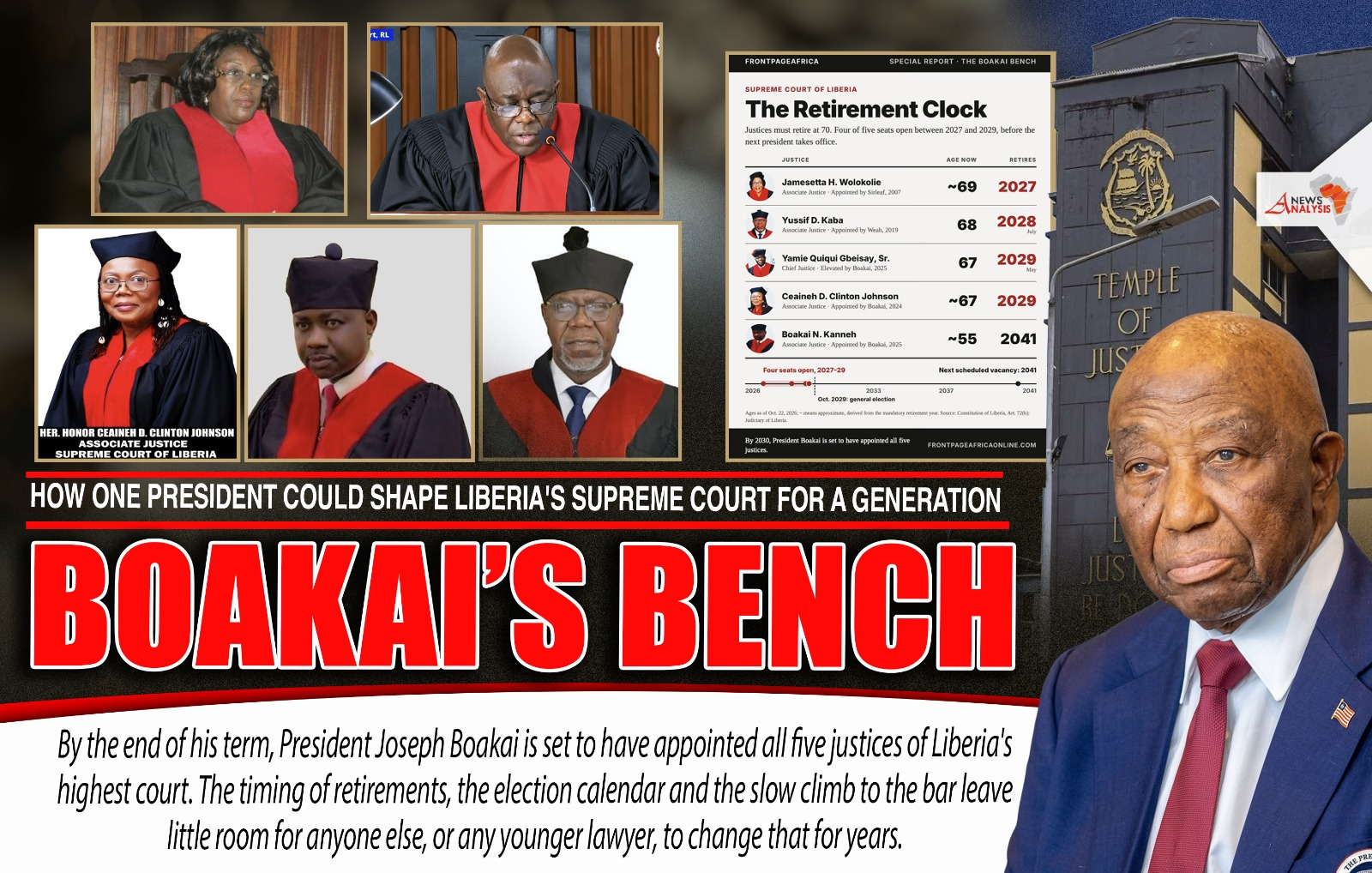
- President Joseph Nyuma Boakai could appoint all five Supreme Court justices by 2029 due to mandatory retirement ages.
- Article 72(b) of the 1986 Constitution requires justices to retire at age 70.
- Boakai has already made three appointments, including Chief Justice Yamie Quiqui Gbeisay, Sr. and Associate Justices Ceaineh D. Clinton-Johnson and Boakai N. Kanneh.
- The remaining two justices appointed by previous presidents are set to retire in 2027 and 2028.
- Concerns have been raised by a veteran lawyer about growing executive influence and the perceived firmness of the new Chief Justice.
Unprecedented Opportunity to Reshape Judiciary
The prospect of a single presidential administration appointing every member of the highest court, while not inherently illegal or improper, raises significant questions about judicial independence.
President Joseph Nyuma Boakai, who assumed office in January 2024, is in a unique position to entirely reconstitute Liberia's Supreme Court. Should the current justices adhere to the constitutionally mandated retirement age, every one of the five seats on the nation's highest judicial body could be filled by presidential appointments by the time Liberians head to the polls for the general elections in October 2029, or shortly thereafter.
This potential for a complete overhaul of the Supreme Court bench is a rare occurrence in Liberian history. The composition of the Court is determined by Article 72(b) of the 1986 Constitution, which stipulates that both the Chief Justice and Associate Justices must retire upon reaching 70 years of age. They are permitted to remain on the bench only to conclude cases that were initiated before their seventieth birthday. The President holds the authority to nominate justices, who then require confirmation by the Senate.
Recent Appointments and Legal Framework
President Boakai has already initiated this process, having made three appointments to the Supreme Court since taking office. In July 2024, his nominee, Judge Ceaineh D. Clinton-Johnson, received unanimous confirmation from the Senate to fill the vacancy left by the late Associate Justice Joseph Nagbe. This confirmation was notable as it was the first under a new Senate rule requiring a two-thirds vote, or 20 senators, for tenured presidential nominees.
A year later, in July 2025, Chief Justice Sie-A-Nyene Yuoh reached the mandatory retirement age. President Boakai subsequently nominated Associate Justice Yamie Quiqui Gbeisay, Sr. to succeed her. Gbeisay, who had been appointed as an associate justice in October 2022 under former President George Weah, was confirmed as Chief Justice in July 2025. To fill the associate justice seat vacated by Gbeisay, the President put forward Cllr. Boakai N. Kanneh, who was then chairman of the Law Reform Commission. Kanneh brings a background as a former deputy foreign minister for legal affairs and a public defender, and has also taught at the Louis Arthur Grimes School of Law. His familial connection as the brother of Gbarpolu County Senator Botoe Kanneh has garnered some political attention.
Upcoming Vacancies and the Road Ahead
The remaining vacancies on the Supreme Court are scheduled to open predictably. Associate Justice Jamesetta Howard Wolokolie, the longest-serving member appointed in 2007 by President Ellen Johnson Sirleaf, is set to retire in 2027. Following her, Associate Justice Yussif D. Kaba, born on July 19, 1958, and appointed in 2019 under President Weah, will retire in 2028. By this point, the last two justices appointed by previous administrations, Ms. Wolokolie and Mr. Kaba, will have departed the bench.
Further changes are anticipated in 2029, an election year. Chief Justice Yamie Quiqui Gbeisay, Sr., born on May 3, 1959, will turn 70 in May 2029, just five months before the general elections. Additionally, Associate Justice Clinton-Johnson, a Boakai appointee, is also slated for retirement in 2029. The youngest member of the Court, Associate Justice Kanneh, is not due to retire until 2041. Should all these appointments be successfully made and confirmed, the entire Supreme Court bench will consist of justices nominated by President Boakai.
Concerns Regarding Judicial Independence
The prospect of a single presidential administration appointing every member of the highest court, while not inherently illegal or improper, raises significant questions about judicial independence. In most democratic systems, the composition of the highest court evolves gradually through appointments made by multiple presidents, a process that serves as a quiet safeguard for the judiciary's autonomy. Liberia's fixed retirement age, while ensuring predictable turnover, can also lead to a clustering of vacancies, as is currently being observed.
Concerns have already surfaced regarding the potential for increased executive influence over the judiciary. A veteran lawyer, speaking to allAfrica, noted that three Supreme Court appointments within a span of less than two years indicated a growing executive sway. This lawyer also expressed reservations about Chief Justice Gbeisay's perceived firmness, citing his lone dissent in the Court's December 6, 2024, ruling concerning the House speakership crisis. That crisis, which saw a majority bloc of lawmakers declare the Speaker's seat vacant and elect Representative Richard Koon outside a formal session in November 2024, with the Executive subsequently recognizing Koon after a Ministry of Justice opinion, underscores the critical importance of an independent judiciary.
Practical Implications
Lawyers and compliance officers operating in Liberia should closely monitor the evolving composition of the Supreme Court under President Boakai, as a bench entirely appointed by one administration could significantly influence future legal interpretations, precedents, and the overall judicial landscape, potentially impacting legal strategies and risk assessments.
Source
Source: Original reporting via allAfrica
How does this affect you?
Get an AI analysis of this article grounded in your jurisdictions, practice areas, and any policy documents you've uploaded to Wansom.
Finish Reading the Full Story and the Expert Analysis.
Get the latest legal & regulatory intelligence in Liberia
Wansom is AI and can make mistakes.