
Liberia Opposition Parties Form Technical Committee Boakai: Unite to Challenge Government
Summary
- Five Liberian opposition parties have formed a Joint Technical Committee to challenge the Boakai government.
- The parties accuse the administration of losing territory to Guinea, selective anti-corruption, defying the Supreme Court, and using the Cybercrime Act to suppress critics.
- Specific corruption allegations include a US$10 million Foya project and an US$8 million Central Bank transfer to SIB Liberia, with calls for LACC investigation.
- The new committee, comprising two members from each party, aims to draft a common agenda and engage stakeholders across Liberia.
- This collaboration is a cautious step, not yet an electoral alliance, designed to build trust and inform future political strategies for the 2029 elections.
Opposition Unites Against Boakai Government
Their stated objective is not merely to oppose the government, but to actively contribute to building a functional Liberia, pledging to hold the Boakai-Koung-Unity Party-led administration accountable for its stewardship of the nation.
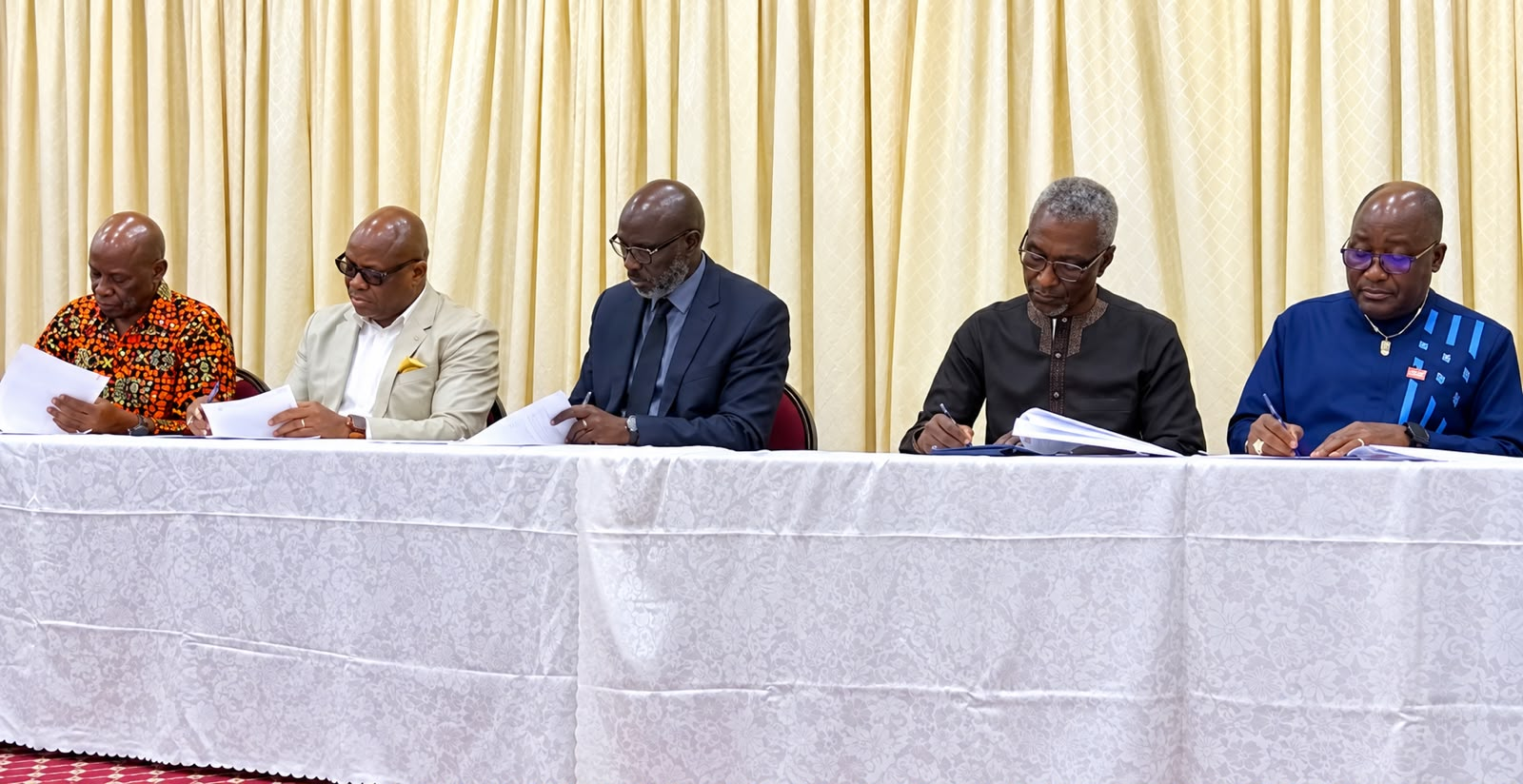
Five prominent Liberian political parties have formally united to challenge the administration of President Joseph Nyuma Boakai, signing an eight-page communiqué that outlines a series of grievances and establishes a new collaborative body. The document, signed on Sunday at the Sinkor Palace on Tubman Boulevard following a second opposition roundtable, accuses the Boakai-Koung government of significant failures, including ceding national territory, engaging in selective anti-corruption efforts, and suppressing dissent through legal means.
The parties involved include the Movement for Progressive Change (MPC), led by Simeon C. M. Freeman, who hosted the event. Other signatories are former President George Manneh Weah of the Coalition for Democratic Change (CDC), Alexander Benedict Cummings of the Alternative National Congress (ANC), Ambassador Dee-Maxwell Saah Kemayah, Sr. from the Movement for Economic Empowerment (MOVEE), and Jonathan A. Mason of the Union of Liberian Democrats Party (ULDP). Their stated objective is not merely to oppose the government, but to actively contribute to building a functional Liberia, pledging to hold the Boakai-Koung-Unity Party-led administration accountable for its stewardship of the nation.
To facilitate their collaborative efforts, the opposition parties have established an Opposition Political Parties Joint Technical Committee (OPPJTC). This committee will comprise two representatives from each participating party, tasked with drafting a unified agenda and setting up thematic working groups. The OPPJTC also plans to engage with opposition lawmakers, civil society organizations, professional groups, and communities across all 15 counties of Liberia. While this marks a significant step towards collaboration, the parties have deliberately refrained from calling it an electoral alliance, emphasizing that each will maintain its distinct identity and autonomy.
Legal and Regulatory Accusations Mount
A central theme of the opposition's communiqué revolves around alleged legal and regulatory transgressions by the Boakai government. They assert that the administration is defying Supreme Court rulings and employing the recently enacted Cybercrime Act to silence critics, thereby steering the country towards what they describe as a police state. Furthermore, the parties contend that the government's anti-corruption and anti-drug campaigns are selective, aggressively targeting the previous administration while overlooking alleged malfeasance within its own ranks.
Specific allegations of corruption include a US$10 million construction project in Foya, President Boakai's hometown, which the opposition labels a "flagship of corruption." They claim that procurement and budget regulations were violated, and the funding sources for the project remain undisclosed. Despite government assertions, the Mano River Union has reportedly denied any involvement or connection to this project. The Alternative National Congress (ANC) formally brought these concerns to the Liberia Anti-Corruption Commission (LACC) in May, receiving a response in June that a preliminary assessment would be conducted; however, the opposition states that no further action has been observed.
Another significant financial concern raised is the transfer of US$8 million in reserve money from the Central Bank of Liberia to SIB Liberia in May 2024. This transfer, executed under an April 18, 2024 directive from President Boakai, is under scrutiny. The opposition highlights that SIB, which emerged from the defunct FIBLL, has faced accusations of financing President Boakai's 2023 election campaign. They have urged the LACC to investigate this matter impartially, emphasizing that the commission's members are protected from arbitrary removal, underscoring the expectation for independent action.
Sovereignty and Strategic Collaboration
The communiqué prominently addresses issues of national sovereignty, particularly the Foya border dispute Liberia Guinea. The opposition parties allege that Guinea is currently occupying Liberian territory within the Foya District of Lofa County. They criticize the Boakai government for its perceived failure to resolve this matter through diplomatic channels or to enlist the support of regional and international bodies such as ECOWAS, the African Union, and the United Nations. The opposition leaders underscored the gravity of the situation, stating that while Liberians may read about territorial losses in past centuries, they will not accept such an outcome in the 21st century.
The formation of the Opposition Political Parties Joint Technical Committee (OPPJTC) reflects a cautious yet strategic approach to political collaboration. The parties explicitly noted that they have studied previous attempts at opposition unity, many of which either failed, achieved only partial success, or ultimately dissolved. This historical context informs their current strategy, which prioritizes building trust through genuine consultation rather than attempting to force political unity through mere declaration. This deliberate, measured approach is intended to foster a more robust and sustainable partnership.
Should this collaborative partnership prove successful, the parties anticipate that it will naturally inform their collective agenda for the 2029 elections. This measured strategy aims to ensure that any future electoral endeavors are built upon a solid foundation of shared objectives and mutual trust, rather than rushed declarations. The establishment of the OPPJTC signals a concerted effort by Liberia opposition parties to hold the Boakai government accountable and shape the nation's political trajectory.
Practical Implications
This development signals potential legal and regulatory risks in Liberia, particularly concerning the application of the Cybercrime Act, the integrity of anti-corruption efforts by the LACC, and the government's adherence to Supreme Court rulings. Lawyers and compliance officers should monitor these issues for potential impacts on client operations, regulatory enforcement, and the broader rule of law environment, especially given the opposition's stated intent to hold the government accountable.
Source
How does this affect you?
Get an AI analysis of this article grounded in your jurisdictions, practice areas, and any policy documents you've uploaded to Wansom.
Finish Reading the Full Story and the Expert Analysis.
Get the latest legal & regulatory intelligence in Liberia
Wansom is AI and can make mistakes.