
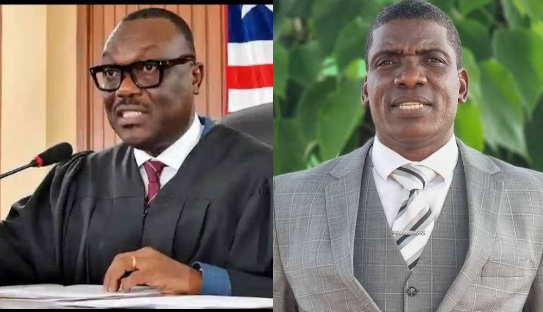
Liberia Judge Feika: Attorney Kowou Faces Ethics Referral, License Suspension
Summary
- Judge Ousman F. Feika suspended Attorney Gbawou Kowou's license for one year and referred him to the Supreme Court's Grievance and Ethics Committee for alleged unprofessional conduct.
- The referral followed Kowou's public allegations of witness tampering on social media and a talk show, made before a formal court filing.
- The court's inquiry found Kowou's witness tampering claims to be "absolutely false and misleading."
- Judge Feika suspended Kowou's law license for one year, citing breaches of multiple ethical rules, including those on undermining courts and publicity about pending litigation.
- The referral was made under Judicial Canon 21, which mandates trial judges to address and refer observed unprofessional conduct.
Attorney Referred for Ethics Review Following Witness Tampering Claims
The court's primary objection centered on the sequence of events, specifically that Attorney Kowou's public statements on social media and a talk show preceded his formal court filing.
Criminal Court C Judge Ousman F. Feika has suspended Attorney Gbawou Kowou's law license for one year and referred the matter to the Supreme Court's Grievance and Ethics Committee for further review. This action follows Judge Feika's dismissal of a complaint by Kowou, which alleged that state prosecutors were engaged in witness tampering. While the judge did not personally suspend Kowou's license, the referral and strong recommendation place the attorney's professional standing under scrutiny by the Committee and potentially the full bench of the Supreme Court.
The dispute originated during the high-profile economic sabotage prosecution of former government officials, including Varney Sirleaf and Dee Maxwell Saah Kemayah, which has since resulted in their conviction by a jury. Attorney Kowou represents co-defendant Wayfa Ciafa in this case, which is being pursued by the Assets Recovery and Property Retrieval Task Force (AREPT), chaired by Cllr. Edwin K. Martin. The incident that triggered the referral occurred on Sunday, October 4, when members of the Group of 77, some of whom had already testified for the defense, visited AREPT's offices. Later that evening, Kowou publicly claimed on Facebook Live and during a call to the Spoon Talk Show that AREPT had summoned his witnesses to intimidate them into recanting their testimony. The following day, he formally filed a Bill of Information with the court, requesting an investigation into his allegations.
Court Debunks Tampering Allegations, Cites Ethical Breaches
In response to Attorney Kowou's formal complaint, the court promptly halted the trial, sequestered the jury, and initiated an inquiry. Judge Feika's subsequent ruling thoroughly rejected nearly all of Kowou's assertions regarding witness tampering. The court found that the witnesses had attended AREPT's offices at the behest of Raymond K. Zarby, the Group of 77's senior administrator, who admitted to misinterpreting an invitation intended for rebuttal witnesses. Furthermore, AREPT staff requested the defense witnesses to leave upon realizing their status, and both sides' witnesses confirmed no threats were made, though phones were routinely collected at the entrance.
The court's investigation also revealed that Attorney Kowou possessed prior knowledge of the witnesses' visit, having advised them to attend, which directly contradicted his claim of being unaware. Crucially, Cllr. Edwin K. Martin, whom Kowou had accused of ordering him beaten, was not present at the AREPT premises during the incident. A video review showed a scuffle initiated when AREPT staff attempted to prevent Kowou from filming and live-streaming inside the compound. Ultimately, the court concluded that the witness tampering allegation was "absolutely false and misleading." The core issue leading to the ethics referral was not the act of raising concerns about witness tampering, which the court affirmed is permissible if credible and brought promptly, but rather the sequence of events: Kowou's public pronouncements on Facebook and a talk show preceded his official court filing. This conduct, coupled with a pre-existing gag order prohibiting lawyers from discussing the case with the media, led Judge Feika to find that Kowou had breached Rules 1, 18, 20, and 22 of the Code of Moral and Professional Ethics, specifically those pertaining to undermining the courts, publicity about pending litigation, and asserting unproven matters as fact.
Legal Basis for Judicial Referral
Judge Feika's decision to refer Attorney Kowou for professional misconduct aligns with established legal frameworks governing the Liberian legal profession. Article 75 of the Liberian Constitution vests the Supreme Court with ultimate authority over the conduct of lawyers. Complementing this, the Judiciary Law empowers the Supreme Court to impose disciplinary measures, including censure, suspension, or removal from practice, on legal professionals. The referral itself is a procedural step mandated by Judicial Canon 21, which instructs trial judges to address unprofessional conduct observed in their courts and, when necessary, to refer such matters to the Grievance and Ethics Committee.
Therefore, Judge Feika acted within his prescribed authority by referring Attorney Kowou. The ruling emphasized that while criticism of a judicial decision is distinct from denigrating the judicial institution, the specific actions taken by Kowou crossed the line into unprofessional conduct. The court's primary objection centered on the sequence of events, specifically that Attorney Kowou's public statements on social media and a talk show preceded his formal court filing, thereby violating ethical rules designed to maintain the integrity of judicial proceedings and prevent the assertion of unproven matters as fact in the public sphere.
Implications for Professional Conduct
This ruling by Judge Ousman Feika carries significant implications for attorneys practicing in Liberia, particularly concerning their conduct in high-profile cases and interactions with the media. It underscores the critical importance for legal professionals to adhere strictly to ethical guidelines regarding public commentary on ongoing cases and to utilize proper judicial channels for addressing grievances. The case highlights that even if an attorney believes they have legitimate concerns about trial irregularities, the timing and forum for raising these issues are paramount. Public statements made before formal court filings can be deemed unprofessional conduct, potentially leading to severe disciplinary actions, irrespective of the underlying concern's validity.
While the procedural correctness of Judge Feika's referral is clear, the proportionality of the recommended one-year suspension remains a subject for further consideration by the Grievance and Ethics Committee and, ultimately, the Supreme Court. A one-year suspension represents a substantial penalty, and its imposition would significantly impact Attorney Kowou's ability to practice law. The final decision will set an important precedent for how the Liberian legal system balances an attorney's right to advocate for their client with their professional obligations to the court and the ethical standards of the profession.
Practical Implications
Lawyers in Liberia must carefully consider the timing and forum for raising allegations of witness tampering or other trial irregularities, as public statements made before formal court filings can be deemed unprofessional conduct and lead to disciplinary referrals, even if the underlying concern is legitimate. This ruling underscores the importance of adhering to the Code of Moral and Professional Ethics regarding publicity about pending litigation and undermining the courts.
Source
How does this affect you?
Get an AI analysis of this article grounded in your jurisdictions, practice areas, and any policy documents you've uploaded to Wansom.
Finish Reading the Full Story and the Expert Analysis.
Get the latest legal & regulatory intelligence in Liberia
Wansom is AI and can make mistakes.