
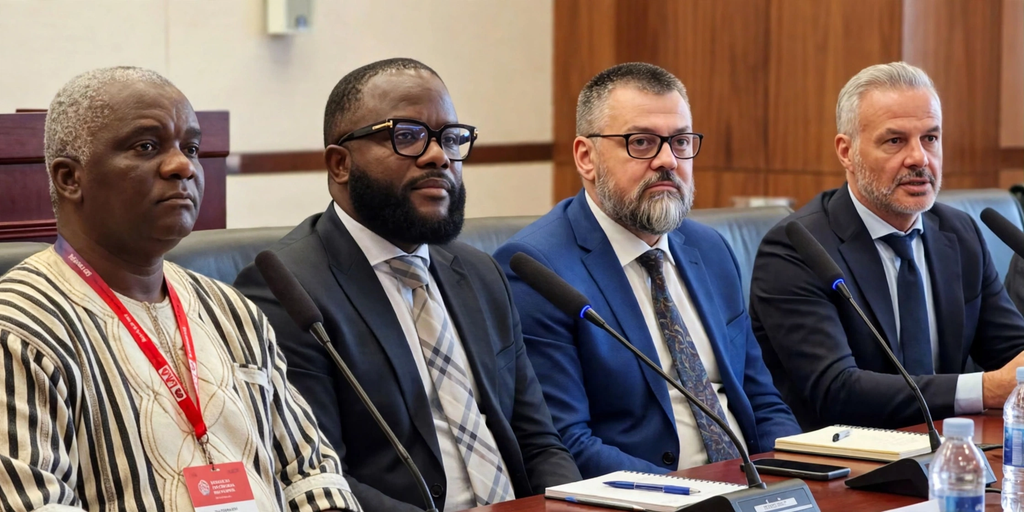
LRA Commissioner Jallah: Liberia Freeport Scanner Payments Collected Without Service
Summary
- Liberian traders paid fees for cargo scanning at the Freeport of Monrovia for weeks, despite the service not being available.
- LRA Commissioner General Dorbor Jallah confirmed to senators that the scanner facility is under construction and no scanning is currently taking place.
- Importers face significant delays and high charges from various entities, leading to increased debt and higher consumer prices for essential goods.
- The Liberia Revenue Authority is implementing reforms, including plans for 24-hour port operations, upgraded customs software, and integrated payment systems.
- A new custom-built scanner from China is planned to process approximately 40 containers per hour, aiming to improve clearance and control.
Unjustified Charges and Economic Strain at the Freeport
Liberian traders have been subjected to weeks of charges for cargo scanning services at the nation's primary seaport, only for the head of the tax agency to reveal that no such scanning is currently taking place.
Liberian traders have been subjected to weeks of charges for cargo scanning services at the nation's primary seaport, only for the head of the tax agency to reveal that no such scanning is currently taking place. During a recent Senate hearing, Dorbor Jallah, Commissioner General of the Liberia Revenue Authority (LRA), confirmed that the facility intended to house the scanner at the Freeport of Monrovia is still under construction, rendering any cargo scanning operations impossible at this time. This admission followed numerous complaints from small and medium-sized importers, who have reported significant delays and excessive Freeport of Monrovia cargo fees, driving them into debt and contributing to increased prices for essential goods across the country.
The Freeport, which serves as the entry point for the majority of goods into Liberia—a West African nation of approximately 5.5 million people heavily reliant on imports for food, fuel, and consumer products—sees the costs of port delays quickly passed on to consumers. The price of staples like rice and cooking oil in Monrovia's markets directly reflects the efficiency, or lack thereof, at the port. Importers, many of whom operate on bank credit, face mounting interest charges for each day their containers remain stalled. Beyond the general delays, a specific point of contention has been the Liberia Freeport scanner payments, which importers have been compelled to make despite the non-existence of the service, as explicitly stated by Commissioner Jallah.
Systemic Inefficiencies and Proposed Reforms
The challenges at the Freeport extend beyond the issue of non-existent scanning services. Business owners report being levied substantial charges by various entities, including the terminal operator APM Terminals Liberia, MEDTECH, and under the CTN/GTMS cargo tracking Liberia system. These fees are applied both before goods arrive and prior to their release, exacerbating the financial burden on importers already struggling with delays. The LRA Commissioner General highlighted that many importers have faced difficulties in paying release fees promptly due to the limited operating hours of banks.
In response to these pervasive Liberia port congestion issues, the Liberia Revenue Authority is actively pursuing several reforms. The LRA is collaborating with the Central Bank of Liberia (CBL) and commercial banks to establish a system for round-the-clock payments, with the CBL having launched an Inclusive Instant Payment System (IIPS) on December 16, 2025, to integrate these systems. Furthermore, the LRA is upgrading its outdated customs software, which previously lacked seamless connectivity with banking institutions. The new, advanced version of the software is designed to facilitate integration with both commercial banks and the Central Bank, streamlining financial transactions. Following discussions with key stakeholders including importers, shipping lines, and customs brokers, the government has transformed the Freeport into a 24-hour operational port, with 24-hour vessel navigation launched in July/August 2026, ensuring customs services are available around the clock to alleviate congestion.
Modernization Efforts and Historical Context
The government is moving forward with plans to install a new, custom-built scanner, sourced from a Chinese manufacturer, within the destination expansion facility currently under construction at the port. This advanced LRA Commissioner Jallah scanner is projected to process approximately 40 containers per hour, enabling customs and security personnel to inspect container contents without physical opening. This capability is expected to significantly accelerate clearance procedures and enhance control over goods entering the country, addressing both efficiency and security concerns. Commissioner Jallah also noted that the increasing demand for imports is leading to cargo accumulation at regional transshipment hubs, underscoring the urgent need for improved port capacity.
The current strain on the port infrastructure is not a recent development, according to Sekou Dukuly, Managing Director of the National Port Authority (NPA). He informed senators that the congestion problem has been escalating for years. Dukuly recalled that as far back as 2017, the World Bank issued warnings to Liberia and other nations within the Mano River Union basin and the broader sub-region. The international body highlighted the astronomical growth of West African economies and advised these countries to enhance and expand their port facilities to cope with anticipated increases in trade volume. These historical warnings underscore the long-standing nature of the challenges now being addressed through the Liberia Revenue Authority reforms and port modernization efforts.
Practical Implications
Legal counsel advising importers and exporters in Liberia should assess potential claims for unjust enrichment or misrepresentation regarding fees paid for non-existent cargo scanning services. Compliance officers must monitor the implementation of promised port reforms, including the new scanner, 24-hour operations, and upgraded payment systems, to ensure adherence to new regulations and to mitigate supply chain disruptions and costs for clients.
Source
How does this affect you?
Get an AI analysis of this article grounded in your jurisdictions, practice areas, and any policy documents you've uploaded to Wansom.
Finish Reading the Full Story and the Expert Analysis.
Get the latest legal & regulatory intelligence in Liberia
Wansom is AI and can make mistakes.