
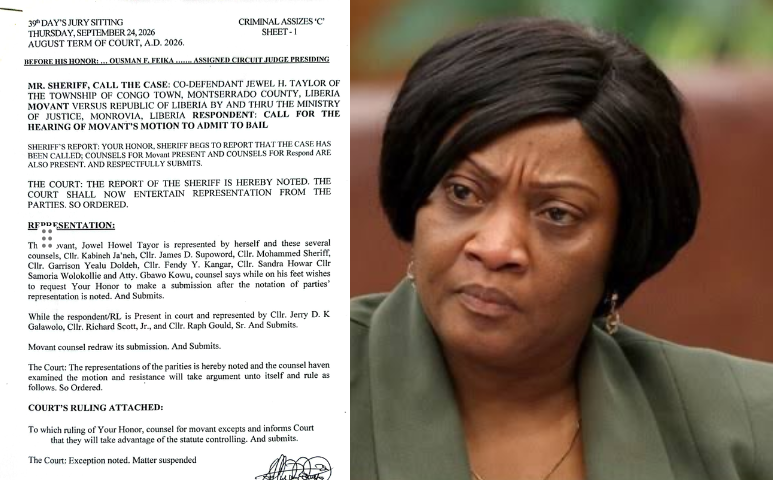
Liberia: COURT DENIES Bail Request to former Vice President JEWEL Howard Taylor
Summary
- Criminal Court “C” in Monrovia denied former Vice President Jewel Howard-Taylor's motion for bail on Thursday.
- The court cited government allegations linking her conduct to a cocaine case as the basis for its decision.
- Ms. Howard-Taylor's claim that the 2023 drug law could not apply to her was explicitly rejected by the judge.
- An alleged August 2026 cartel payment was referenced by the court in its ruling to deny bail.
- The decision was made at the Temple of Justice, Monrovia.
Court Rejects Bail for Former Vice President
The court's interpretation of the 2023 drug law and its applicability to the alleged circumstances is a significant aspect of this ruling.
Criminal Court “C” in Monrovia, situated at the Temple of Justice, recently issued a ruling denying a bail application filed by former Vice President Jewel Howard-Taylor. The decision, handed down on Thursday, means that Ms. Howard-Taylor will remain under home detention, having previously been granted compassionate release, as her legal proceedings continue.
The court's determination was based on specific allegations presented by the government. These allegations, according to the judicial body, directly implicate Ms. Howard-Taylor's involvement in a significant cocaine case, forming the primary justification for withholding her release on bail. The judicial panel found the government's submissions compelling enough to warrant continued pre-trial detention.
The denial of bail underscores the serious nature of the charges Ms. Howard-Taylor faces. The court's assessment of the evidence, even at this preliminary stage, indicates a strong governmental case linking her to the alleged illicit activities. This development marks a critical juncture in the high-profile legal battle involving the former Liberian official.
Legal Arguments and Judicial Interpretation
A central component of Ms. Howard-Taylor's defense strategy involved challenging the applicability of Liberia's 2023 drug law to her situation. Her legal team contended that this recent legislation should not be retroactively applied or otherwise used in her case. However, the presiding judge explicitly rejected this argument, asserting that the new drug law is indeed relevant to the ongoing proceedings.
In its reasoning for denying bail, the court specifically referenced an alleged payment made to a cartel in August 2026. This detail, as cited by the court, played a role in its decision to keep the former Vice President in custody. The court's interpretation of the 2023 drug law and its applicability to the alleged circumstances is a significant aspect of this ruling.
This judicial stance provides crucial insight into how Liberian courts are interpreting and applying the recently enacted drug legislation. The rejection of the defense's argument regarding the 2023 law's scope sets a precedent for future cases involving drug-related offenses, particularly concerning the temporal application of new statutes.
Implications for Liberian Jurisprudence
The decision by Criminal Court “C” to deny bail to a former Vice President carries substantial implications for Liberia's legal landscape. It signals a firm judicial approach to serious criminal charges, particularly those involving alleged drug trafficking, irrespective of the defendant's past political stature. This ruling emphasizes that high-ranking individuals are not exempt from the rigorous application of the law.
Furthermore, the court's explicit rejection of the argument concerning the 2023 drug law's applicability is a pivotal moment for legal practitioners. It clarifies the judiciary's position on the interpretation of new legislation, suggesting a broad scope for its enforcement. Lawyers in Liberia will need to consider this precedent carefully when advising clients on drug-related offenses and assessing the potential for bail applications, especially in light of the court's willingness to apply the 2023 drug law to ongoing cases.
This ruling underscores the judiciary's commitment to upholding the integrity of the legal system and addressing serious allegations, even when they involve prominent public figures. The detailed reasoning, particularly regarding the new drug law and the alleged cartel payment, will serve as an important reference point for future legal analyses and judicial proceedings within Liberia.
Practical Implications
The court's rejection of the ex-VP's argument regarding the 2023 drug law's applicability provides crucial insight into judicial interpretation of new legislation in Liberia. Lawyers should note this precedent when assessing bail applications and advising clients on drug-related offenses, particularly concerning the potential retrospective application or scope of the 2023 drug law.
Source
How does this affect you?
Get an AI analysis of this article grounded in your jurisdictions, practice areas, and any policy documents you've uploaded to Wansom.
Finish Reading the Full Story and the Expert Analysis.
Get the latest legal & regulatory intelligence in Liberia
Wansom is AI and can make mistakes.