
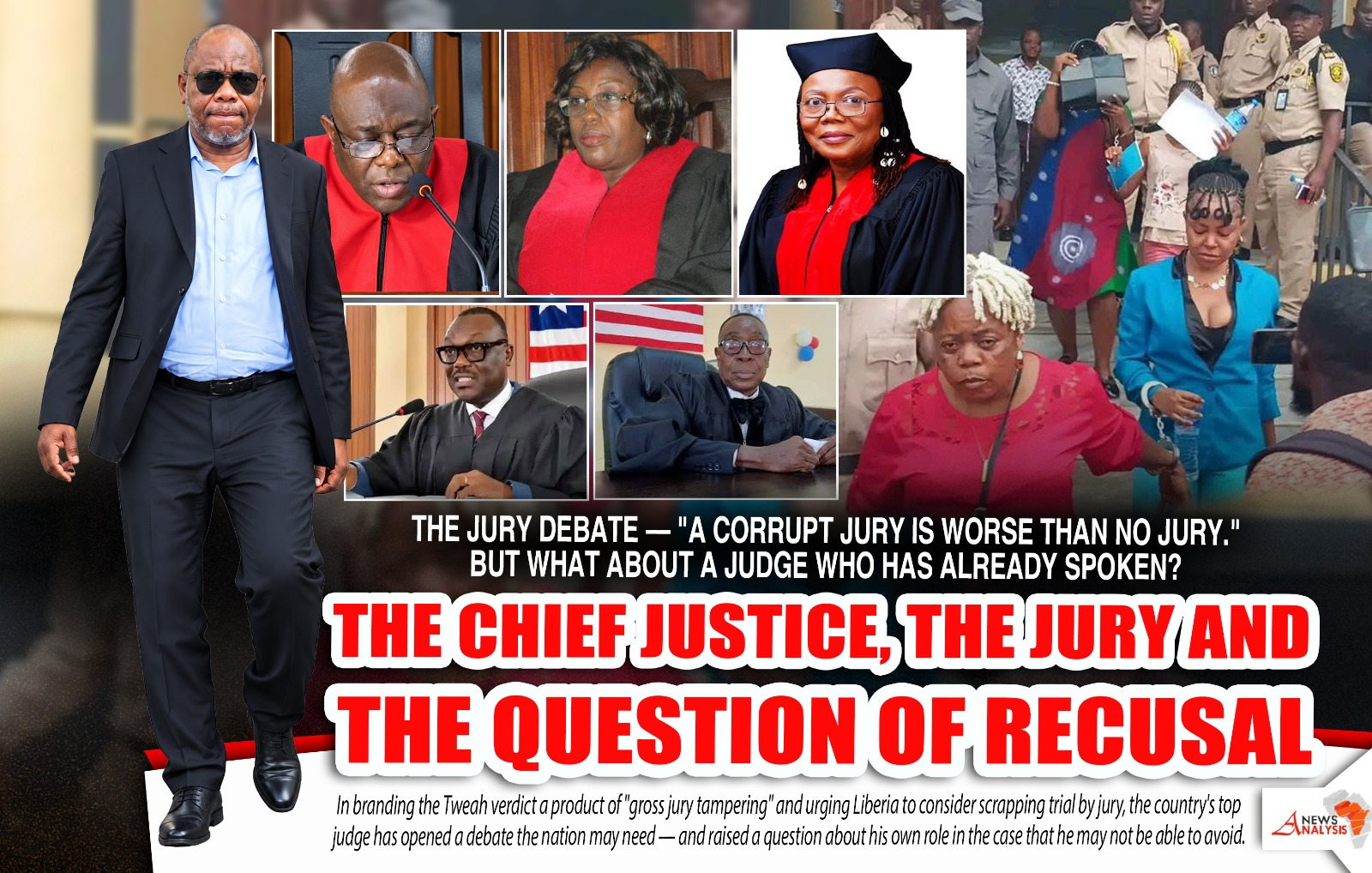
Liberia Chief Justice Gbeisay: Tweah Case Jury Tampering, Recusal Debate
Summary
- Chief Justice Yamie Quiqui Gbeisay Sr. publicly criticized Liberia's jury system, citing widespread tampering and calling for its potential abolition.
- He specifically referenced "gross jury tampering" in the high-profile US$6.2 million economic sabotage case involving former Finance Minister Samuel D. Tweah Jr.
- The Tweah case is currently under appeal after a trial judge set aside a split jury verdict due to alleged juror misconduct.
- Defense lawyers argue that evidence of jurors possessing phones does not automatically prove verdict corruption.
- Chief Justice Gbeisay previously established a recusal standard, stating that perceived bias is sufficient grounds for a judge to step aside.
Judicial Scrutiny and the Jury System
This precedent, set by Chief Justice Gbeisay himself, creates a direct tension with his recent public pronouncements regarding the Tweah case, potentially necessitating his recusal.
Chief Justice Yamie Quiqui Gbeisay Sr. used the opening of the Supreme Court's October Term to deliver a stark critique of Liberia's jury system, rather than a customary ceremonial address. Speaking from the Temple of Justice, he asserted that jury manipulation was undermining the integrity of justice in both civil and criminal proceedings across the nation. He specifically cited instances of reported tampering in counties such as Nimba, Grand Gedeh, Bomi, and Margibi, affecting cases ranging from rape to drug trafficking.
The Chief Justice then turned his attention to the highly sensitive US$6.2 million economic sabotage case involving former Finance Minister Samuel D. Tweah Jr. and his co-defendants. He declared that a post-trial inquiry, conducted by Criminal Court C Judge Ousman F. Feika, had definitively established "gross jury tampering" in this particular matter. Gbeisay emphatically stated that "A corrupt jury is worse than no jury at all," and urged the Legislature, the Liberian National Bar Association, the Law Reform Commission, and the Liberian populace to consider the complete abolition of trial by jury. These remarks have since generated considerable discussion among legal professionals, on broadcast media, and across social platforms.
The Tweah Case Appeal
The core of the current legal challenge in the Tweah case stems from a split verdict delivered on May 8 by a 15-member jury. This verdict acquitted Mr. Tweah and one co-defendant, while convicting three others on charges of theft and criminal facilitation. Following this, Judge Feika initiated an inquiry into allegations of juror misconduct, which subsequently led him to set aside the original verdict and mandate a new trial.
Defense attorneys have since appealed Judge Feika's decision. While Mr. Tweah himself has opted not to join the appeal, his co-defendants have formally signed on. A central point of contention in the appeal revolves around the standard of proof required to invalidate a jury's findings. The inquiry reportedly confirmed that jurors possessed mobile phones, but the defense contends that this fact alone does not sufficiently demonstrate that the phones were used to improperly influence the jurors or corrupt the verdict itself. They emphasize that merely possessing a prohibited device, engaging in outside communication, and actively corrupting a verdict represent distinct factual and legal considerations, and evidence of the first does not automatically substantiate the latter two. Furthermore, the defense has raised questions regarding the identities and voting records of the jurors identified with phones, issues that will require scrutiny against official jury records and the inquiry's findings during the appellate process.
Precedent for Recusal
Chief Justice Gbeisay has previously addressed similar concerns regarding judicial impartiality, notably in an earlier phase of the very same Tweah prosecution. In January 2025, while serving as Chamber Justice, he issued an order for the then-presiding trial judge to recuse himself from the case. This directive was prompted by remarks made by the judge that the prosecution deemed prejudicial. At the time, the Supreme Court expressed its dismay at the judge's statements.
During that instance, Chief Justice Gbeisay articulated a clear standard for recusal: he stated that a judge's perceived bias, whether real or implied, constitutes sufficient grounds for stepping aside. He further elaborated that if a judge's words and actions lead a party to reasonably believe they cannot receive a fair trial, then the judge ought to recuse themselves to uphold transparency and ensure justice. He underscored the principle that judges must not only be impartial in their conduct but also maintain the appearance of impartiality. This established standard from the Chief Justice's own rulings is now a critical point of reference.
Implications for Appellate Review
The Chief Justice's recent public pronouncements, particularly his assertion of "gross jury tampering" in the Tweah case, carry significant weight given his position as the head of the Judiciary. These statements, delivered from the Supreme Court bench, could be interpreted as a definitive finding rather than mere commentary. This situation creates a direct challenge to the principle of judicial impartiality, especially as the Tweah case is now poised for appellate review before the Supreme Court.
The defendants who are currently challenging Judge Feika's ruling may reasonably argue, based on Chief Justice Gbeisay's own previously established recusal standard, that they have grounds to doubt his capacity to approach their appeal with an open and unbiased mind. The Judiciary itself, only months prior in May, had drawn a similar line regarding the necessity of perceived impartiality. This precedent, set by Chief Justice Gbeisay himself, creates a direct tension with his recent public pronouncements regarding the Tweah case, potentially necessitating his recusal.
Practical Implications
Lawyers involved in the Samuel D. Tweah Jr. appeal, or any future cases where a judge's public statements might pre-empt appellate review, should consider citing Chief Justice Gbeisay's own prior rulings on judicial recusal and perceived bias to argue for his or another judge's recusal if the matter reaches the Supreme Court.
Source
How does this affect you?
Get an AI analysis of this article grounded in your jurisdictions, practice areas, and any policy documents you've uploaded to Wansom.
Finish Reading the Full Story and the Expert Analysis.
Get the latest legal & regulatory intelligence in Liberia
Wansom is AI and can make mistakes.