
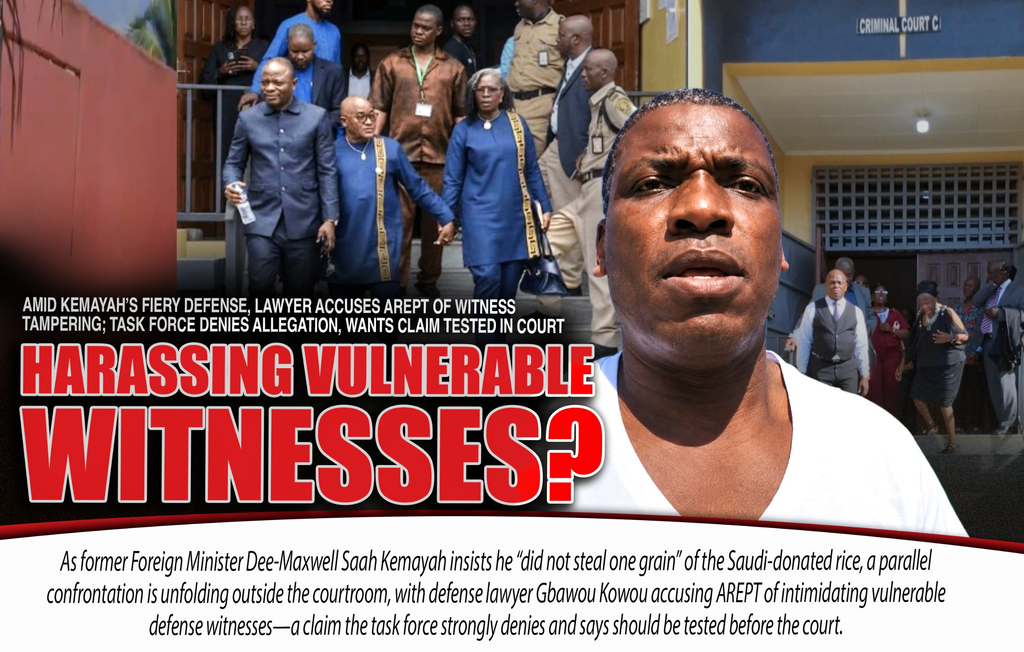
Liberia AREPT: Witness Tampering Allegation Hits Kemayah Trial
Summary
- Gbawou Kowou, whose law license has since been suspended, accused Liberia's Asset Recovery and Property Retrieval Taskforce (AREPT) of witness tampering in the Dee-Maxwell Saah Kemayah trial.
- Kowou alleges defense witnesses were pressured to report to AREPT after testifying for former Foreign Minister Kemayah in the Saudi rice case, where Kemayah has since been found guilty on some charges.
- AREPT denies the allegations, stating that two defense witnesses who arrived with an invited individual were immediately asked to leave their premises upon recognition.
- The dispute escalated into a confrontation at AREPT headquarters, involving a livestream by Kowou, whose law license has since been suspended, and police intervention.
- Both the defense and AREPT agree that the court should formally address and resolve the witness tampering allegations.
Allegations of Witness Interference Emerge in High-Profile Trial
The court's resolution of these witness tampering allegations will establish crucial precedents for protecting witness integrity and ensuring due process in ongoing trials.
A significant controversy has erupted outside the courtroom in Liberia, as Gbawou Kowou, whose law license has since been suspended, has formally accused the Asset Recovery and Property Retrieval Taskforce (AREPT) of intimidating or improperly engaging defense witnesses. This serious Liberia AREPT witness tampering allegation surfaced during the criminal trial of former Foreign Minister Dee-Maxwell Saah Kemayah, who has been found guilty on some charges in connection with the 'Saudi rice case'. Kemayah himself, while on the witness stand, vehemently denied any wrongdoing, stating he "did not steal one grain" of the Saudi-donated rice.
According to Kowou, witnesses who had already testified on behalf of the accused in Criminal Court "C" — including members of the Group of 77 and individuals from the community of persons with disabilities — were subsequently pressured or threatened to report to AREPT's offices. In response, AREPT has categorically denied any attempt to interfere with testimony, characterizing the incident as a misunderstanding. The task force, through its Public Relations Officer Joseph F. Daniels, stated that a potential witness, who had previously provided a statement, was asked to appear at their office along with others familiar with the Saudi rice matter. This individual then arrived with two persons who were later identified as recent defense witnesses. AREPT maintains that its lawyers, upon recognizing their status, immediately asked the two individuals to leave the premises, asserting they were neither invited by AREPT, interviewed, nor had any statements taken from them.
The dispute escalated into a public confrontation when Kowou, whose law license has since been suspended, traveled to AREPT's headquarters in Paynesville. There, he livestreamed his demands for access, claiming that the witnesses were inside and the facility's gates had been locked. "I’m live at AREPT. Witnesses who testified on our behalf yesterday were brought here and threatened," Kowou stated during his broadcast. The incident eventually drew the attention of Liberia National Police officers. Kowou was later granted entry to the compound before being taken to a police station following the heated exchange, though he continued to insist on potential interference with witnesses in an ongoing criminal proceeding.
Legal Context and the Integrity of Criminal Proceedings
The Liberia AREPT witness tampering allegation introduces a critical question regarding the treatment of witnesses within an active criminal proceeding. The core issue revolves around whether a prosecutorial agency can approach or summon individuals who have already testified for the defense, particularly without the knowledge or presence of their legal counsel. This situation raises significant concerns about where legitimate investigative efforts end and improper interference with the judicial process begins, especially as prosecutors are currently preparing to present rebuttal witnesses in the Dee-Maxwell Saah Kemayah trial, where he has been found guilty on some charges.
Both the defense and AREPT agree that the court is the appropriate venue to resolve this dispute. AREPT has challenged the defense to present any evidence of witness tampering or intimidation directly to the trial judge, emphasizing that such allegations should be properly addressed within the judicial system. The outcome of this challenge will be crucial in defining the boundaries for state agencies interacting with witnesses in Liberia's criminal procedure, ensuring fairness and due process for all parties involved in the Saudi rice case Liberia.
Why It Matters for Liberian Justice
The court's resolution of these witness tampering allegations will establish crucial precedents for protecting witness integrity and ensuring due process in ongoing trials. This incident underscores the fundamental importance of maintaining the sanctity of witness testimony and preventing any actions that could be perceived as coercing or influencing individuals who have participated in a judicial proceeding. The legal community, particularly criminal defense lawyers in Liberia, will be closely monitoring the court's handling of this matter.
The clarity provided by the court's decision will help define the permissible scope of interaction between state agencies and defense witnesses, thereby safeguarding the integrity of the Liberian justice system. It highlights the need for robust mechanisms to address and adjudicate claims of interference, ensuring that all parties, including those accused in high-profile cases like the Dee-Maxwell Saah Kemayah trial, where he has been found guilty on some charges, receive a fair hearing free from external pressures on their witnesses.
Practical Implications
Lawyers involved in criminal defense in Liberia should closely monitor the court's resolution of these witness tampering allegations against AREPT, as it will clarify the permissible boundaries for state agencies interacting with defense witnesses and establish precedents for protecting witness integrity and due process in ongoing trials.
Source
How does this affect you?
Get an AI analysis of this article grounded in your jurisdictions, practice areas, and any policy documents you've uploaded to Wansom.
Finish Reading the Full Story and the Expert Analysis.
Get the latest legal & regulatory intelligence in Liberia
Wansom is AI and can make mistakes.