
Liberia 2027 Budget: Lawmakers Fuel Record Spending, Debt Service
Summary
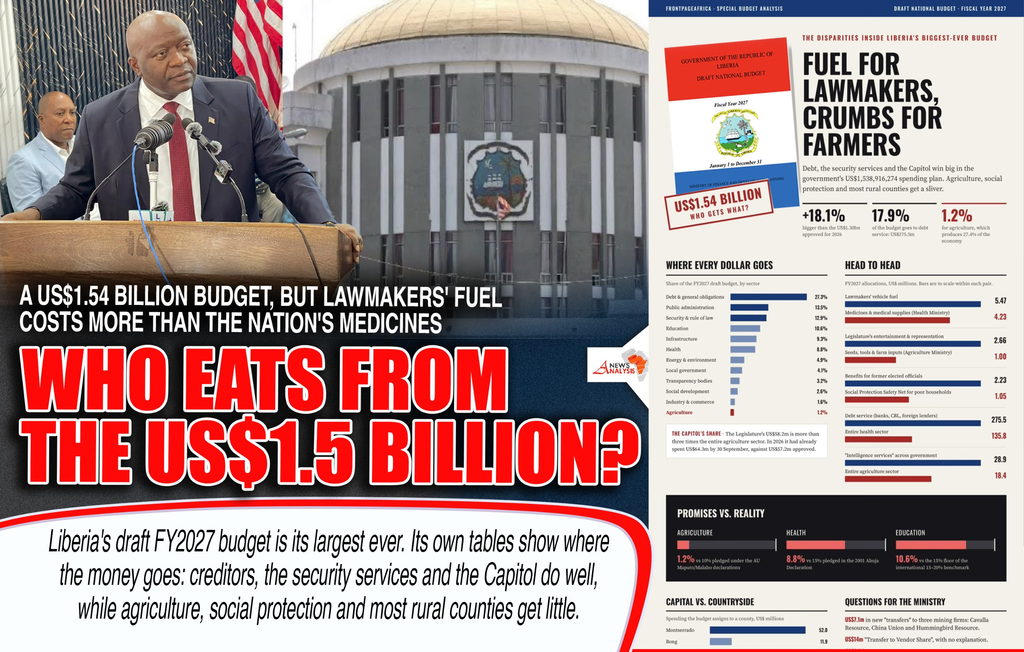
- Liberia's draft national budget for 2027 totals US$1.54 billion, marking an 18.1% increase from the previous year.
- The budget allocates US$275.5 million to debt service, which is twice the health budget and fifteen times the agriculture spending.
- Public sector pay will rise to US$369.4 million, benefiting over 17,000 workers, including teachers and police.
- The Legislature is allocated US$58.2 million, more than three times the entire agriculture sector's budget.
- The Legislature's vehicle fuel allowance of US$5.47 million exceeds the Ministry of Health's entire budget for drugs and medical consumables.
Liberia's Record Budget for 2027
The Legislature's vehicle fuel allowance of US$5.47 million exceeds the Ministry of Health's entire budget for drugs and medical consumables, which remains at US$4.23 million, despite the Ministry of Health having spent less than half of its allocated drug money by September of the previous year.
Liberia is poised to implement its largest national budget in history for the fiscal year 2027, with the Ministry of Finance and Development Planning proposing a total expenditure of US$1,538,916,274. This figure represents a substantial increase of US$236 million, or 18.1 percent, compared to the US$1.30 billion approved for the preceding year, 2026. The government has characterized this financial plan as "A Growing Budget for Bigger Impact," reflecting an optimistic outlook.
This unprecedented spending plan follows a significant milestone in domestic revenue collection, which surpassed US$1 billion in a single year for the first time on September 14, 2026. Officials attribute this surge in revenue to several factors, including a robust mining sector, a strengthened Liberian dollar, and a transition from a sales tax (GST) to a value-added tax (VAT). However, an in-depth analysis of the 845-page budget document reveals that a considerable portion of this new funding is earmarked for specific areas, primarily creditors, security services, the Legislature, and the capital region of Monrovia, with significantly less allocated to farmers, the nation's poorest households, and much of rural Liberia.
Key Allocations and Disparities
A substantial portion of the Liberia national budget 2027, specifically US$419.6 million, or 27.3 percent, is categorized under a new heading: General Obligations and Programs. Within this, debt service accounts for US$275.5 million, an increase from US$232 million in the current year. The primary beneficiaries of these debt payments are domestic institutions, with commercial banks receiving US$103.3 million, largely for Treasury bond repayments, and the Central Bank of Liberia allocated US$65 million, which includes US$22.4 million in interest. External creditors, led by the World Bank, are set to receive US$78.8 million. Notably, debt service now consumes approximately one in every five dollars of core domestic revenue, a sum that is twice the entire health budget and fifteen times the government's planned expenditure on agriculture.
Public sector pay increases represent another significant allocation, totaling US$369.4 million, which constitutes nearly a quarter of the overall budget. This is intended to benefit approximately 17,065 workers through new hires, the conversion of volunteers to paid staff, and salary top-ups. Teachers are among the main recipients, with new minimum monthly salaries set at US$650 for those with a master's degree, US$400 for a bachelor's degree, and US$200 for a C-Certificate, with pay equalization across Ministry of Education and Monrovia Consolidated School System schools. Additionally, 1,934 police officers will receive rank-based raises, and 616 staff members of the Liberia Drug Enforcement Agency are slated for a 15 percent increase. The security and rule-of-law sector is also set for a 21.5 percent boost, reaching US$198.4 million, with plans to recruit 600 police officers and between 800 and 1,200 soldiers.
Legislative Spending and Oversight Concerns
The Liberia legislative spending for the nation's 103 lawmakers and their staff is set at US$58.2 million for 2027. This allocation significantly overshadows other critical sectors, being more than three times the entire agriculture sector's budget of US$18.4 million and over four times that of the Ministry of Agriculture alone, which stands at US$13.1 million. A review of 2026 figures highlights a pattern of overspending within the Legislature, which had already spent US$64.3 million by September 30 against an approved budget of US$57.2 million. Specific instances include constituency visits, where over US$6.2 million was spent against a US$1.12 million budget, and legislative committee hearings, which saw US$6.5 million spent compared to a US$1.4 million allocation. Transfers to the Public Accounts Committee also exceeded their budget, with US$3.6 million paid against US$738,000 budgeted.
For the 2027 fiscal year, the budget for constituency visits is slated to more than triple to US$3.8 million. Furthermore, the Legislature's vehicle fuel allowance is set to increase by US$1 million, reaching US$5.47 million. This figure for legislative fuel alone surpasses the Ministry of Health's entire budget for drugs and medical consumables, which remains at US$4.23 million, despite the Ministry of Health having spent less than half of its allocated drug money by September of the previous year. Such disproportionate allocations raise questions regarding Liberia public finance oversight and resource management. The National Security Agency (NSA) is allocated US$30.25 million for 2027, without capital projects, despite having spent US$30.2 million by September 30, 2026, against a US$24.7 million budget, indicating a 22 percent overspend with a quarter of the year remaining. Overall spending on intelligence services across government is projected to rise from US$21.1 million to US$28.9 million, with the NSA's share increasing to US$13.7 million and the Ministry of Justice's to nearly US$8 million, though the budget and its annexes do not provide explanations for these specific expenditures.
Practical Implications
Lawyers advising clients on public procurement or government contracts in Liberia should note the significant shifts in the 2027 national budget, particularly the increased legislative spending and debt service, which may impact future government priorities and payment schedules. Compliance officers should monitor these allocations for potential fiscal mismanagement or corruption risks, especially concerning the disproportionate spending on legislative fuel compared to essential services like medicine.
Source
How does this affect you?
Get an AI analysis of this article grounded in your jurisdictions, practice areas, and any policy documents you've uploaded to Wansom.
Finish Reading the Full Story and the Expert Analysis.
Get the latest legal & regulatory intelligence in Liberia
Wansom is AI and can make mistakes.