
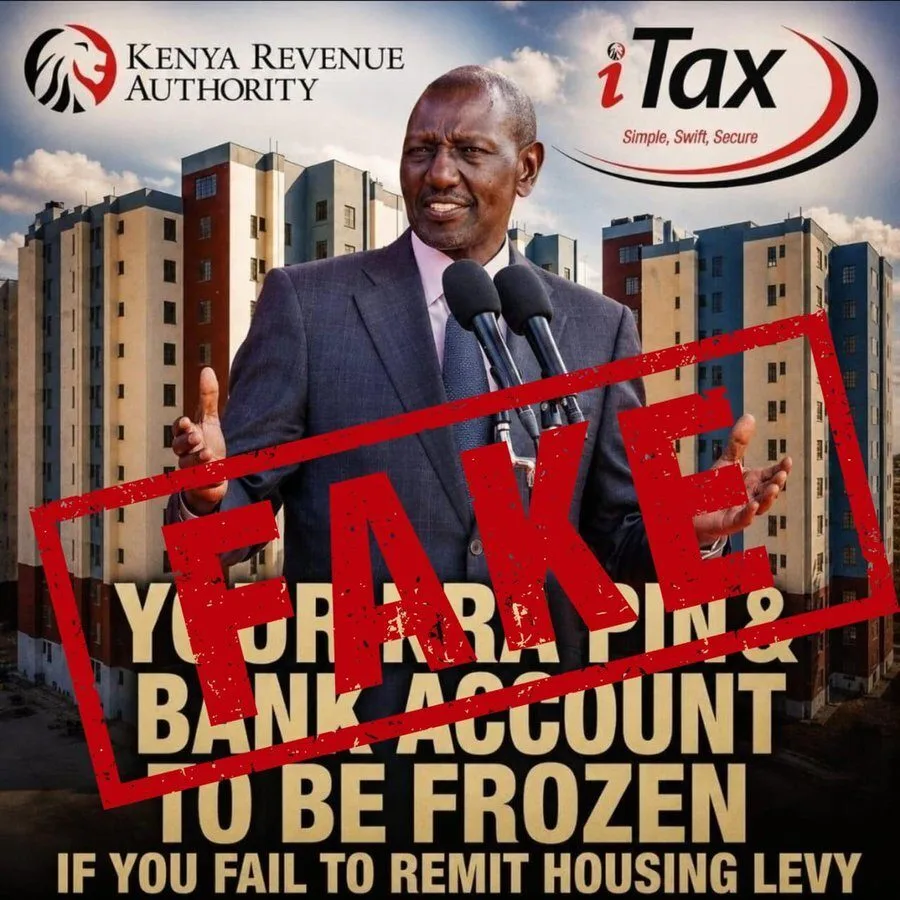
Kenya Revenue Authority: No Bank Account Freezing Over Housing Levy
Summary
- A fake graphic has been circulating online claiming that bank accounts will be frozen if the Affordable Housing Levy is not remitted.
- The Kenya Revenue Authority (KRA) has disowned the graphic, urging taxpayers to verify tax-related announcements through official communication channels.
- Kenyans have been advised to treat claims about tax obligations with caution and seek confirmation directly from KRA before taking action.
- Lawyers should advise clients to verify tax-related announcements through KRA's official communication channels before sharing or acting on them.
What Happened
The authority has, however, repeatedly warned taxpayers about fraudulent messages, fake social media accounts and misleading information purporting to originate from the revenue agency.
A fake graphic has been circulating online claiming that bank accounts of Kenyans who fail to remit the Affordable Housing Levy will be frozen. The graphic, which bears the image of President William Ruto and the KRA branding, is a clear attempt to exploit the ongoing public debate over the levy's constitutionality, administration, and collection. The message appears to create a sense of urgency and fear among taxpayers, warning that failure to remit the levy will result in automatic bank account freezing.
The graphic carries the KRA slogan, 'Tax Simple, Swift, Secure', alongside a bold warning that reads: 'BANK ACCOUNT TO BE FROZEN IF YOU FAIL TO REMIT HOUSING LEVY.' The accompanying photograph of President William Ruto adds to the impression that the warning is an official government directive. However, this is not the case.
KRA has distanced itself from the message and cautioned taxpayers against acting on unverified information circulating on social media.
Relevant Legal/Regulatory Context
The Affordable Housing Levy was re-introduced as a mandatory contribution under the government's affordable housing programme through the Affordable Housing Act, 2024, after an earlier version was declared unconstitutional. Employees contribute 1.5 per cent of their gross monthly salary towards the levy, while employers make a matching contribution of 1.5 per cent. The constitutionality of the re-introduced levy has since been upheld by the High Court.
The government has defended the levy as a key source of funding for the affordable housing programme, which is one of President William Ruto's flagship initiatives under the Bottom-Up Economic Transformation Agenda. However, the public debate surrounding the levy has created an environment conducive to misinformation and fake news.
KRA has repeatedly warned taxpayers about fraudulent messages, fake social media accounts, and misleading information purporting to originate from the revenue agency.
Why It Matters
The warning issued by KRA is particularly significant because fabricated notices carrying official logos, government branding, and images of senior state officials can easily be mistaken for genuine government communication. Kenyans have therefore been advised to treat claims about tax obligations, penalties, and enforcement measures with caution and seek confirmation directly from KRA before taking action.
Lawyers should advise clients to verify tax-related announcements through KRA's official communication channels before sharing or acting on them. This is crucial in preventing misinformation and ensuring that taxpayers are not misled into taking unnecessary actions or incurring avoidable penalties.
The latest clarification by KRA comes as government agencies increasingly use their official digital platforms to counter misinformation and distinguish legitimate public notices from fabricated material.
Practical Implications
Lawyers should advise clients to verify tax-related announcements through KRA's official communication channels before sharing or acting on them, as fake messages can easily be mistaken for genuine government communication.
Source
Source: Original reporting via [Source]
How does this affect you?
Get an AI analysis of this article grounded in your jurisdictions, practice areas, and any policy documents you've uploaded to Wansom.
Wansom is AI and can make mistakes.