
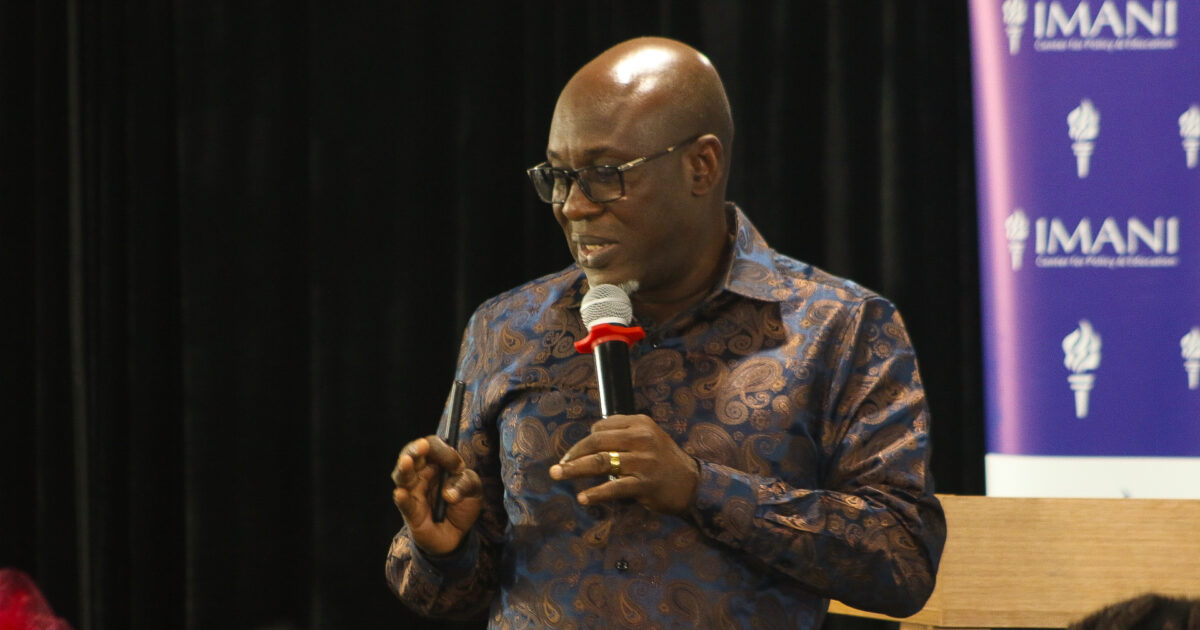
Kofi Bentil: Military Civilian Enforcement in Ghana Must Be Civilian
Summary
- Kofi Bentil, Vice President of IMANI Africa, rejected calls for increased military involvement in enforcing civilian discipline across Africa.
- He argued that effective civilian law enforcement and the rule of law are essential for maintaining order, citing developed nations as examples where the military remains in barracks.
- Bentil criticized the idea of military intervention, noting that African military institutions have sometimes been involved in unconstitutional power seizures and abuse.
- His speech at SYPALA 2026 emphasized building strong civilian institutions that operate consistently within constitutional limits, rather than imposing discipline through military force.
A Call for Civilian Authority
This perspective highlights that the core challenge is not merely imposing discipline, but rather constructing and empowering institutions capable of enforcing laws consistently and strictly within constitutional limits.
Kofi Bentil, a prominent lawyer and Vice President of IMANI Africa, recently voiced strong opposition to proposals advocating for increased military involvement in maintaining public order across Africa. Speaking at the Students and Young Professionals African Liberty Academy (SYPALA) 2026, an event organized by the IMANI Centre for Policy and Education in collaboration with the University of Professional Studies, Accra (UPSA), Bentil asserted that robust civilian law enforcement mechanisms and adherence to the rule of law are the true foundations for societal discipline, rather than military intervention. His remarks, delivered on Tuesday, August 25, directly countered arguments he encountered during a prior discussion with military leaders from various African nations. These leaders had suggested that Africa required more stringent discipline, including military action to address issues like traffic infractions and general disorder. However, Bentil firmly disagreed with this approach, advocating for a fundamentally different strategy.
Bentil's stance underscores a critical debate regarding the appropriate role of the military in civilian affairs, particularly in Ghana. He highlighted that while the desire for greater discipline is understandable, the method of achieving it must align with democratic principles and established legal frameworks. The discussion at SYPALA 2026 served as a platform to reinforce the importance of strengthening Ghana law enforcement institutions and ensuring that order is maintained through due process, rather than through extra-legal means or military intervention civilian affairs Africa.
Upholding the Rule of Law
Bentil underscored that the presence of military personnel on the streets cannot substitute for an effective civilian law enforcement system. He pointed to highly developed nations as prime examples, noting that countries like the United States, European nations, the United Kingdom, Norway, and Switzerland achieve high levels of societal order by relying on well-functioning civilian institutions and legal frameworks. In these societies, he observed, the military generally remains confined to its barracks, indicating that their development is intrinsically linked to the strength of their civilian governance. For Bentil, the crucial differentiator is the consistent application of the rule of law and the efficacy of civilian law enforcement institutions in Ghana and beyond.
He defined effective law enforcement as a system where citizens understand that legal transgressions, such as traffic violations, will predictably lead to consequences like arrest and fines, thereby fostering compliance. This predictability, he argued, is the cornerstone of true discipline and is entirely independent of military presence. The emphasis on a strong rule of law in Ghana, supported by capable civilian bodies, is presented as the only sustainable path to societal order and progress, echoing the principles discussed at the Kofi Bentil SYPALA 2026 speech.
Safeguarding Constitutional Boundaries
Furthermore, Bentil challenged the rationale behind deploying military forces to address civilian indiscipline, particularly given instances where military bodies in Africa have themselves engaged in unconstitutional acts, including the overthrow of governments and abuse of citizens. He controversially characterized the military in Africa as "the most indisciplined institution" due to these historical actions. This perspective highlights that the core challenge is not merely imposing discipline, but rather constructing and empowering institutions capable of enforcing laws consistently and strictly within constitutional limits law enforcement Ghana.
His address at SYPALA 2026 formed part of a broader discourse on the principles of limited government and the imperative for all state institutions to operate within clearly defined boundaries. Bentil cautioned that while governments are established by citizens and granted specific powers to serve and protect, these powers risk becoming instruments of oppression if left unchecked. He emphasized that no government should operate independently of its populace or exceed its delegated authority, reinforcing the need for robust civilian oversight and adherence to the rule of law in Ghana.
Practical Implications
Lawyers and compliance officers should note the emphasis on strengthening civilian law enforcement and judicial institutions as the proper mechanism for maintaining order, which underpins legal certainty and due process in Ghana, and be prepared to advocate against extra-legal or military interventions in civilian affairs.
Source
Source: Reporting by Carbonatix
How does this affect you?
Get an AI analysis of this article grounded in your jurisdictions, practice areas, and any policy documents you've uploaded to Wansom.
Wansom is AI and can make mistakes.