
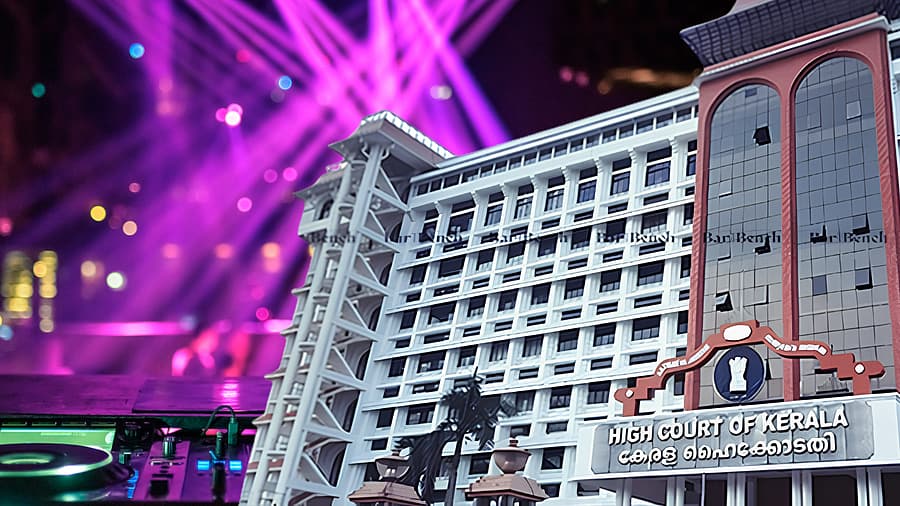
Kerala High Court: Possibility of Crime No Ground to Restrict Operating Hours
Summary
- The Kerala High Court ruled that police cannot restrict the operating hours of licensed bars hosting DJ parties.
- Justice Murali Purushothaman stated that the mere possibility of criminal activities is not a valid ground for such restrictions.
- Establishments with FL-3 liquor permits are allowed extended operating hours under Foreign Liquor Amendment Rules.
- Police must take stringent action against actual criminal activities, not impose blanket restrictions based on suspicion.
- Any curtailment of extended hours requires specific rules to be framed by the State government.
What Happened
Justice Purushothaman explicitly stated that the mere potential for criminal activities does not, by itself, constitute a sufficient basis for police intervention to curtail the operational hours of these licensed establishments.
The Kerala High Court recently issued a significant directive, affirming that law enforcement agencies lack the authority to impose time-based restrictions on DJ parties hosted by establishments holding valid FL-3 liquor permits. These permits specifically authorize such venues to operate during extended hours. The ruling, delivered on Tuesday by Justice Murali Purushothaman in the case of Mahadevan v State of Kerala & ors, underscores the limitations on police powers when dealing with licensed businesses.
Justice Purushothaman explicitly stated that the mere potential for criminal activities does not, by itself, constitute a sufficient basis for police intervention to curtail the operational hours of these licensed establishments. This judgment clarifies the boundaries of police authority, particularly concerning venues that are already operating within the framework of existing state regulations. The decision emphasizes that suspicion alone is not enough to override established licensing provisions.
Legal Framework
The Court's decision is rooted in the interplay between the Kerala Police Act and the Foreign Liquor Amendment Rules, which govern the extended operating hours for FL-3 permit-holding hotels. The ruling highlighted that while the police are tasked with preventing and addressing criminal acts, this responsibility does not extend to arbitrarily restricting the activities of bars that possess the necessary licenses. Specifically, the Court found that the Kerala Police Act does not grant the power to impose such restrictions based solely on the possibility of crime.
The Foreign Liquor Amendment Rules are crucial here, as they permit these establishments to operate for extended periods. The High Court clarified that any curtailment of these permitted hours would require specific rules to be framed by the State government itself. Without such explicit state-level regulations, the police cannot unilaterally override the provisions granted under the existing Foreign Liquor Rules, even if they suspect illicit activities like drug use might occur during DJ parties.
Implications of the Ruling
This ruling carries significant implications for both law enforcement and licensed hospitality businesses in Kerala. It firmly establishes that the police cannot use general suspicions of criminal behavior, such as drug use, as a pretext to limit the operational timings of licensed bars. Instead, the Court stressed that if law enforcement genuinely believes that criminal activities are unfolding under the guise of DJ parties, their duty is to take decisive and stringent action in accordance with established legal procedures to curb those specific offenses.
The judgment serves as a clear directive: until the government enacts appropriate rules that specifically outline exceptions to the extended operating hours permitted by the Foreign Liquor Rules, the police are prohibited from restricting or curtailing a hotel's operating hours. This means that in the absence of concrete, special grounds or new state-level legislation, the existing provisions for extended operations for FL-3 permit holders must be respected, reinforcing the principle that licensed businesses should not face arbitrary restrictions based on mere conjecture.
Source
How does this affect you?
Get an AI analysis of this article grounded in your jurisdictions, practice areas, and any policy documents you've uploaded to Wansom.
Finish Reading the Full Story and the Expert Analysis.
Get the latest legal & regulatory intelligence in India
Wansom is AI and can make mistakes.