
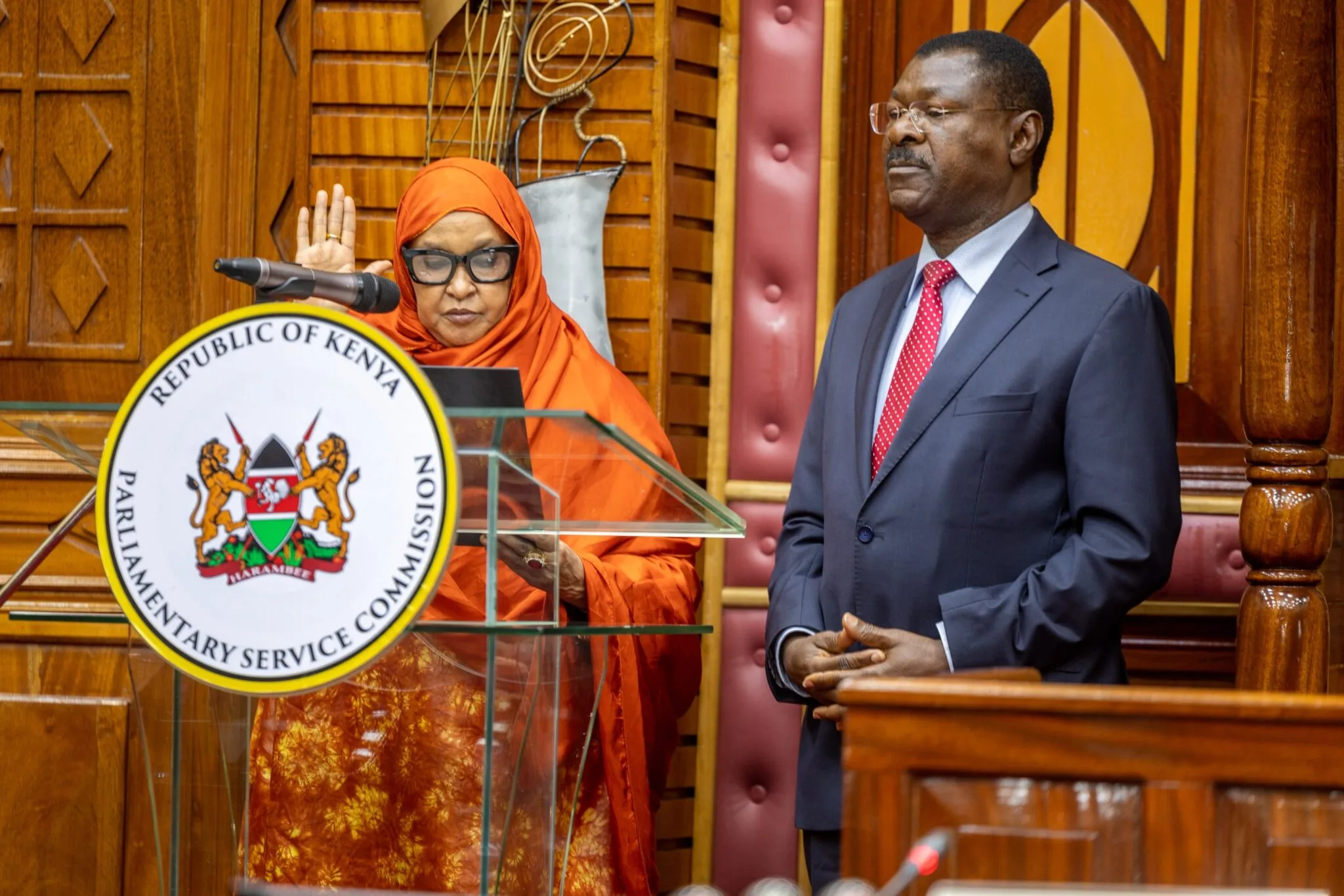
Fatuma Ibrahim Ali: Sworn In As PSC Commissioner Kenya
Summary
- Fatuma Ibrahim Ali was sworn in as a non-MP commissioner of the Kenya Parliamentary Service Commission on October 8.
- She pledged to prioritize consensus, integrity, and teamwork in her new role, following her approval by both Houses of Parliament.
- Her appointment followed a rigorous vetting process that assessed candidates on qualifications and compliance with Chapter Six of the Constitution.
- National Assembly Speaker Moses Wetang’ula emphasized the PSC's commitment to consensus-based decision-making, stating the Commission avoids voting on contentious issues.
- Ms. Ali emerged as the top candidate from a pool of twelve applicants, replacing former commissioner Rachel Ameso.
Key Appointment to Parliamentary Service Commission
This commitment to collaborative decision-making is seen as crucial for maintaining unity and effectively fulfilling the Commission's constitutional mandate without creating internal divisions.
On October 8, Fatuma Ibrahim Ali, formerly the Wajir County Woman Representative, formally assumed her new responsibilities as a non-member commissioner of the Kenya Parliamentary Service Commission (PSC). The swearing-in ceremony took place at County Hall within the Parliament Buildings in Nairobi, marking a significant addition to the Commission's composition. Her appointment fills the vacancy left by Rachel Ameso, whose term had concluded.
Ms. Ali's path to becoming a PSC commissioner involved a comprehensive selection process. She was identified as the leading candidate among twelve individuals who had been shortlisted and interviewed by the PSC on September 10. Her nomination received parliamentary approval, with the Senate endorsing her on October 1 and the National Assembly following suit on October 7, thereby paving the way for her official oath of office.
Upon her swearing-in, Ms. Ali expressed her profound humility regarding the appointment. She articulated a clear commitment to working collaboratively with her fellow commissioners to advance the core mandate of the PSC. Her prior experience includes serving as the Wajir County Woman Representative during the 11th Parliament, providing her with direct insight into parliamentary operations.
A Focus on Consensus and Unity
A cornerstone of Ms. Ali's stated approach to her new role is a strong emphasis on consensus-building, teamwork, and upholding integrity. She highlighted consensus as an indispensable principle for effective decision-making within the Commission, believing it essential for maintaining unity, ensuring the PSC remains focused on its constitutional responsibilities, and safeguarding the broader interests of Parliament. This commitment to collaborative decision-making is seen as crucial for maintaining unity and effectively fulfilling the Commission's constitutional mandate without creating internal divisions.
National Assembly Speaker Moses Wetang’ula, who also chairs the PSC, echoed and reinforced this operational philosophy. He revealed that the Commission has consistently avoided resorting to voting to resolve internal disagreements. Instead, when consensus is not immediately reached, issues are deliberated further, often deferred to allow for more reflection and discussion. Speaker Wetang’ula underscored that this method ensures all members are "carried along," fostering a unified approach rather than creating "winners and losers" that can result from a simple majority vote.
Rigorous Vetting and Integrity Standards
The selection process for the new PSC non-MP commissioner was thorough, evaluating candidates against several key criteria. These included academic qualifications, practical experience in public affairs, a demonstrated understanding of the mandates of both Parliament and the Parliamentary Service Commission, and proven leadership and management capabilities. Significantly, the vetting also rigorously assessed compliance with the stringent leadership and integrity requirements stipulated under Chapter Six of the Constitution of Kenya, underscoring the nation's commitment to ethical public service.
Speaker Wetang’ula emphasized that Ms. Ali joins the PSC at a pivotal moment, as the Commission actively seeks to bolster Parliament's institutional strength, champion integrity across its operations, and enhance public comprehension of its vital work. He expressed confidence that her extensive background in parliamentary and public affairs would undoubtedly contribute significant value to the Commission's ongoing endeavors.
Leadership's Vision for the PSC
Welcoming Ms. Ali, Speaker Wetang’ula acknowledged her rich history within Parliament and public service, expressing certainty that her experience would strengthen the institution. He issued a clear directive for the new commissioner to act as a dedicated team player, consistently prioritizing the collective interests of Parliament, its members, staff, and the broader democratic institution above any personal, sectarian, or regional considerations.
The Speaker also took the opportunity to commend the outgoing commissioner, Rachel Ameso, for her substantial contributions, noting that she had left an "indelible mark" during her tenure. Further endorsement came from Nyandarua Woman Representative Faith Gitau, who has known Ms. Ali for over a decade. Ms. Gitau lauded the appointment, describing Ms. Ali as a committed public servant and expressing full confidence in her capacity to excel in her new responsibilities, recalling their previous collaboration during Ms. Ali's campaign for the East African Legislative Assembly.
Practical Implications
Lawyers and compliance officers should note the new composition of the Parliamentary Service Commission (PSC) and its stated commitment to consensus-based decision-making, as this informs the operational approach of a key body overseeing parliamentary services. The vetting under Chapter Six of the Constitution also reinforces ongoing integrity requirements for public office in Kenya.
Source
How does this affect you?
Get an AI analysis of this article grounded in your jurisdictions, practice areas, and any policy documents you've uploaded to Wansom.
Finish Reading the Full Story and the Expert Analysis.
Get the latest legal & regulatory intelligence in Kenya
Wansom is AI and can make mistakes.