
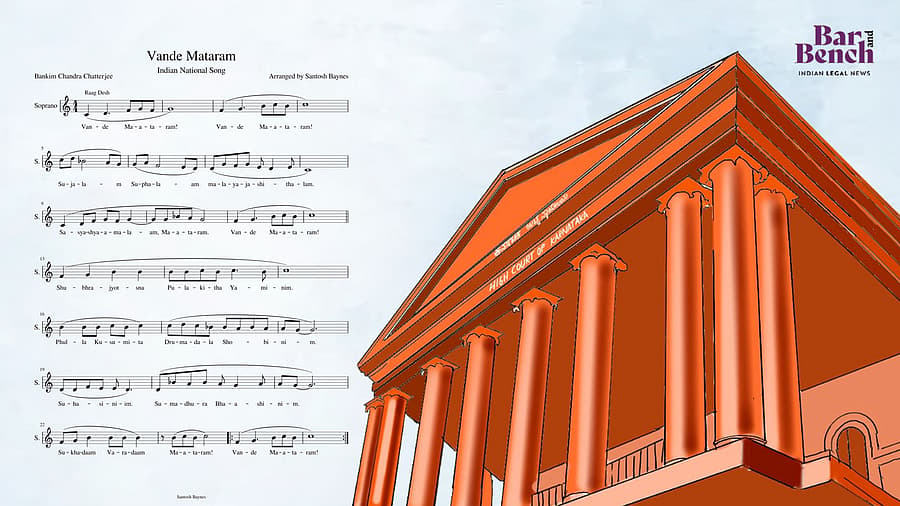
Karnataka High Court: Vande Mataram Stanzas Order Challenged in PIL
Summary
- A Public Interest Litigation has been filed in the Karnataka High Court challenging a state government order.
- The order mandates that only the first two stanzas of Vande Mataram be sung at State functions, with an exception for high-ranking dignitaries.
- The PIL argues this order undermines Parliament's intent, as Vande Mataram was recently given national song status by the Prevention of Insults to National Honour (Amendment) Act, 2026.
- It also contends the order restricts freedom of speech under Article 19(1)(a) and was issued without proper legal advice or administrative notes.
- The case, `Girish Bharadwaj v State of Karnataka`, is expected to have an urgent hearing soon.
What Happened
The PIL also fundamentally argues that the government's mandate infringes upon citizens' constitutional rights, specifically their freedom of speech and expression as enshrined under Article 19(1)(a) of the Constitution.
A Public Interest Litigation (PIL) has been initiated in the Karnataka High Court, directly challenging a recent directive from the Karnataka State government. This legal action, titled `Girish Bharadwaj v State of Karnataka`, contests an order that restricts the rendition of the national song, Vande Mataram, at official State functions. The petitioner, advocate Girish Bharadwaj, is represented by advocate Angad Kamath, and the matter is anticipated to be brought before the court for an urgent hearing this coming Wednesday.
The contentious order, issued by the State government on September 8, stipulates that only the initial two stanzas of Vande Mataram are to be sung during State-organized events. However, the directive includes a specific exemption: if the President, Vice-President, Prime Minister, or Governor are in attendance at a programme, the full six stanzas of the national song are permitted to be performed. This selective application of the song's length forms a central point of contention in the newly filed PIL.
Legal Grounds for Challenge
The PIL argues that the Karnataka State government's order significantly undermines the legislative intent of the Parliament. This contention arises from the recent enactment of the Prevention of Insults to National Honour (Amendment) Act, 2026, which formally recognized Vande Mataram as a national song and accorded it a status comparable to that of the national anthem. The petitioner asserts that by limiting its rendition, the state directive contradicts the spirit of this parliamentary legislation designed to protect the song's full version.
Furthermore, the petition raises concerns regarding the procedural integrity behind the state order's formulation. It highlights that the cabinet's decision to issue the directive stemmed from an 'informal discussion,' notably lacking any accompanying legal advice or a formal cabinet Note from the administrative department. The PIL also fundamentally argues that the government's mandate infringes upon citizens' constitutional rights, specifically their freedom of speech and expression as enshrined under Article 19(1)(a) of the Constitution.
Broader Implications
This legal challenge to the `Karnataka State government national song order` carries significant implications for the interpretation of national symbols and the scope of state authority in regulating their use. By questioning the restriction on Vande Mataram's stanzas, the PIL directly confronts whether a state government can issue directives that potentially conflict with parliamentary acts concerning national honour and fundamental rights. The case of `Girish Bharadwaj v State of Karnataka` therefore becomes a crucial test for judicial review of executive actions impacting cultural and national expressions.
The petitioner's argument that the order restricts freedom of speech under Article 19(1)(a) of the Constitution underscores the potential for such directives to impinge on individual liberties. The challenge to the `Vande Mataram two stanzas order challenge` also highlights the importance of proper administrative procedure, emphasizing that significant governmental mandates should be supported by formal legal counsel and departmental notes rather than informal discussions. The outcome of this `Karnataka High Court Vande Mataram stanzas PIL` could establish important precedents for how national symbols are managed and how state regulations are scrutinized against constitutional provisions and central legislation like the `Prevention of Insults to National Honour Act 2026`.
Practical Implications
This Public Interest Litigation challenges a state order on fundamental rights and the proper procedure for issuing such directives. Lawyers should monitor the outcome as it could set a precedent for judicial review of state regulations concerning national symbols and the scope of Article 19(1)(a) freedom of speech.
Source
How does this affect you?
Get an AI analysis of this article grounded in your jurisdictions, practice areas, and any policy documents you've uploaded to Wansom.
Finish Reading the Full Story and the Expert Analysis.
Get the latest legal & regulatory intelligence in India
Wansom is AI and can make mistakes.