
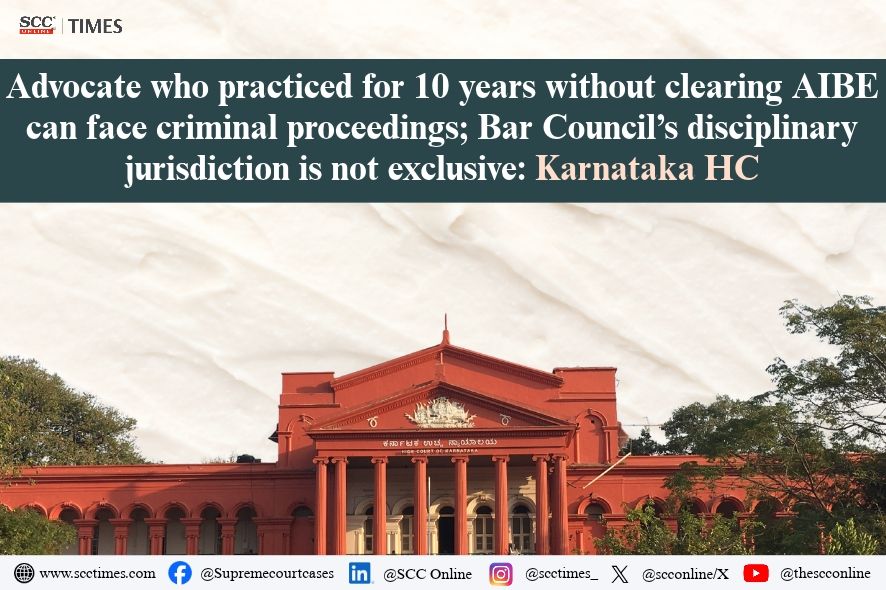
Karnataka High Court: Advocate AIBE Criminal Proceedings for 10-Year Practice
Summary
- The Karnataka High Court considered a complaint against an advocate who allegedly practiced for ten years without clearing the All India Bar Examination (AIBE).
- Provisional enrolment requires advocates to clear the AIBE within a two-year period.
- The Court examined both the Bar Council's disciplinary powers and a complainant's right to initiate criminal proceedings.
- The ruling clarifies that an advocate practicing without AIBE clearance can face criminal proceedings.
- This decision establishes that the Bar Council's disciplinary jurisdiction is not exclusive in such matters.
Allegations Before the High Court
The Karnataka High Court's ruling clarifies that an advocate who practices for an extended period, such as ten years, without clearing the AIBE, may be subject to criminal proceedings.
The Karnataka High Court recently took up a significant complaint involving a legal practitioner accused of serious professional misconduct. The individual in question allegedly continued to practice law for approximately ten years without successfully passing the mandatory All India Bar Examination (AIBE). This alleged prolonged practice occurred despite the clear regulatory framework stipulating a two-year window for provisional enrollees to clear the AIBE.
The complaint brought before the High Court highlighted a potential breach of professional standards and regulatory requirements designed to ensure competence within the legal profession. The advocate's purported decade-long practice without fulfilling this fundamental qualification raised questions about the oversight mechanisms and the consequences for non-compliance with the AIBE mandate. The Court's deliberation on this matter underscores the judiciary's role in upholding the integrity of legal practice.
Expanding the Scope of Accountability
In its review of the complaint, the Karnataka High Court undertook a comprehensive examination of the powers vested in the Bar Council concerning disciplinary actions against legal professionals. Beyond merely assessing the Bar Council's authority, the Court also critically analyzed the complainant's entitlement to initiate criminal proceedings against the advocate. This dual focus signals a broader interpretation of accountability for those who fail to meet essential professional qualifications.
The Court's consideration of criminal proceedings alongside disciplinary measures indicates a potential shift in how All India Bar Examination non-compliance is viewed within the legal system. It suggests that practicing without the requisite qualifications, particularly beyond the provisional enrolment two-year limit, could transcend mere professional misconduct and enter the realm of criminal liability. This aspect of the ruling is particularly noteworthy for its implications regarding the enforcement of legal practice standards.
Implications for Legal Practice
The Karnataka High Court's recent ruling carries substantial weight for the legal fraternity, clarifying that an advocate who practices for an extended period, such as ten years, without clearing the AIBE, may be subject to criminal proceedings. This pivotal decision establishes that the Bar Council’s disciplinary jurisdiction is not the sole avenue for redress in cases of All India Bar Examination non-compliance. The judgment thus broadens the potential repercussions for those who disregard the mandatory qualification.
This ruling underscores the critical importance of adhering to the provisional enrolment two-year limit for passing the AIBE. It sends a clear message that failure to comply with this fundamental requirement can lead to severe legal consequences, extending beyond professional sanctions to include criminal liability. The Karnataka High Court AIBE ruling reinforces the principle that the integrity of the legal profession is paramount, and non-compliance with its foundational standards will be met with robust legal action.
Practical Implications
This ruling clarifies that advocates practicing without clearing the All India Bar Examination (AIBE) are not only subject to the Bar Council's disciplinary actions but can also face criminal proceedings. Lawyers should advise provisional enrollees to strictly adhere to the two-year AIBE clearance deadline to avoid severe legal repercussions, including criminal liability, and understand that the Bar Council's jurisdiction is not exclusive in such matters.
Source
Source: Original reporting via SCC Times
How does this affect you?
Get an AI analysis of this article grounded in your jurisdictions, practice areas, and any policy documents you've uploaded to Wansom.
Wansom is AI and can make mistakes.