
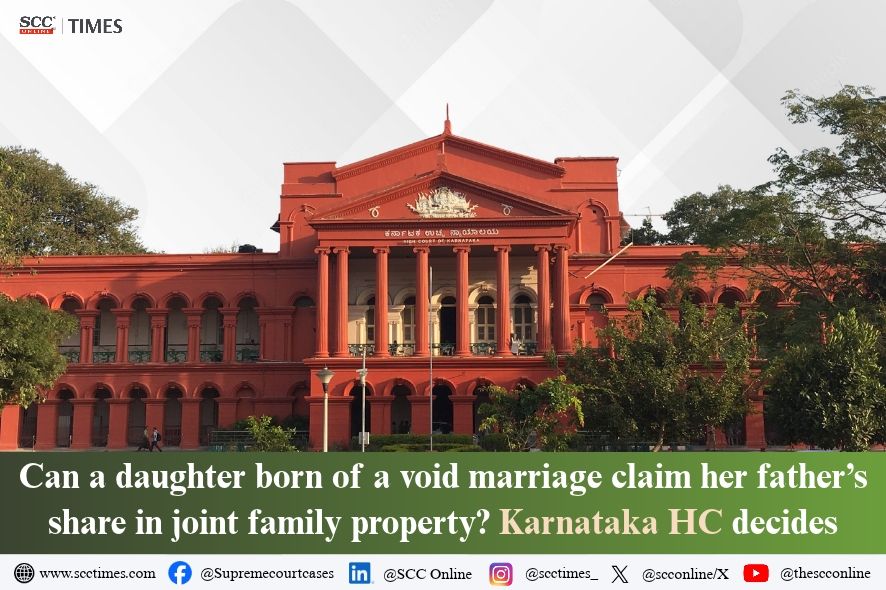
Karnataka High Court: Daughter Has Void Marriage Property Rights
Summary
- The Karnataka High Court has clarified the inheritance rights of children born from void marriages.
- Section 16 of the Hindu Marriage Act, 1955, legitimizes children from void marriages.
- This legitimization allows such children to inherit their deceased parent's share in ancestral property.
- A daughter born of a void marriage can claim her father’s share in joint family property.
What the Court Clarified
The legitimization conferred by Section 16 directly translates into concrete inheritance rights, specifically enabling a child born from a void marriage to succeed to their deceased parent's share in ancestral property.
The Karnataka High Court recently addressed a significant question concerning inheritance rights, specifically focusing on whether a daughter born from a void marriage holds a claim to her father's portion of joint family property. This judicial intervention provides crucial clarity on "Karnataka HC void marriage property rights", reinforcing the established legal position regarding the succession entitlements of such children. The court's determination underscores the protective provisions embedded within Indian family law designed to safeguard the interests of offspring, irrespective of the legal validity of their parents' union.
This ruling by the Karnataka High Court serves as an important precedent, guiding future interpretations of inheritance laws in similar circumstances. It directly tackles the complexities arising from marital invalidity and its potential impact on the next generation's financial security. By affirming these rights, the court has contributed to a more equitable application of property distribution principles under Hindu law, ensuring that the legal status of a marriage does not unjustly penalize innocent children.
The decision specifically pertains to the ability of a daughter, whose parents' marriage was legally void, to inherit her father's share within the framework of a joint family property. This clarification is vital for legal practitioners and families alike, as it delineates the boundaries of succession rights for children who might otherwise face disenfranchisement due to the technicalities of their parents' marital status.
The Legal Basis for Legitimacy
Central to the Karnataka High Court's pronouncement is Section 16 of the Hindu Marriage Act, 1955, a pivotal legislative provision that grants legitimacy to children born out of marriages deemed void under the Act. This section is instrumental in addressing the "legitimacy of child void marriage India", ensuring that such children are not treated as illegitimate in the eyes of the law, despite the nullity of their parents' marital bond. The legislative intent behind Section 16 is to protect the welfare and legal standing of these children, preventing them from suffering the consequences of a union that was legally flawed from its inception.
The effect of Section 16 is profound, as it bestows upon these children the same legal status as those born from a valid marriage, particularly concerning their rights to inheritance. This statutory legitimization is a cornerstone of "Hindu Marriage Act Section 16 inheritance" principles, directly enabling children from void marriages to assert their claims to their parents' estates. Without this specific provision, their succession rights would be ambiguous, potentially leading to significant legal and social challenges.
This legal framework ensures that the personal status of the parents' marriage does not dictate the fundamental rights of their offspring. By explicitly legitimizing children born from void marriages, the Act creates a pathway for them to be recognized as legal heirs, thereby securing their future and preventing potential destitution. It reflects a progressive approach to family law, prioritizing the rights of the child above the technical deficiencies of the marital union.
Inheritance of Ancestral Property
The legitimization conferred by Section 16 directly translates into concrete inheritance rights, specifically enabling a child born from a void marriage to succeed to their deceased parent's share in ancestral property. This is a critical aspect of "daughter void marriage ancestral property" rights, as it ensures that daughters, like sons, are not excluded from inheriting their rightful share simply because their parents' marriage was legally invalid. The court's decision reinforces that such children are entitled to their parent's portion within the larger "joint family property daughter rights" framework.
This interpretation means that the share of a parent in ancestral property, which would typically devolve upon their legitimate children, is also available to children born from void marriages, provided they are legitimized under Section 16. This clarification is vital for the equitable distribution of family assets and prevents discrimination against children based on circumstances beyond their control. It ensures that the legal fiction of legitimacy established by the Act has real-world implications for property succession.
Consequently, legal professionals advising on Hindu family law and inheritance must meticulously consider the implications of Section 16. The affirmation of these rights by the Karnataka High Court means that children from void marriages have a clear legal standing to claim their deceased parent's share in ancestral property, impacting how estates are settled and how joint family properties are partitioned. This ensures that the protective umbrella of the Hindu Marriage Act extends fully to safeguard the inheritance rights of all children, regardless of the legal status of their parents' marriage.
Practical Implications
Lawyers advising on Hindu family law and inheritance should note the Karnataka High Court's interpretation of Section 16 of the Hindu Marriage Act, 1955, which affirms the right of children born from void marriages to inherit ancestral property. This clarifies their succession rights and impacts property distribution in such cases, requiring careful consideration when drafting wills or advising on estate matters.
Source
How does this affect you?
Get an AI analysis of this article grounded in your jurisdictions, practice areas, and any policy documents you've uploaded to Wansom.
Wansom is AI and can make mistakes.