
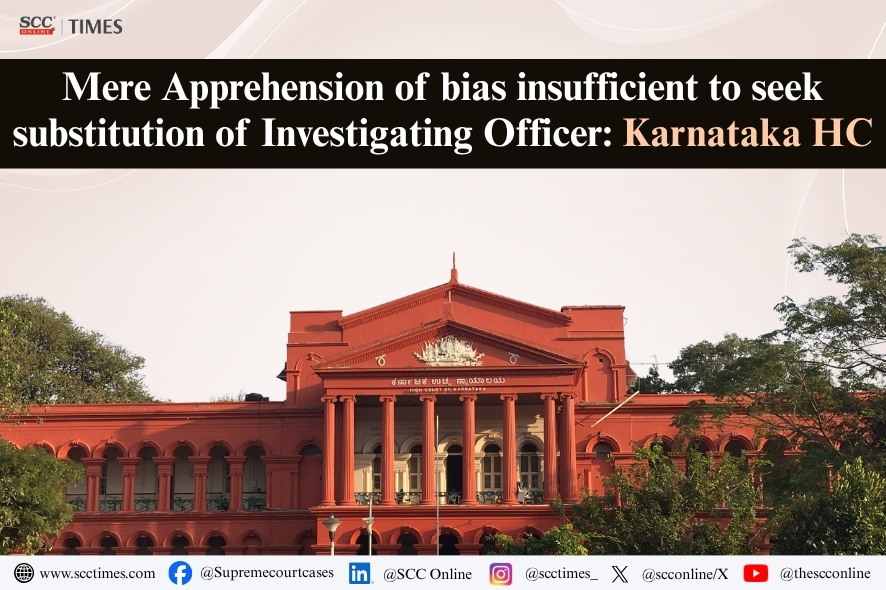
Karnataka HC: Investigating Officer Substitution Bias Requires Proof
Summary
- The Karnataka High Court ruled that mere apprehension of bias is insufficient to seek the substitution of an Investigating Officer.
- Individuals under investigation cannot insist on choosing their preferred Investigating Officer.
- A clear case of mala fides, demonstrable bias, lack of jurisdiction, or abuse of process must be proven for an IO substitution.
- This decision sets a high evidentiary bar for challenging the appointment of an Investigating Officer in Karnataka.
Karnataka High Court Sets High Bar for IO Substitution
The Karnataka High Court has unequivocally stated that individuals facing investigation cannot simply demand a change in their Investigating Officer based solely on a perceived risk of unfairness.
The Karnataka High Court has issued a significant ruling clarifying the stringent conditions under which an Investigating Officer (IO) can be replaced in a criminal probe. The court unequivocally stated that a mere apprehension of bias is not sufficient grounds for an individual under investigation to demand the substitution of an Investigating Officer. This decision underscores the judiciary's stance on maintaining the integrity and independence of the investigative process, limiting the ability of accused persons to influence the choice of their investigators.
For a change in the Investigating Officer to be considered by a competent court, the ruling mandates that a clear and compelling case must be presented. Specifically, the court requires evidence of mala fides, demonstrable bias, a lack of jurisdiction on the part of the IO, or a clear abuse of the investigative process. Without such concrete proof, the person under investigation cannot insist that the inquiry be conducted by an officer of their personal preference, thereby reinforcing the principle that the selection of an IO is not at the discretion of the accused.
Legal Context of Investigating Officer Independence
This pronouncement by the Karnataka High Court reinforces established principles governing criminal investigation procedure in India, particularly concerning the independence of law enforcement agencies. The judiciary generally refrains from interfering with the investigative process unless there are compelling reasons, such as a clear miscarriage of justice or a fundamental procedural flaw. The court's emphasis on `mala fides investigating officer India` as a prerequisite for intervention highlights the high threshold for proving improper conduct by an investigator.
The ruling implicitly addresses the `right to choose investigating officer`, clarifying that no such inherent right exists for an accused person. The investigative machinery is designed to operate impartially, and allowing individuals to handpick their investigators could compromise the fairness and effectiveness of the process. Therefore, any challenge to an IO's appointment must move beyond subjective feelings of unfairness and present objective, verifiable grounds demonstrating a genuine impediment to a fair investigation.
Implications for Criminal Defense Strategy in Karnataka
The Karnataka HC Investigating Officer substitution bias ruling carries substantial implications for legal practitioners and individuals facing criminal charges within the state. Lawyers advising clients in Karnataka must now understand that challenging an Investigating Officer's appointment requires concrete evidence of `mala fides`, demonstrable bias, or an abuse of process, as `mere apprehension bias investigation` is explicitly deemed insufficient. This sets a high bar for such applications and necessitates a robust evidentiary foundation rather than speculative claims.
Defense strategies during criminal investigations will need to adapt to this stringent requirement. Instead of relying on general concerns about an IO's impartiality, legal teams must focus on uncovering specific instances of misconduct, jurisdictional overreach, or clear prejudice that can be substantiated before a competent court. This judicial stance ensures that applications for IO replacement are not used as a tactic to delay or derail legitimate investigations, thereby impacting the overall efficiency and integrity of the `criminal investigation procedure Karnataka`.
Practical Implications
Lawyers in Karnataka must advise clients that challenging an Investigating Officer's appointment requires concrete evidence of mala fides, demonstrable bias, or abuse of process, as mere apprehension of bias is insufficient. This ruling sets a high bar for such applications and impacts defense strategy during criminal investigations.
Source
How does this affect you?
Get an AI analysis of this article grounded in your jurisdictions, practice areas, and any policy documents you've uploaded to Wansom.
Finish Reading the Full Story and the Expert Analysis.
Get the latest legal & regulatory intelligence in India
Wansom is AI and can make mistakes.