
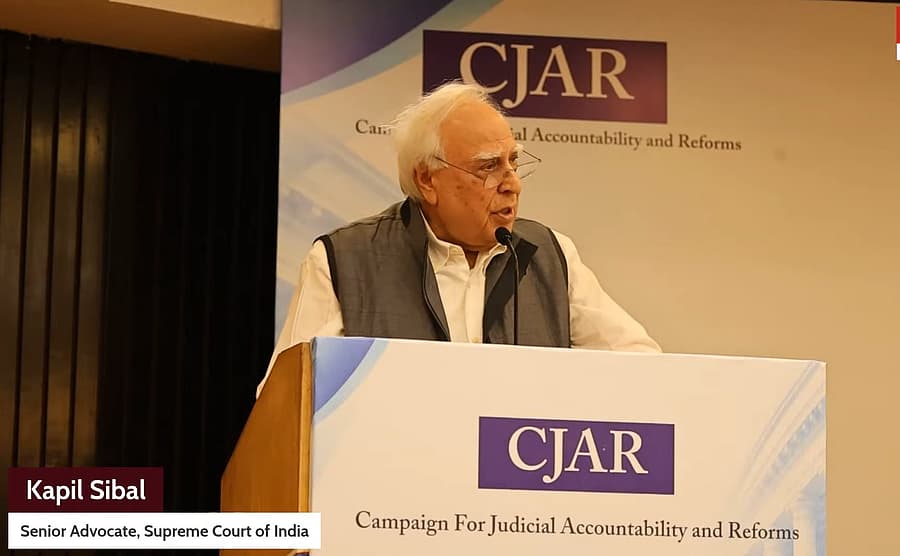
Kapil Sibal: Critiques Master of Roster System, Judicial Accountability
Summary
- Senior Advocate Kapil Sibal criticized the administrative functioning of India's higher judiciary on Tuesday.
- He warned that the 'master of the roster' system, Collegium's backroom bargaining, and opaque disciplinary inquiries are causing a crisis of public confidence.
- Sibal argued that unlike judicial pronouncements, administrative decisions by Chief Justices lack public debate and review, making the institution vulnerable.
- He questioned how to achieve accountability when judges are primarily answerable only to their own conscience in such matters.
- The critique was delivered at an event organized by the Campaign for Judicial Accountability and Reforms (CJAR) in New Delhi.
Sibal Critiques Judicial Administration
The unreviewable nature of administrative decisions, particularly concerning the 'master of the roster' system and the Collegium's internal workings, creates a perception of unaccountability that can erode trust.
Senior Advocate Kapil Sibal recently delivered a sharp critique of the higher judiciary's administrative operations, asserting that several practices are undermining public trust. Speaking on Tuesday at an event organized by the Campaign for Judicial Accountability and Reforms (CJAR) at the India International Centre in New Delhi, Sibal specifically targeted the 'master of the roster' system, which grants the Chief Justice significant power over case allocation.
Beyond the allocation system, Sibal also highlighted concerns regarding the opaque nature of the Collegium's internal deliberations, which involve backroom bargaining, and the complete lack of transparency surrounding in-house disciplinary inquiries into judges accused of misconduct. These issues, he argued, collectively contribute to a significant crisis of public confidence in the judicial system. His remarks underscore a growing debate around the 'master of roster system India' and its implications for judicial integrity.
Accountability and Unreviewable Discretion
Sibal drew a clear distinction between the public scrutiny applied to judicial pronouncements and the absence of such oversight for administrative decisions. While court judgments are routinely subjected to public debate and analysis, he observed that the administrative discretion exercised by Chief Justices remains largely unreviewable. This lack of external scrutiny, he contended, leaves the judicial institution susceptible to systemic erosion.
He emphasized the difficulty in holding administrative actions accountable, stating that it is not possible to publicly criticize a judge or a Chief Justice for assigning a particular matter to another judge. This administrative opacity, according to Sibal, creates a vacuum where accountability is primarily left to a judge's individual conscience. He questioned the effectiveness of such a system in ensuring robust judicial accountability, particularly when judges may not consistently engage in self-reflection regarding the rectitude of their administrative choices.
Systemic Vulnerability and Public Trust
The senior advocate's remarks illuminate a critical aspect of judicial functioning: the tension between administrative autonomy and public expectation of transparency. The unreviewable nature of administrative decisions, particularly concerning the 'master of the roster' system and the Collegium's internal workings, creates a perception of unaccountability that can erode trust. This critique by Kapil Sibal master of roster system highlights how internal processes, if not sufficiently transparent, can undermine the judiciary's standing.
Sibal's concerns about the 'Collegium system transparency debate' and 'judicial disciplinary inquiries India' point to a broader vulnerability within the judicial framework. He suggested that while judges are human beings, their ultimate accountability to their own conscience is often insufficient to address systemic issues. The ongoing public discourse, fueled by figures like Sibal, underscores the urgent need for greater transparency and defined mechanisms for 'India judicial accountability Sibal' believes are currently lacking, contributing to a crisis of public confidence.
Practical Implications
Lawyers and compliance officers in India should monitor the ongoing public discourse on judicial administrative practices, particularly the 'master of the roster' system, as critiques from prominent legal figures like Kapil Sibal highlight systemic concerns about accountability and transparency that could influence future judicial reforms or public confidence in the legal system.
Source
How does this affect you?
Get an AI analysis of this article grounded in your jurisdictions, practice areas, and any policy documents you've uploaded to Wansom.
Finish Reading the Full Story and the Expert Analysis.
Wansom is AI and can make mistakes.