
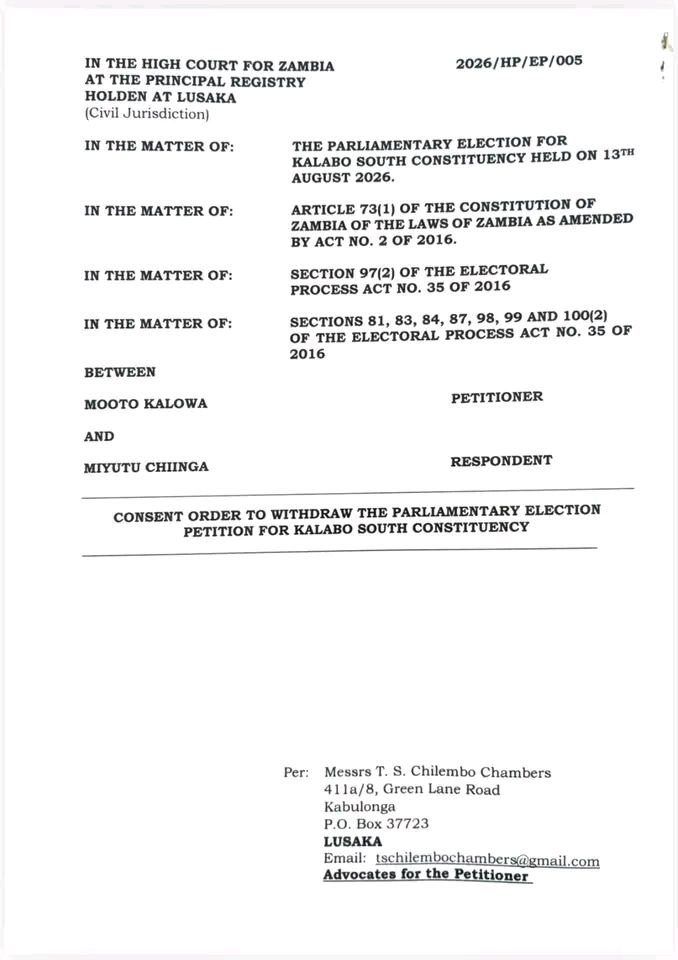
Kalabo South Election Petition Withdrawn: Parties File Consent Order
Summary
- The parliamentary election petition for Kalabo South Constituency has been withdrawn.
- This petition challenged the results of the August 2026 election.
- The withdrawal was by consent of all involved parties.
- Both sides cited the need to ease family tensions and restore unity as reasons.
- A formal consent order was filed in Mongu on October 16, 2026, to finalize the withdrawal.
What Happened
This particular case, involving the Kalabo South election petition withdrawn, offers a compelling illustration of how non-legal considerations can profoundly influence the trajectory and resolution of political disputes.
In a notable development from Mongu on Friday, October 16, 2026, the parliamentary election petition challenging the results of the Kalabo South Constituency vote has been officially withdrawn. This significant decision, concerning the August 2026 election, was reached through a mutual agreement between all involved parties. The withdrawal of the Kalabo South election petition marks a resolution to the electoral dispute that had been ongoing since the general polls.
The primary motivation behind this consensual withdrawal was explicitly stated by both sides: a collective desire to alleviate existing family tensions and foster a renewed sense of unity within the community. Rather than pursuing a potentially divisive legal battle, the parties opted for an amicable settlement, which culminated in the filing of a formal consent order. This approach underscores a preference for social cohesion over prolonged adversarial proceedings in the context of the Kalabo South parliamentary election 2026.
Legal Context
The resolution of this electoral challenge through a consent order highlights a specific mechanism available within Zambia's legal framework for election dispute resolution. An election petition in Zambia typically initiates a formal legal process to contest election results, often involving detailed scrutiny of voting procedures and outcomes. However, the ability for parties to agree to a Zambia election petition withdrawal by consent provides an alternative pathway that can circumvent the full rigors of court proceedings.
The filing of a consent order election petition Zambia legally formalizes the agreement between the petitioner and the respondent, effectively bringing the legal challenge to an end without a judicial ruling on the merits of the original petition. This process requires the court's endorsement, ensuring that the withdrawal is indeed voluntary and agreed upon by all relevant parties. Such an outcome demonstrates flexibility within the electoral justice system, allowing for resolutions that may consider broader societal interests beyond strict legal arguments.
Why It Matters
This particular case, involving the Kalabo South election petition withdrawn, offers a compelling illustration of how non-legal considerations can profoundly influence the trajectory and resolution of political disputes. While election petitions are inherently legal challenges, the explicit citing of "family unity" and the need to "ease tensions" as the driving force behind the withdrawal introduces a dimension often overlooked in traditional legal analysis. It suggests that in certain contexts, the social fabric and communal harmony can take precedence over the pursuit of a purely legal victory.
For legal practitioners, this scenario provides an important precedent. It demonstrates that clients involved in election disputes, or indeed any high-stakes litigation, might find alternative resolution paths by considering the broader social and familial implications of their actions. The successful Zambia election petition withdrawal by consent, driven by a desire for unity, underscores that not all disputes require a definitive legal winner and loser, potentially offering a more holistic approach to election dispute resolution in Zambia. This outcome could serve as a model for navigating complex political disagreements where community ties are paramount.
Practical Implications
Lawyers should note that election petitions in Zambia can be withdrawn by consent, demonstrating that non-legal factors like family unity can influence the resolution of political disputes, potentially offering an alternative path for clients seeking to avoid protracted litigation.
Source
How does this affect you?
Get an AI analysis of this article grounded in your jurisdictions, practice areas, and any policy documents you've uploaded to Wansom.
Finish Reading the Full Story and the Expert Analysis.
Get the latest legal & regulatory intelligence in Zambia
Wansom is AI and can make mistakes.