
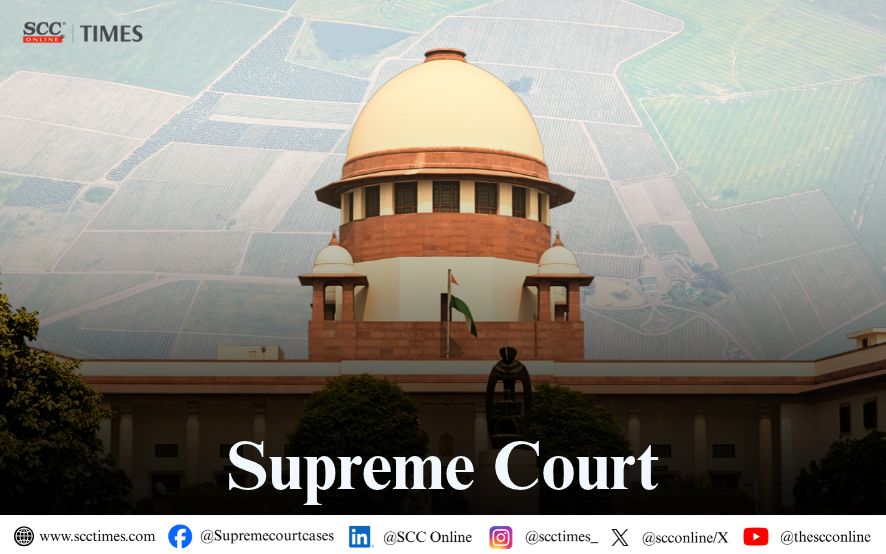
Supreme Court: Justice Sanjay Karol to Lead Edenburg City Dispute Committee
Summary
- Justice Sanjay Karol has been appointed to chair a Special Committee for the Edenburg City plot dispute.
- The committee will oversee Phase II claim verification, including comprehensive title checks and revenue audits.
- Defaulting claimants have a final three weeks to submit their documents for verification.
- The dispute originated from a 1996 writ petition concerning Durga Builders' development in Faridabad.
- The committee is directed to submit its report within four months and propose an equitable allocation mechanism.
New Leadership for Edenburg City Dispute Resolution
The newly appointed Special Committee, under Justice Sanjay Karol, is tasked with overseeing the crucial Phase II scrutiny and verification of plot claims, aiming to bring resolution to a complex and protracted legal battle.
The Supreme Court has recently taken a significant step in the long-running Edenburg City (formerly Okhla Enclave) plot allotment dispute in Faridabad. A Division Bench, comprising Justices Vikram Nath and Sandeep Mehta, has appointed former Supreme Court Judge Justice Sanjay Karol to lead a reconstituted Special Committee. This committee is tasked with overseeing the crucial Phase II scrutiny and verification of plot claims, aiming to bring resolution to a complex and protracted legal battle.
The Court emphasized that the eligibility criteria and cut-off dates established in its judgment of October 3, 2019, are now final and binding. The Special Committee's mandate includes a comprehensive title verification process, a thorough revenue audit, and the reconciliation of competing claims against the actual availability of land. This directive underscores the Court's commitment to ensuring fairness and accuracy in the allocation process.
Background of the Faridabad Plot Dispute
The genesis of this extensive dispute traces back to Writ Petition (Civil) No. 876 of 1996, which the Supreme Court initially resolved with its October 3, 2019 judgment. The case involves a residential colony, initially known as Okhla Enclave and later rebranded as Edenburg City, developed by Durga Builders (P) Ltd. and its associated entities. This development spans approximately 235 acres across Villages Sehatpur, Agwanpur, and Ismailpur in Sector 91, Faridabad, Haryana.
The Department of Town and Country Planning, Haryana, had issued seven colonisation licenses under the Haryana Development and Regulation of Urban Areas Act, 1975. The residential plots were categorized into Economically Weaker Section (EWS), No Profit No Loss (NPNL), and General Category, with the intention of using sales from General Category plots to cross-subsidize the EWS and NPNL allotments. However, the developer failed to meet its statutory and contractual obligations, including the execution of internal and external development works, payment of external development charges, and renewal fees for licenses. Furthermore, the developer engaged in unauthorized and duplicate allotments and imposed arbitrary demands for development charges.
Prior Legal Interventions and Irregularities
Aggrieved by the developer's failure to provide essential civic infrastructure and honor contractual agreements, various associations representing plot allottees sought redress from the Supreme Court under Article 32 of the Constitution, with W.P. (C) No. 876 of 1996 serving as the lead matter. Throughout the litigation, the Court issued numerous directives concerning plot adjustments, payment of development charges, approval of building plans, and the execution of conveyance deeds. The Punjab and Haryana High Court also mandated that 567 litigating allottees be granted parity with the 492 original petitioners before the Supreme Court, a decision subsequently upheld by the apex court.
Investigations later uncovered significant and systemic irregularities in the conveyances executed by the developer. These included unauthorized and duplicate sale deeds, backdated conveyances, and registered sale deeds that conspicuously lacked the purchasers' signatures. Given the multitude of conflicting claims, the Supreme Court, through an order dated October 21, 2008, appointed Shri H.P. Sharma as a Court Commissioner. His role was to identify genuine allottees, verify land ownership, assess the development work completed, and audit the funds collected by the developer. The Commissioner ultimately identified 2,196 valid plot entitlements from a pool of over 3,000 claimants. Following this, the Director General, Town and Country Planning, Haryana (DGTCP), was instructed to conduct a new field survey and reconcile these entitlements with the 844 allottees recognized under the High Court's orders, further highlighting the need for a robust Haryana plot verification committee.
New Directives and Committee's Mandate
In its latest pronouncement, the Supreme Court has provided a final opportunity for defaulting claimants to submit their necessary claim documents within a strict three-week timeframe. The newly appointed Special Committee, under Justice Sanjay Karol, is also tasked with developing a transparent and equitable mechanism for plot allocation. Furthermore, the committee will explore the feasibility of converting unutilized Economically Weaker Section (EWS) land into No Profit No Loss (NPNL) plots or group housing complexes, a move that could significantly impact the overall resolution.
The Supreme Court has directed the Special Committee to endeavor to submit its comprehensive report within four months, signaling an intent to expedite the final resolution of this long-standing dispute concerning the Supreme Court Edenburg City plot.
Practical Implications
Lawyers representing claimants in the Edenburg City/Okhla Enclave plot dispute must note the appointment of Justice Sanjay Karol to head the Special Committee and the three-week deadline for submitting claim documents. This development necessitates advising clients on compliance with the new verification process and potential impacts on their plot entitlements, especially concerning the comprehensive title verification and revenue audit.
Source
How does this affect you?
Get an AI analysis of this article grounded in your jurisdictions, practice areas, and any policy documents you've uploaded to Wansom.
Finish Reading the Full Story and the Expert Analysis.
Get the latest legal & regulatory intelligence in India
Wansom is AI and can make mistakes.