
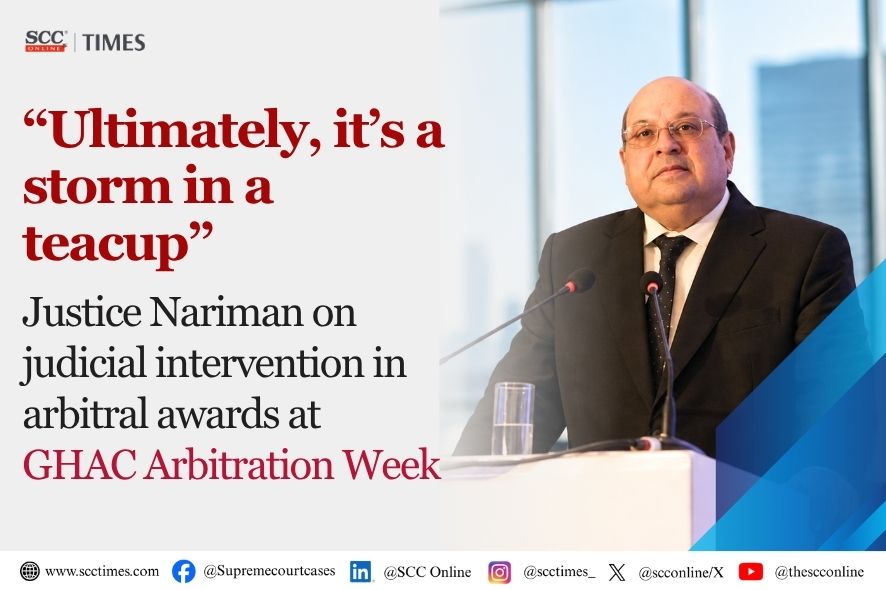
Justice Nariman: Sets Limits on Arbitration Judicial Intervention in India
Summary
- Justice R.F. Nariman shared his perspectives on judicial intervention in arbitral awards at GHAC Arbitration Day 1.
- His reflections focused on defining the precise limits of court interference in arbitration proceedings.
- Justice Nariman also discussed the specific circumstances under which arbitral matters should be remitted to tribunals rather than being entirely set aside.
- These observations contribute to the ongoing discourse on upholding arbitral finality and predictability in India.
Key Reflections on Arbitration's Future
His authoritative voice, particularly on matters concerning judicial intervention, signals a continued commitment within the higher echelons of the judiciary to uphold the finality and enforceability of arbitral awards.
Justice R.F. Nariman, a prominent legal figure, recently offered significant insights into the intricate relationship between judicial authority and arbitral processes during the inaugural GHAC Arbitration Day. His discourse centered on the critical issue of judicial intervention in arbitral awards, a topic of perennial interest within the legal community. These reflections underscore the ongoing debate regarding the appropriate boundaries for court involvement in dispute resolution mechanisms designed for efficiency and finality.
The former Supreme Court Justice specifically addressed the delicate balance required to maintain the integrity of arbitration while ensuring adequate oversight. His observations delved into the precise limits of court interference, a crucial aspect for practitioners and parties engaging in alternative dispute resolution. This focus on defining judicial boundaries is particularly pertinent in the evolving landscape of Justice Nariman arbitration judicial intervention India, where the judiciary plays a pivotal role in shaping the efficacy of arbitral proceedings.
Furthermore, Justice Nariman's remarks extended to the circumstances under which arbitral matters should be referred back to the original tribunal for reconsideration, rather than being entirely set aside by a court. This nuanced perspective highlights a preference for preserving the arbitral process where possible, suggesting a judicial philosophy that favors correction over outright annulment. His participation at GHAC Arbitration Day 1 provided a high-profile platform for these essential discussions, influencing the discourse around Indian arbitration judicial review.
Navigating Judicial Oversight in Arbitral Awards
The principles underpinning arbitration law in India emphasize party autonomy and the expeditious resolution of commercial disputes, aiming to provide a swift and final determination outside traditional court litigation. However, the necessity for a degree of judicial oversight remains, primarily to address fundamental flaws in the arbitral process or awards that contravene public policy. This inherent tension between arbitral finality and the need for judicial review forms the backdrop of discussions concerning court interference arbitral awards India.
The legal framework governing arbitration provides specific, limited grounds upon which an arbitral award can be challenged and potentially set aside. These provisions are designed to prevent courts from re-evaluating the merits of a dispute already decided by an arbitrator, thereby upholding the sanctity of the arbitral process. The challenge for the judiciary, and a key area of Justice Nariman arbitration law, lies in interpreting these grounds strictly to avoid transforming arbitration into merely another preliminary step before full-blown litigation.
Discussions around setting aside arbitration awards frequently revolve around procedural fairness, jurisdictional issues, and patent illegality. Justice Nariman's reflections contribute to this ongoing dialogue by advocating for a disciplined approach to judicial review, reinforcing the idea that courts should exercise restraint. The objective is to ensure that while egregious errors can be corrected, the fundamental purpose of arbitration as a binding and efficient dispute resolution mechanism is not undermined by excessive judicial scrutiny.
The Imperative of Limited Court Interference
Justice Nariman's emphasis on the limits of court interference is a cornerstone of robust arbitration practice. The rationale behind restricting judicial intervention is multifaceted, primarily aimed at fostering confidence in arbitration as a reliable and predictable method for resolving disputes. Unfettered judicial review can lead to prolonged litigation, negate the cost and time efficiencies of arbitration, and ultimately discourage its adoption by commercial entities seeking definitive outcomes.
His insights into when matters should be sent back to the arbitral tribunal, rather than being quashed outright, offer a practical pathway for judicial restraint. This approach allows for the rectification of specific issues or procedural irregularities by the original decision-makers, preserving the bulk of the arbitral award and the parties' investment in the process. It represents a less disruptive form of Indian arbitration judicial review, aligning with the legislative intent to support and strengthen arbitration.
This nuanced perspective, as articulated by Justice Nariman, reinforces the principle that courts should not act as appellate bodies for arbitral awards. Instead, their role is supervisory, ensuring that the arbitral process adheres to fundamental legal standards and that awards do not suffer from jurisdictional defects or manifest injustice. The ongoing dialogue, highlighted by Justice Nariman's participation at GHAC Arbitration Day 1, continues to shape the understanding and application of these critical boundaries.
Upholding Arbitral Finality and Predictability
The implications of Justice Nariman's reflections are significant for the future trajectory of arbitration in India. His authoritative voice, particularly on matters concerning judicial intervention, signals a continued commitment within the higher echelons of the judiciary to uphold the finality and enforceability of arbitral awards. This stance is crucial for enhancing India's reputation as an arbitration-friendly jurisdiction, attracting both domestic and international parties to resolve their disputes through this mechanism.
For legal professionals and compliance officers, closely monitoring such judicial pronouncements is paramount. Understanding the evolving contours of court interference arbitral awards India allows for more accurate risk assessment when drafting arbitration clauses, pursuing or defending arbitral claims, and strategizing post-award challenges. The emphasis on limited intervention and the preference for remittal over setting aside arbitration awards provides a clearer framework for anticipating judicial responses.
Ultimately, the discussions initiated by Justice Nariman at GHAC Arbitration Day 1 contribute to a more predictable and stable environment for arbitration. By reinforcing the principle that judicial review is an exception rather than the rule, and by clarifying the conditions under which courts should act, these reflections strengthen the foundational pillars of Justice Nariman arbitration law. This ensures that the benefits of arbitration – speed, expertise, and finality – are preserved for all stakeholders.
Practical Implications
Lawyers and compliance officers should closely monitor judicial pronouncements on arbitration in India, particularly regarding the limits of court intervention in arbitral awards, as Justice Nariman's reflections indicate a continued focus on upholding arbitral finality. This perspective can inform strategies for challenging or defending awards and assessing the risk of judicial interference.
Source
Source: Original reporting via SCC Times
How does this affect you?
Get an AI analysis of this article grounded in your jurisdictions, practice areas, and any policy documents you've uploaded to Wansom.
Finish Reading the Full Story and the Expert Analysis.
Get the latest legal & regulatory intelligence in India
Wansom is AI and can make mistakes.