
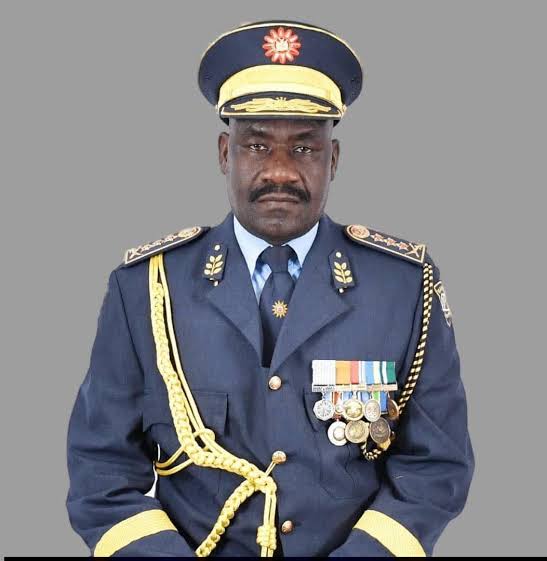
Namibia: Joseph Shikongo Crash Docket Whereabouts Disputed by Officials
Summary
- The investigation docket for a fatal crash involving suspended police chief Joseph Shikongo is currently of unknown whereabouts.
- Acting Prosecutor General Martha Imalwa stated the docket was returned to the police for further investigations.
- Deputy Inspector General Elias Mutota, however, maintains the police do not possess the docket.
- This discrepancy highlights conflicting accounts between the prosecutor general's office and the police in Namibia.
- The unresolved location of the Shikongo accident investigation docket raises concerns about procedural integrity.
Disputed Docket Location in High-Profile Crash Probe
The conflicting accounts from high-ranking officials create significant uncertainty regarding the proper handling and progression of this sensitive investigation.
The precise whereabouts of the investigation docket pertaining to a fatal traffic accident, which involves suspended police chief Joseph Shikongo, are currently a subject of contention. Official statements from two prominent Namibian state entities, the prosecutor general’s office and the police, offer contradictory information regarding the document's location. This inter-agency disagreement has cast a shadow over the ongoing probe into the incident.
The central issue revolves around the physical custody of the Shikongo accident investigation docket, a crucial component for any legal proceedings or further investigative steps. The lack of clarity surrounding the Joseph Shikongo crash docket whereabouts in Namibia has brought attention to the procedural integrity of high-profile cases within the nation's justice system.
Conflicting Official Statements Emerge
Acting Prosecutor General Martha Imalwa has publicly stated that her office returned the contentious docket to the police. According to Imalwa, this action was taken to facilitate additional investigations required for the case's progression. Her assertion places the responsibility for the docket's current possession squarely with the police force.
However, this account is directly contradicted by Deputy Inspector General Elias Mutota. Mutota maintains that the police do not currently hold the docket, effectively denying Imalwa's claim. This direct conflict between Martha Imalwa, the prosecutor general's representative, and Elias Mutota, a high-ranking police official, leaves the actual location of the police docket missing in Namibia ambiguous and unresolved.
Implications for Justice and Accountability
The dispute over the Shikongo accident investigation docket's location carries significant implications for the administration of justice. A criminal docket serves as the central repository for all evidence, statements, and investigative findings. Its uncertain whereabouts can severely impede the "Namibia police chief crash probe," potentially delaying or even derailing the legal process.
Such procedural irregularities raise serious questions about the chain of custody for critical evidence, a fundamental principle in ensuring a fair and transparent legal process. When the very document that underpins an investigation, especially one involving a suspended police chief, cannot be definitively located or accounted for by the relevant authorities, it creates a perception of disarray and potential for due process concerns.
Erosion of Public Trust
The ongoing confusion surrounding the Joseph Shikongo crash docket whereabouts in Namibia extends beyond mere administrative oversight; it has the potential to erode public confidence in the country's law enforcement and judicial institutions. In a case involving a high-ranking official, transparency and clear accountability are paramount.
The conflicting accounts from high-ranking officials create significant uncertainty regarding the proper handling and progression of this sensitive investigation. This situation underscores the critical need for robust internal protocols and inter-agency cooperation to prevent such disputes, ensuring that justice is not only done but is also seen to be done, particularly in matters of public interest and official conduct.
Practical Implications
Lawyers involved in criminal defense or prosecution in Namibia should note the potential for procedural irregularities and inter-agency disputes regarding evidence handling in high-profile cases, which could impact case progression and due process. This situation highlights the importance of scrutinizing the chain of custody for dockets.
Source
How does this affect you?
Get an AI analysis of this article grounded in your jurisdictions, practice areas, and any policy documents you've uploaded to Wansom.
Finish Reading the Full Story and the Expert Analysis.
Get the latest legal & regulatory intelligence in Namibia
Wansom is AI and can make mistakes.