
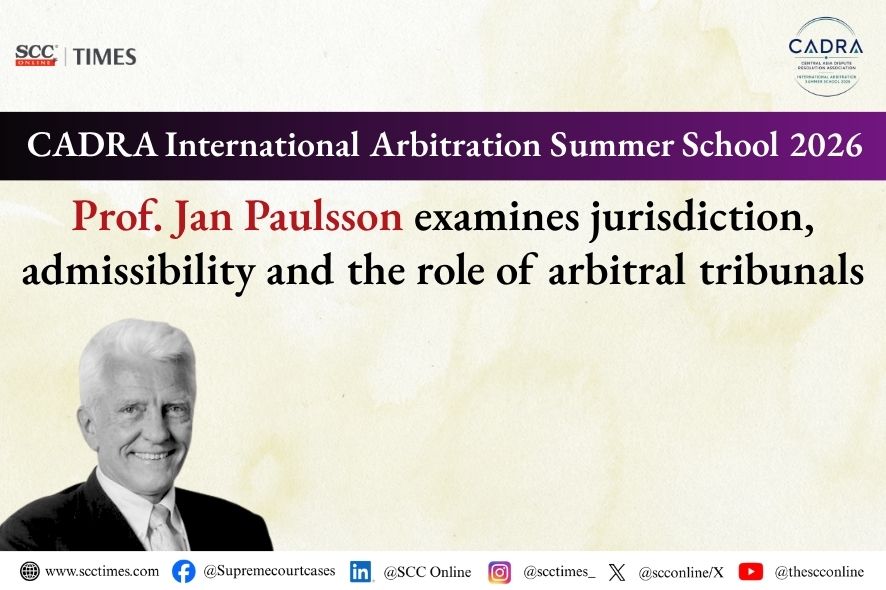
Jan Paulsson: Clarifying Arbitration Jurisdiction Admissibility
Summary
- Professor Jan Paulsson discussed the critical distinction between jurisdiction and admissibility in international arbitration at the CADRA International Arbitration Summer School 2026.
- His presentation covered key topics including preliminary objections, contractual conditions precedent, arbitral authority, and court review.
- Paulsson also examined how these concepts apply to both treaty and contractual claims in arbitration.
- The discussion provides a framework for understanding the tribunal's power to hear a case versus the proper presentation of a claim.
- These insights are crucial for refining strategies in raising or defending preliminary objections and navigating complex procedural challenges in international arbitration.
Unpacking Key Arbitral Concepts
For legal professionals and compliance officers engaged in international arbitration, Professor Jan Paulsson's detailed examination of jurisdiction and admissibility offers invaluable strategic guidance.
At the CADRA International Arbitration Summer School in 2026, Professor Jan Paulsson led a significant discussion focusing on the critical distinction between jurisdiction and admissibility within the realm of international arbitration. His address delved into several pivotal aspects that shape the landscape of arbitral proceedings. This examination is particularly relevant for practitioners navigating the complexities of international arbitration jurisdiction admissibility.
Professor Paulsson's comprehensive analysis covered a range of interconnected themes. These included the nature of preliminary objections, the role and impact of contractual conditions precedent, the inherent authority of arbitral tribunals, and the scope of court review over arbitral decisions. Furthermore, his insights extended to how these distinctions apply to the treatment of both treaty and contractual claims arbitration, offering a nuanced perspective on these often-intertwined areas of law.
The Nuance of Jurisdiction and Admissibility
The core of Professor Paulsson's presentation at the CADRA International Arbitration Summer School centered on differentiating between a tribunal's jurisdiction and the admissibility of a claim. This distinction is fundamental in international arbitration, as it dictates whether an arbitral panel has the power to hear a case at all (jurisdiction) versus whether a claim, even if falling within the tribunal's jurisdiction, is properly brought before it at a given time (admissibility). Understanding this difference is crucial for any party involved in international arbitration jurisdiction admissibility disputes.
Preliminary objections frequently arise from these very concepts. For instance, a challenge to a tribunal's jurisdiction might argue that no valid arbitration agreement exists, or that the dispute falls outside its scope. Conversely, an objection to admissibility could contend that a party has failed to satisfy a mandatory pre-arbitration step, such as a negotiation period or mediation, often stipulated as contractual conditions precedent. Professor Jan Paulsson's framework provides a clearer lens through which to analyze these intricate procedural hurdles.
Impact on Arbitral Authority and Judicial Oversight
Professor Paulsson's exploration of jurisdiction and admissibility has profound implications for how arbitral authority is perceived and exercised. By meticulously separating these concepts, his work helps to delineate the precise boundaries within which an arbitral tribunal can operate. This clarity is vital for ensuring the legitimacy and enforceability of awards, as it directly influences how tribunals address challenges to their competence and the merits of a claim.
Moreover, the distinction is highly relevant to the process of court review. National courts, when asked to set aside or enforce an arbitral award, often scrutinize the tribunal's jurisdictional findings. However, the treatment of admissibility issues by courts can differ, potentially leading to varied outcomes depending on the specific legal framework. Professor Paulsson's insights into these areas, including the specific considerations for treaty and contractual claims arbitration, underscore the importance of precise legal argumentation when engaging with judicial oversight of arbitral processes.
Strategic Considerations for Practitioners
For legal professionals and compliance officers engaged in international arbitration, Professor Jan Paulsson's detailed examination of jurisdiction and admissibility offers invaluable strategic guidance. His work provides a robust framework for assessing potential challenges and formulating effective responses to preliminary objections. By clearly understanding whether an issue pertains to the tribunal's fundamental power or to the procedural propriety of a claim, parties can refine their arguments and enhance their chances of success.
Navigating complex procedural challenges in international arbitration demands a sophisticated understanding of these distinctions. Whether drafting arbitration clauses, responding to a request for arbitration, or challenging an award, a clear grasp of the nuances between jurisdiction and admissibility, as highlighted by Professor Paulsson at the CADRA International Arbitration Summer School, is indispensable. This refined approach allows practitioners to more effectively manage risks and optimize their advocacy in high-stakes international disputes involving treaty and contractual claims.
Practical Implications
Lawyers and compliance officers involved in international arbitration should review Prof. Paulsson's distinctions between jurisdiction and admissibility to refine their strategy for raising or defending preliminary objections and navigating complex procedural challenges.
Source
How does this affect you?
Get an AI analysis of this article grounded in your jurisdictions, practice areas, and any policy documents you've uploaded to Wansom.
Finish Reading the Full Story and the Expert Analysis.
Get the latest legal & regulatory intelligence in India
Wansom is AI and can make mistakes.