
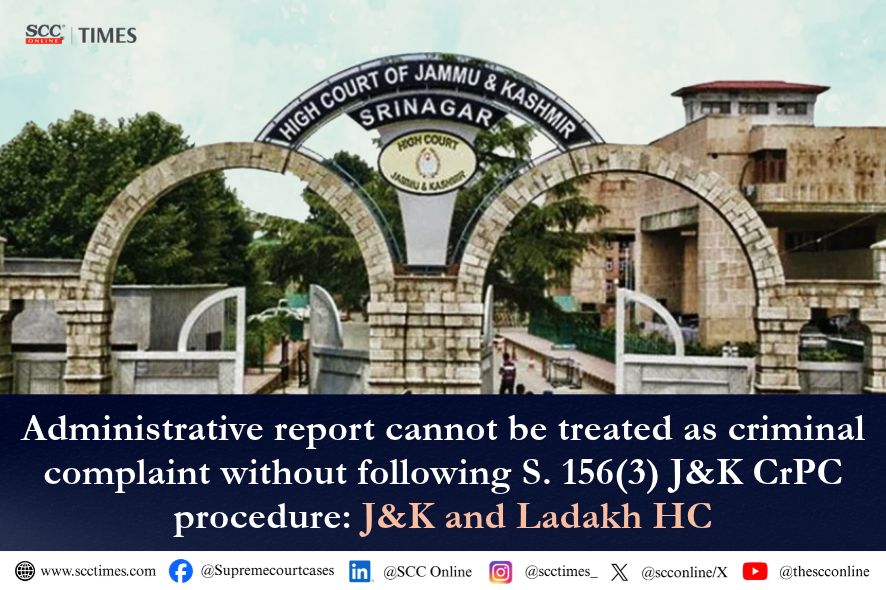
J&K Ladakh HC: Quashes FIR, Clarifies S. 156(3) CrPC Procedure
Summary
- The Jammu & Kashmir and Ladakh High Court quashed an FIR against revenue and municipal officials.
- The FIR originated from a Judicial Magistrate's directions, which improperly criminalized an administrative land dispute.
- The High Court found that the Magistrate failed to follow the mandatory procedure under Section 156(3) J&K CrPC.
- This ruling emphasizes that administrative reports cannot be treated as criminal complaints without strict adherence to legal protocols.
- The decision safeguards officials from unwarranted criminal proceedings stemming from administrative matters.
What Happened
The High Court determined that the Judicial Magistrate failed to follow the established procedure governing the exercise of powers under Section 156(3) J&K CrPC.
The Jammu & Kashmir and Ladakh High Court recently intervened in a case involving public officials, issuing a significant ruling that underscores the importance of procedural adherence in criminal matters. The High Court took action to quash an FIR that had been registered against several revenue and municipal officials. This criminal complaint had originated from specific directions issued by a Judicial Magistrate.
The core of the High Court's decision rested on its finding that the Magistrate had improperly transformed what was fundamentally an administrative dispute into a criminal one. The underlying disagreement pertained to land that was already under the possession of a Court, indicating its administrative or civil nature. By directing the registration of an FIR, the Magistrate was deemed to have incorrectly assigned a "criminal colour" to a situation that did not warrant such an approach.
Crucially, the High Court determined that the Judicial Magistrate failed to follow the established procedure governing the exercise of powers under Section 156(3) J&K CrPC. This procedural lapse was central to the High Court's decision to invalidate the criminal proceedings against the revenue and municipal officials. The ruling highlights a critical distinction between administrative grievances and criminal offenses, emphasizing that the former cannot be arbitrarily converted into the latter without strict legal compliance.
Adherence to Section 156(3) J&K CrPC Procedure
The ruling by the Jammu & Kashmir and Ladakh High Court provides vital clarification on the proper application of Section 156(3) J&K CrPC procedure. This particular section of the Code of Criminal Procedure empowers a Magistrate to direct the police to conduct an investigation into a cognizable offense. However, this power is not unfettered and must be exercised with due judicial application of mind, ensuring that the prerequisites for initiating a criminal investigation are met.
The High Court's judgment implicitly reinforces that before issuing directions under Section 156(3) J&K CrPC, a Magistrate must carefully assess whether the complaint truly discloses a cognizable offense and is not merely an attempt to criminalize an administrative or civil dispute. The failure to adhere to this rigorous procedure can lead to the quashing of an FIR, as demonstrated in the present case where an administrative report criminal complaint was improperly acted upon. This ensures that the machinery of criminal justice is not misused for matters that fall outside its purview.
The distinction between an administrative report and a criminal complaint is paramount. An administrative report typically deals with departmental or civil irregularities, whereas a criminal complaint alleges the commission of a crime. The High Court's decision serves as a reminder that a Magistrate's role is to scrutinize the nature of the complaint thoroughly, rather than automatically converting any grievance into a criminal investigation, especially when it concerns land in possession of a Court or other administrative matters.
Why This Ruling Matters
This recent decision by the Jammu & Kashmir and Ladakh High Court carries significant implications for both legal practitioners and public officials. For lawyers, it provides a strong precedent to challenge criminal proceedings, particularly those initiated against revenue municipal officials FIR, where Magistrate directions have bypassed the mandatory procedural safeguards of Section 156(3) J&K CrPC. It reinforces the principle that an administrative report cannot be treated as a criminal complaint without strict adherence to legal protocols.
The quashed FIR Magistrate directions in this instance offer a crucial safeguard for government functionaries who might otherwise face unwarranted criminal charges stemming from their official duties or administrative disputes. By emphasizing the necessity of proper J&K Ladakh HC S. 156(3) CrPC procedure, the High Court has set a clear standard, ensuring that the power to direct police investigation is exercised judiciously and within the confines of the law. This ruling helps prevent the weaponization of criminal law for administrative grievances.
Ultimately, this judgment from the Jammu & Kashmir and Ladakh High Court serves as a critical reminder to all judicial officers regarding their responsibilities when invoking powers under the Code of Criminal Procedure. It underscores the imperative to differentiate between administrative issues and genuine criminal offenses, thereby upholding the integrity of the judicial process and protecting individuals from arbitrary criminalization.
Practical Implications
Lawyers should note that FIRs registered based on administrative reports, without strict adherence to the procedural requirements of Section 156(3) J&K CrPC, are susceptible to being quashed. This ruling provides a strong basis for challenging criminal proceedings initiated by Magistrates who convert administrative disputes into criminal complaints without following due process.
Source
Source: Original reporting via SCC Times
How does this affect you?
Get an AI analysis of this article grounded in your jurisdictions, practice areas, and any policy documents you've uploaded to Wansom.
Finish Reading the Full Story and the Expert Analysis.
Wansom is AI and can make mistakes.